
 Michael Satterfield
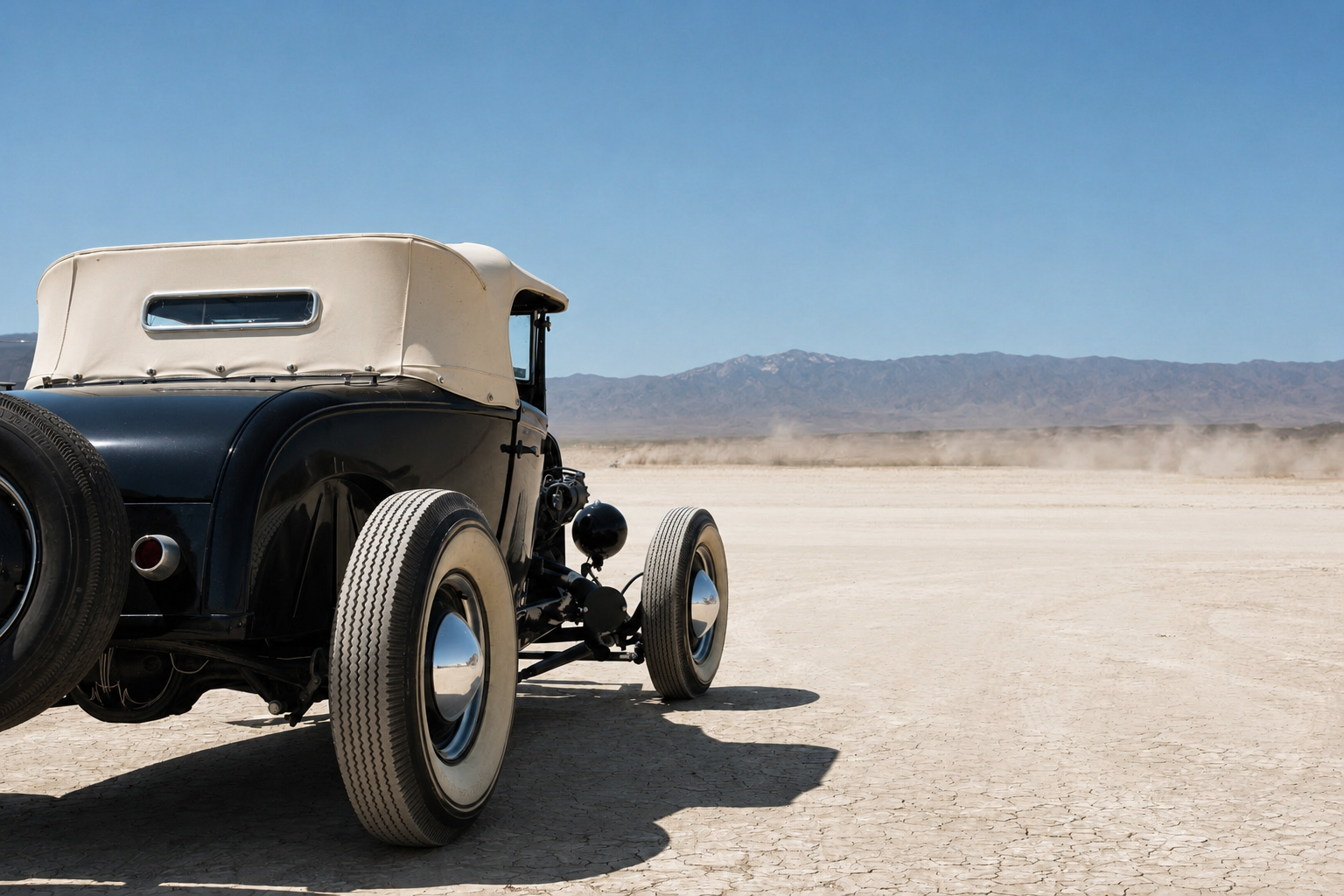
There is nowhere on earth quite like El Mirage during a Southern California Timing Association (SCTA) weekend. The desert wind, the dust hanging somewhere out on the course, and the heat shimmer blur the mountains into a watercolor horizon. A battered roadster sits quietly on skinny tires, looking less like a race car than something that wandered out of an old photograph. Then an engine fires. The stillness disappears beneath the sound of open exhaust, and a few seconds later there is dust, speed, and the unmistakable feeling that you have stumbled into one of the last corners of American motorsport where the past has not been polished away.
El Mirage is not retro. It is not vintage-themed. Nobody arranged it to look good in photographs. The SCTA never took away classes; they just kept adding new ones, so on the same weekend you can see the most modern streamliners parked alongside a classic 1950s hot rod.
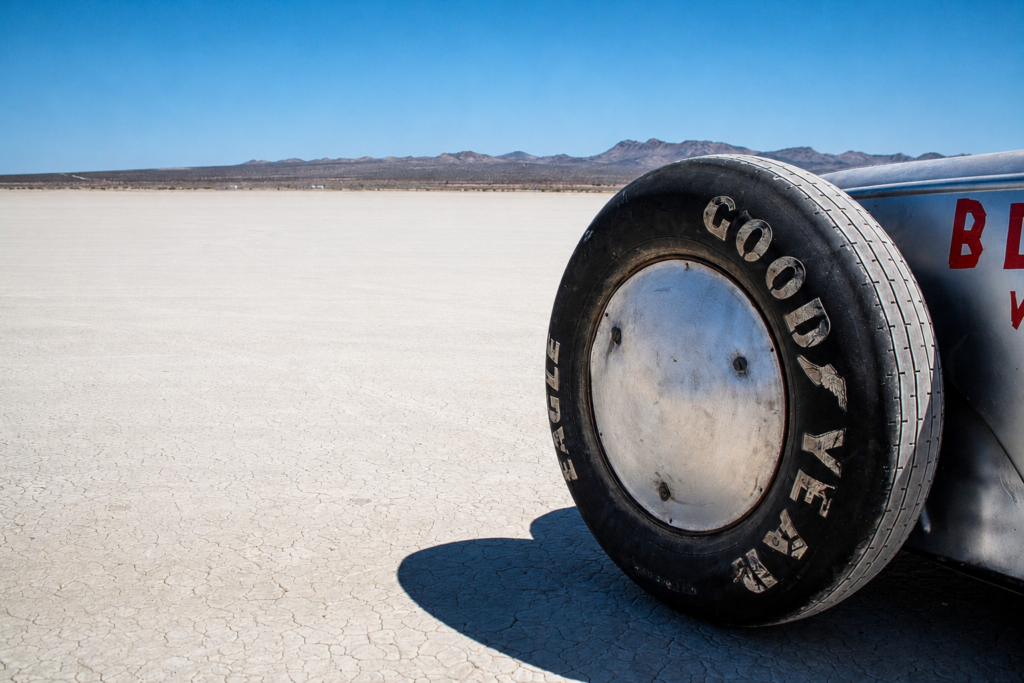
That is part of what makes the place so compelling. Land speed racing is one of the purest forms of motorsport because the objective requires almost no explanation. Go faster. There are no elaborate pit suites, no corporate hospitality lounges, no grandstands packed with spectators waiting for a perfectly timed show. The landscape itself is the venue, a vast dry lakebed framed by mountains beneath an enormous California sky. Trucks, trailers, motorcycles, race cars, shade canopies, folding chairs, coolers, and toolboxes gather into temporary camps along the edge of the course. Generators hum. Engines crack to life. Someone is always adjusting something.
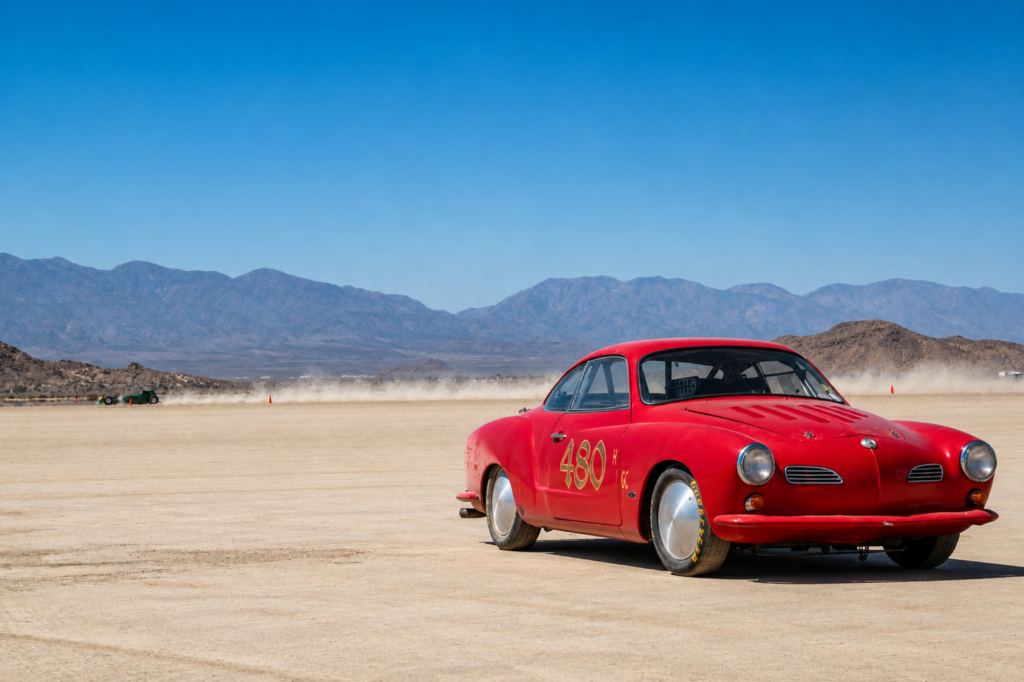
El Mirage: Everything is covered in dust. By midmorning, so are you.
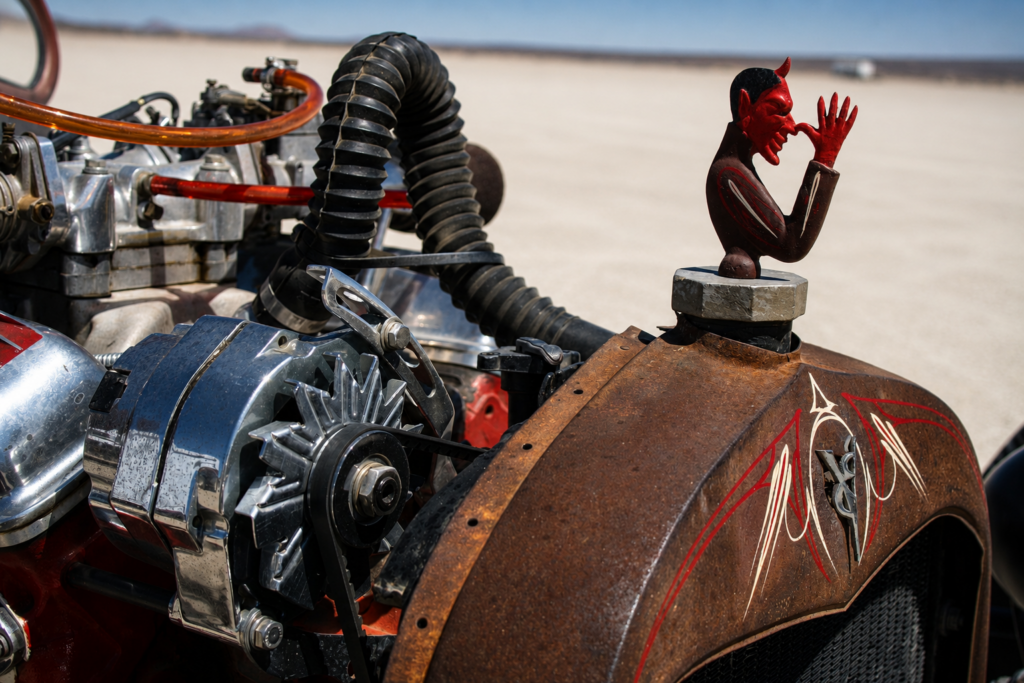
The dust is part of the character of El Mirage. It settles into louvers and seams, gathers around tires, coats boots, and hangs behind speeding cars like smoke. Fresh paint becomes slightly dull. Old paint becomes better. Machines that have spent decades being cut apart, repaired, repainted, and modified look perfectly at home against the lakebed’s cracked surface. In a car scene where patina can now be ordered from a custom paint shop, El Mirage offers the genuine article.
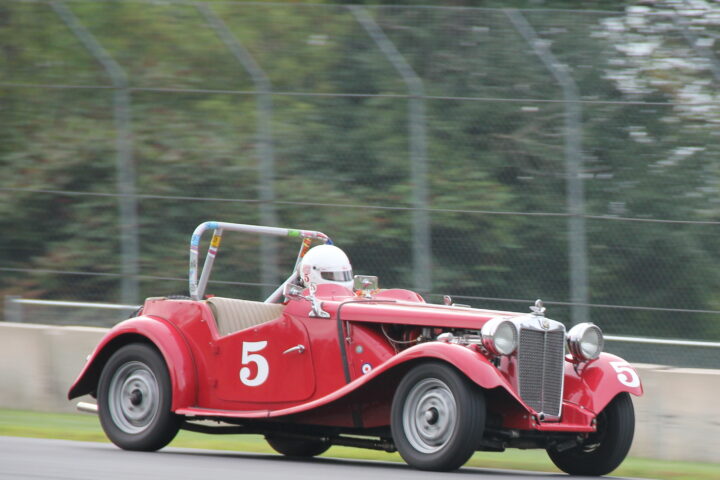
American hot rodding has become increasingly civilized. Cars that were once built in garages now cross auction blocks under perfect lighting. Flatheads, Ardun heads, belly tanks, and early roadsters are displayed at concours events where the grass is manicured, and fingerprints are regarded as a minor emergency. At El Mirage, the cars are actually being put to work. A chopped roof is not a styling exercise. A narrow body is not a design statement. A set of moon discs is not just because someone thought they looked period-correct. These things exist because generations of racers have tested what makes a car faster.
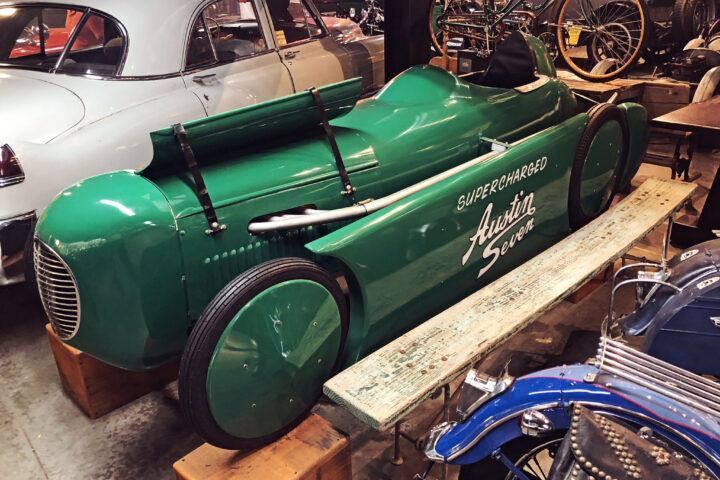
Land speed racing is full of people willing to spend a year finding those three miles per hour to set a record. At El Mirage, this is considered completely sensible behavior. The variety is part of the appeal. A traditional roadster might roll past looking ready for a 1950s issue of Hot Rod, followed by a motorcycle, a chopped coupe, or a purpose-built streamliner so low and narrow it appears less driven than worn. A red Karmann Ghia can sit on the lake transformed from a cheerful German economy car into serious competition machinery. Nearby, a vintage wagon waits beside a long, low race car that looks as though it was designed with a ruler, a welding torch, and very little interest in passenger comfort.
There is something democratic about all of it. A polished transporter does not make your car faster. Neither does a social media following, an expensive watch, or a collection of sponsor logos. Eventually you have to roll onto the course, put your foot down, and let the clocks settle the matter. The lake is remarkably unimpressed by résumés.
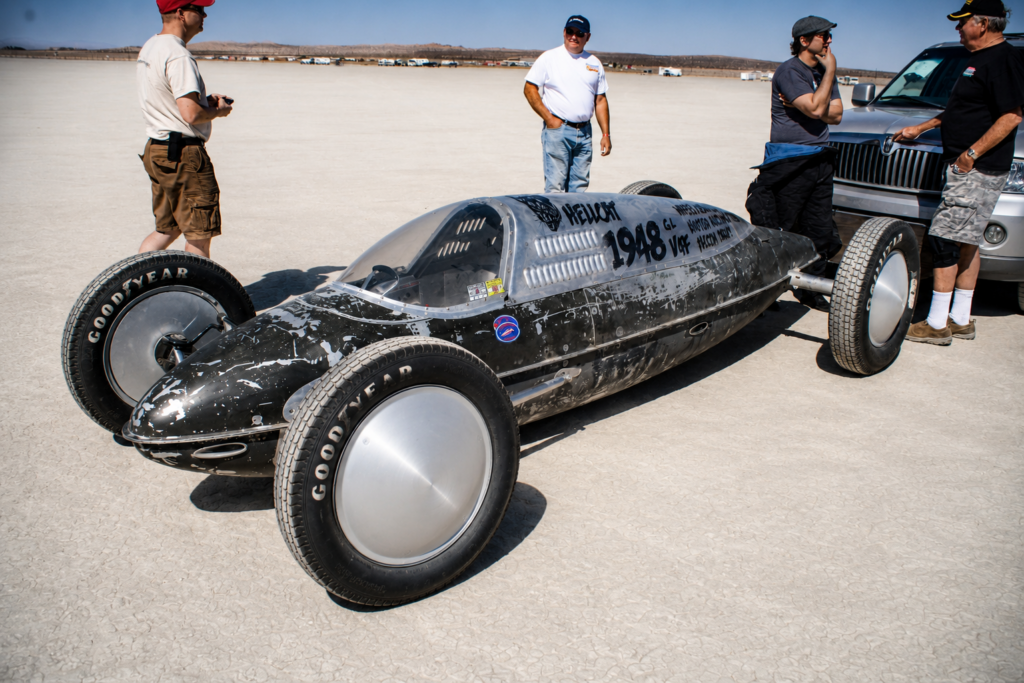
You need to be there to Understand It
Photography can capture much of El Mirage, but it struggles with sound. The lakebed is so wide that noise seems to behave differently here. An engine can be deafening when a car leaves the starting line, then slowly fade until it becomes a faint mechanical note somewhere against the horizon. You follow the car as it grows smaller, surrounded by nothing but empty desert, until eventually the dust becomes more visible than the machine itself.
The dust trail lingers long after the car has disappeared. Sometimes it hangs low over the course. Sometimes the wind lifts it into the sunlight and drags it sideways across the lake. On a cloudy morning, the desert can become almost monochromatic, all gray sky, tan earth, black machinery, and brown haze. A few hours later, the clouds are gone and the lake sits beneath a hard blue sky that seems to take up three-quarters of the world.
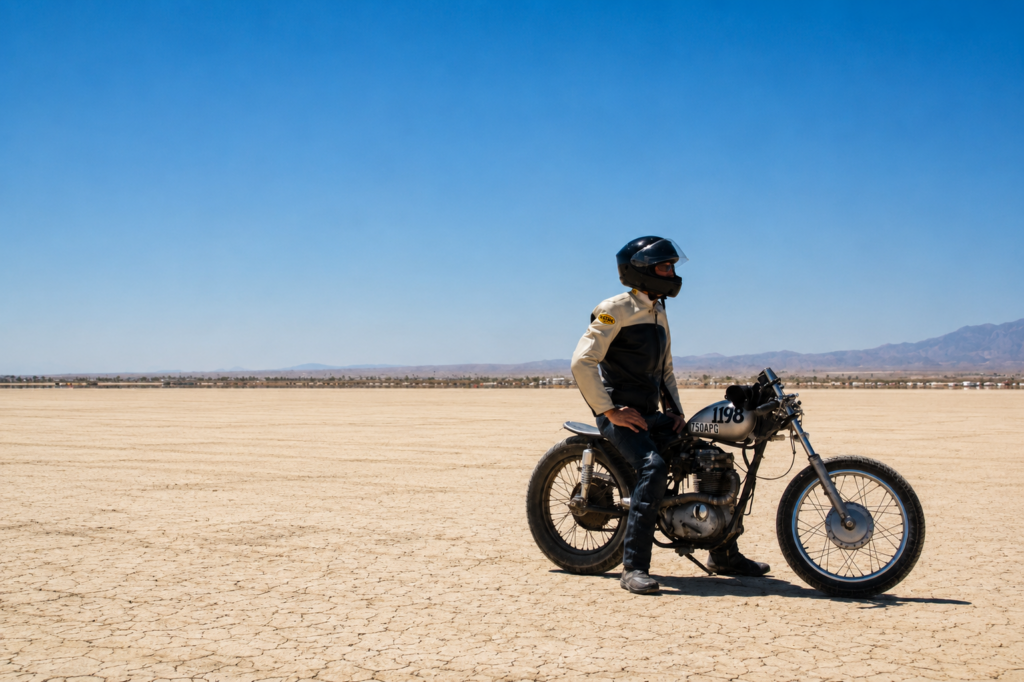
That scale is difficult to understand until you stand there. A motorcycle and rider become tiny beneath it. A race car parked fifty yards away looks almost like a prop left behind after a movie crew departed. The mountains seem close enough to reach before you remember how empty the desert is between here and there.
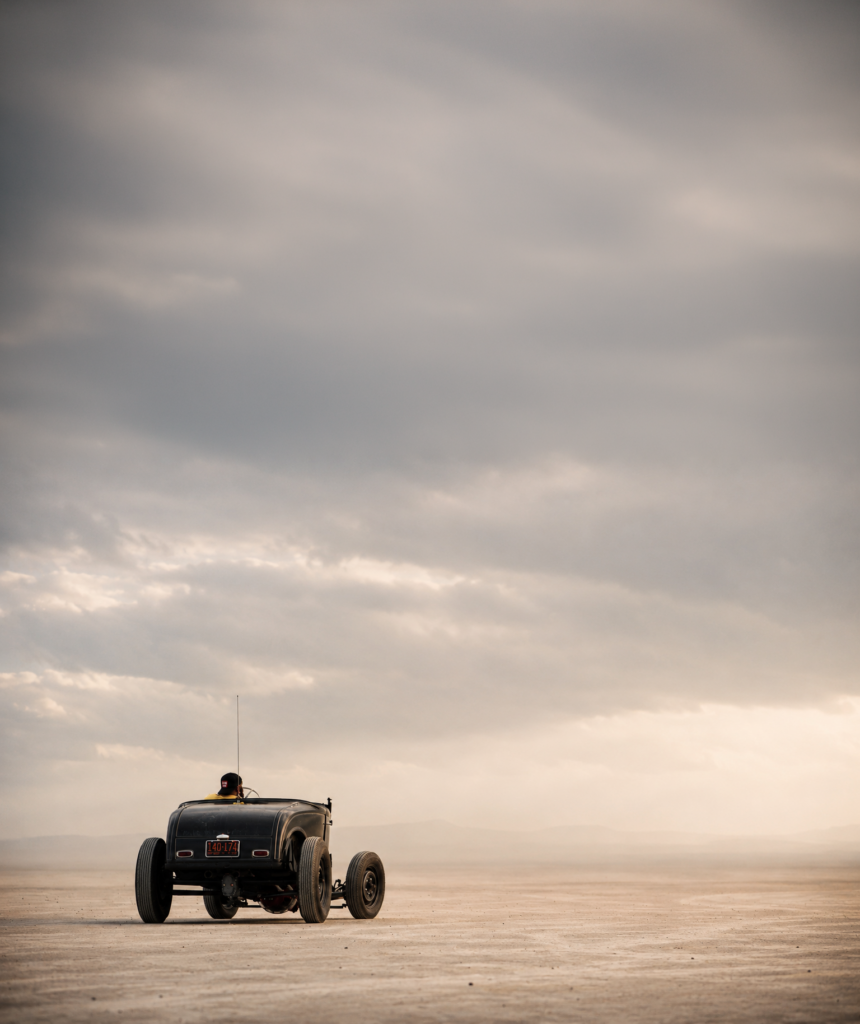
El Mirage is naturally cinematic, although calling it cinematic almost gives Hollywood too much credit. Nobody positioned the mountains. Nobody ordered the clouds. Nobody told an old roadster to stop exactly where the light would catch the curve of its fender. The desert simply keeps producing scenes photographers spend their careers trying to manufacture. All you have to do is recognize them before they disappear.
The cars are the obvious attraction, but the real culture of land speed racing is built around the people who keep bringing them back. Race cars do not arrive in the desert by themselves. Behind every one is a collection of people who built it, repaired it, pushed it, towed it, timed it, inspected it, or simply stood nearby handing over the correct wrench at the correct moment.
The pits feel less like a professional paddock and more like a temporary town whose principal industry happens to be speed. People wander between camps. Advice is traded freely. Someone is lying in the dirt adjusting a suspension component while someone else is digging through a toolbox. Families sit beneath awnings. Old racers tell stories. Younger racers listen, at least until it is their turn to run. Coolers open, engines fire, helmets go on, and another machine heads toward the start.
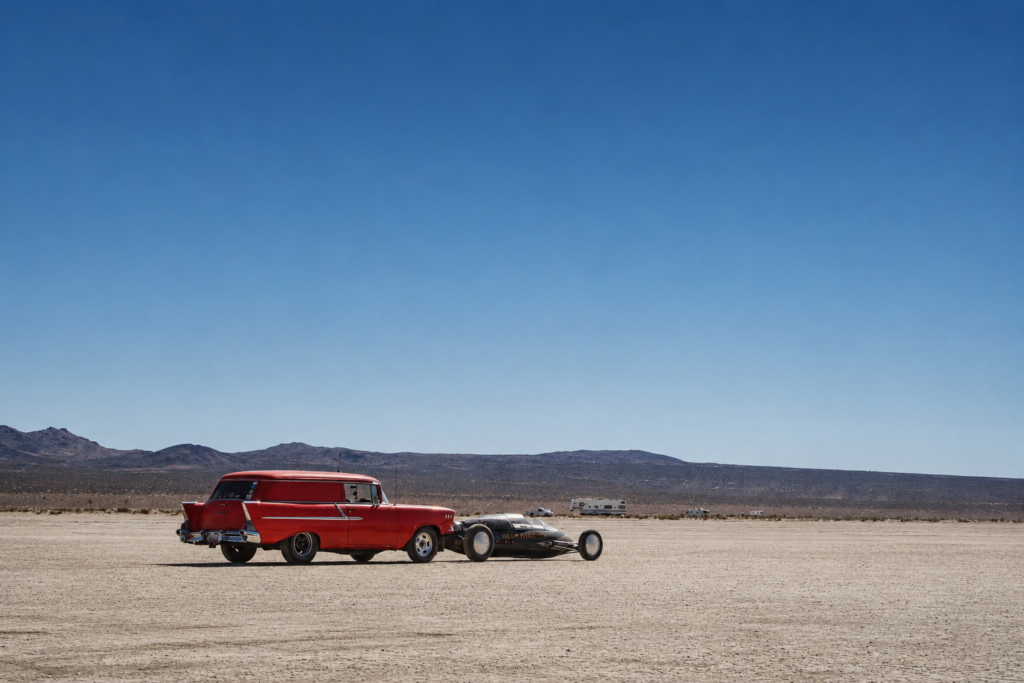
There is an informality to the place that feels increasingly rare in motorsport. The people here take speed seriously without taking themselves terribly seriously, which may be one of the healthiest traditions racing has managed to preserve.
Spend enough time at El Mirage, and it becomes impossible not to think about how much motorsport has changed. Professional racing now revolves around telemetry, simulation, data engineers, marketing departments, hospitality programs, and increasingly sophisticated technology. There is nothing inherently wrong with any of that. Racing has always pushed forward. But standing on a dry lakebed reminds you what existed underneath everything else before motorsport became an industry.
Before wind tunnels and computer simulations, curiosity was what drove innovation in Land Speed Racing. What happens if we put this engine in that car? What if we lower it? What if we make the body narrower? What if we change the gearing? What if we add another carburetor? Then just testing and adjusting to see if it really did make it go faster.
That question helped create American hot rodding. It sent young men into garages after work with welding torches, catalogs, junkyard engines, and highly questionable financial priorities. It turned surplus aircraft fuel tanks into race cars and ordinary coupes into record chasers. It gave birth to machines that made very little sense anywhere except a dry lake or a stretch of salt. The technology changes. The question does not.
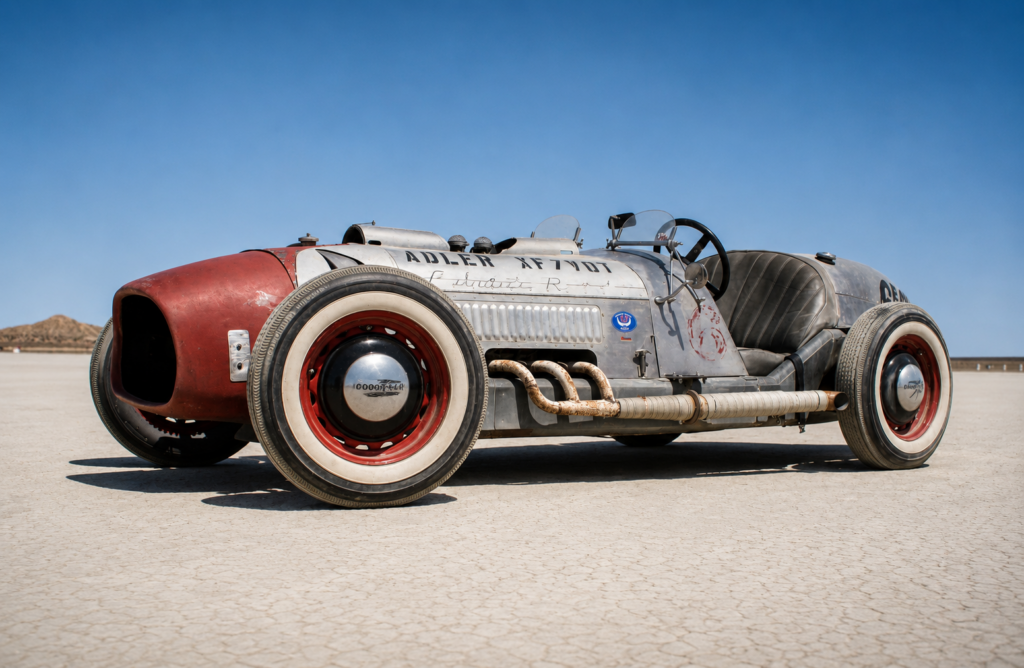
Late in the day, El Mirage begins to soften. The harsh desert light turns warmer, shadows stretch beneath the cars, and the dust catches the sun. A roadster sitting alone on the lake suddenly looks like something from 1949. A motorcycle rider becomes a silhouette against the horizon. Race cars waiting quietly in the pits seem less like machines and more like artifacts from some alternate version of America where everyone collectively decided commuting was boring and horsepower deserved greater attention.
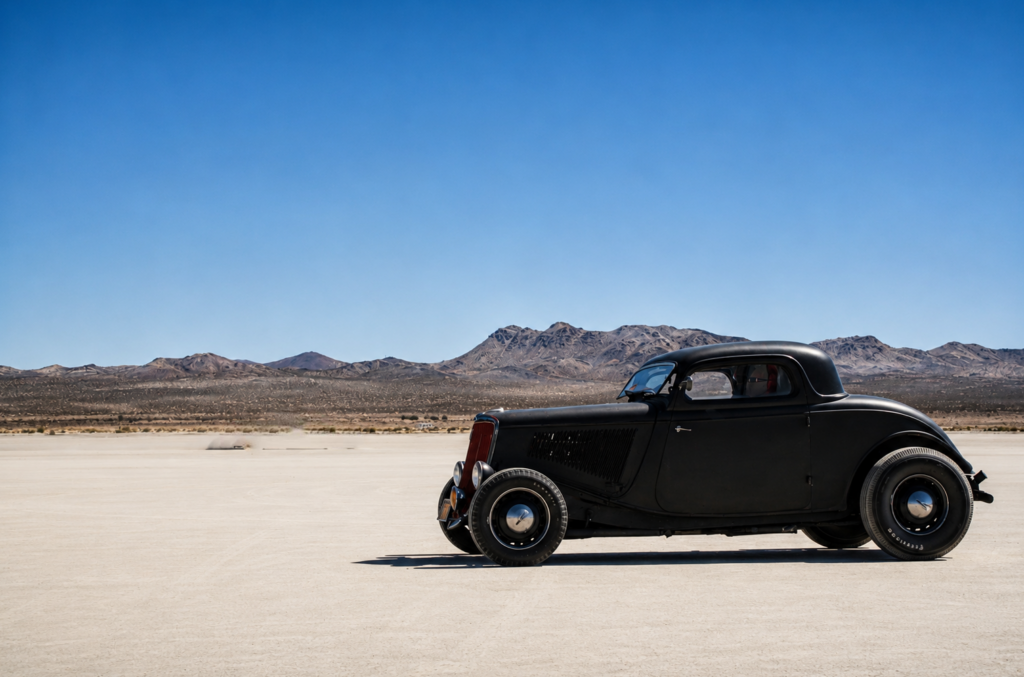
Then someone pulls on a helmet. A crew closes in around a car. An engine fires, the exhaust note rolls across the lakebed, and the desert wakes up again.
That is the magic of El Mirage. It connects two eras without trying to recreate either one. The ghosts of early hot rodding are everywhere, but this is not a museum. Records are still being chased. Cars are still being developed. Mistakes are still being made. Parts are still breaking. Racers are still returning with new ideas and slightly emptier bank accounts.
People are still going faster. Records are still being set. And perhaps that is what makes El Mirage feel different from almost every other automotive event in America. It does not ask you to remember when racing was like this. It invites you to come watch while it still is.
Quick Facts: SCTA and El Mirage Land Speed Racing
- SCTA: Southern California Timing Association
- Founded: 1937, when Southern California car clubs joined together to establish organized timing, competition, and safety standards for dry-lake racing.
- First SCTA competition: The organization held its first race at Muroc Dry Lake in 1938. After World War II, El Mirage became the primary home of SCTA dry-lake competition.
- Location: El Mirage Dry Lake is in California’s Mojave Desert, west of Adelanto in San Bernardino County.
- Public land: El Mirage is part of the Bureau of Land Management’s El Mirage OHV Recreation Area, which encompasses approximately 27,275 acres.
- Racing surface: Unlike the salt at Bonneville, El Mirage racers compete on the naturally hard-packed surface of a dry lakebed.
- 2026 SCTA schedule: SCTA lists four two-day El Mirage race meetings for the year, held in May, June, October, and November.
- Cars and motorcycles: SCTA competition includes everything from traditional roadsters and coupes to streamliners, lakesters, production-based cars, and motorcycles.
- Volunteer tradition: El Mirage land speed racing remains largely volunteer-run, with SCTA club members and event workers providing the manpower required to stage each meet.
- Rookie requirements: First-time drivers must complete rookie orientation before making a competition run. Vehicles must also pass technical inspection, and drivers must meet licensing requirements for the speeds they intend to run.
- Records: To earn a certified SCTA record at El Mirage, a competitor must exceed the existing record or the SCTA-established minimum for a class.
- Connection to Bonneville: El Mirage is regarded by the SCTA as the grassroots home of land speed racing, where many competitors develop cars, gain experience, and earn licenses before racing at Bonneville.
- Spectators: El Mirage races are open to spectators, although access to operational areas is controlled for safety.
- Camping: Camping is permitted within the recreation area, making an SCTA weekend as much a gathering of racers, families, and clubs as a traditional motorsport event.
FAQ
What is El Mirage Dry Lake?
El Mirage is a dry lakebed in California’s Mojave Desert that has played an important role in American hot-rodding and land speed racing history. Its broad, hard-packed surface provides a natural straight-line racing course, and it remains an active home of SCTA competition today.
What does SCTA stand for?
SCTA stands for the Southern California Timing Association. It was organized in 1937 by Southern California car clubs seeking standardized rules, timing procedures, and improved safety for dry-lake racing.
When did racing begin at El Mirage?
Southern California hot rodders were racing on dry lakes by the early 1930s. SCTA competition began in 1938 at Muroc, while El Mirage emerged as the organization’s principal postwar racing location beginning in the mid-1940s.
Is El Mirage the birthplace of hot rodding?
It is more accurate to describe the Southern California dry lakes collectively as one of the birthplaces of American hot rodding. Muroc, Harper, Rosamond, and El Mirage all played major roles. El Mirage is especially significant because organized land speed racing continues there today, preserving a direct link to that early culture.
How is El Mirage different from Bonneville?
The most obvious difference is the surface. Bonneville is raced on salt, while El Mirage uses a hard-packed dirt lakebed. Bonneville also offers longer courses suited to extremely high speeds, while El Mirage has traditionally served as a more grassroots venue for testing, licensing, development, and record competition.
What kinds of vehicles race at El Mirage?
SCTA classes encompass an enormous range of machinery, including traditional hot rods, roadsters, coupes, production-based cars, modified cars, lakesters, streamliners, trucks, and motorcycles. The diversity of machinery is one of the defining features of land speed racing.
Is land speed racing wheel-to-wheel competition?
No. Land speed racing is fundamentally a competition against the clock. Vehicles make individual timed runs rather than racing side by side, with competitors attempting to exceed class records or improve their own performance.
Can anyone race at El Mirage?
There is a path for newcomers, but you cannot simply arrive and make an unrestricted high-speed pass. Vehicles must meet SCTA technical and safety requirements, drivers must complete the required paperwork and licensing process, and new drivers must attend rookie orientation. SCTA also offers a guest category for time-only runs.
Do you have to belong to an SCTA club?
Competitors seeking normal SCTA competition participation are associated with one of the SCTA member clubs. The organization also allows a guest option for competitors making time-only runs rather than pursuing standard SCTA points and records.
Can spectators attend El Mirage land speed races?
Yes. Spectators can attend, although they must remain within designated safe areas and follow SCTA and BLM rules. Because conditions can be hot, windy, dusty, and exposed, visitors should come prepared with water, sunscreen, shade, and appropriate clothing.
Why is El Mirage important to American car culture?
El Mirage represents an unusually intact connection to the formative years of American hot rodding. The basic formula that attracted racers generations ago remains recognizable today: build a machine yourself, bring it to the desert, have it inspected, line up, and find out how fast it will go. While much of hot-rod history now lives in museums and collections, at El Mirage it is still being practiced.
Is racing at El Mirage still active today?
Yes. The SCTA continues to sanction land speed racing at El Mirage, with four two-day race weekends listed for the 2026 season.
Who manages El Mirage Dry Lake?
The surrounding El Mirage OHV Recreation Area is managed by the Bureau of Land Management’s Barstow Field Office. The BLM manages public access and recreation at the site, while SCTA organizes its permitted land speed racing events.




Great story, love the photos, very well written.
If most of these photos were black and white you wouldn’t know they were taken in the 1950s or 60s
What a cinematic place to shoot photos or video adding to my list of motorsports to shoot.
It is still so crazy that more car people don’t come up to watch the land speed racing at El Mirage, out side of paying the park entry fee, it is free to attend.
You shot some beautiful images
The vibes out at el mirage are so cool, need to go out and do a photo shoot out there