
 TGR Staff
In the world of automotive unveilings, manufacturers have become remarkably good at producing spectacle. Dramatic lighting displays, carefully choreographed reveals, and enough theatrical smoke make a 1980s rock concert look restrained. On October 15, 2026, Tesla decided to go much further.
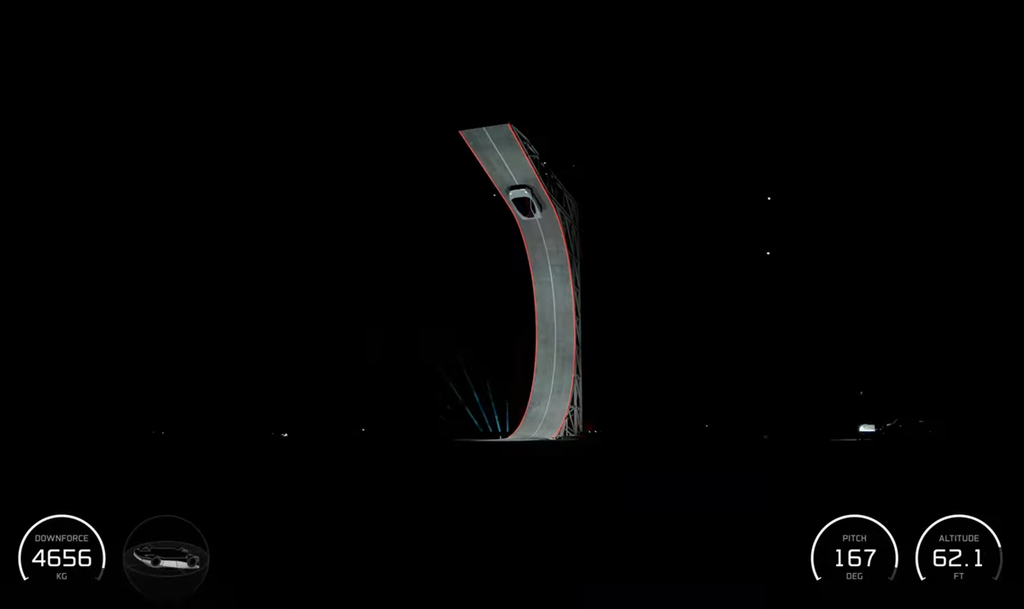
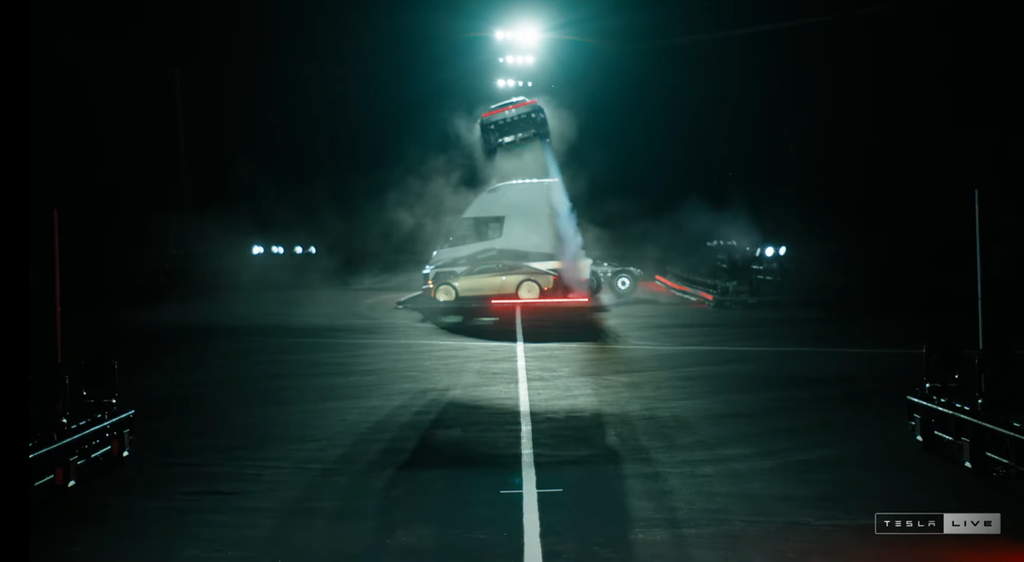
At SpaceX’s rocket testing facility in McGregor, Texas, the company unveiled its next-generation Roadster by driving a prototype up a towering curved ramp, turning it upside down, and launching it into the air. The white electric sports car completed an aerial rotation before returning to the ground, supported by a combination of specialized fans and compressed-gas thrusters.
Another demonstration sent the Roadster briefly airborne over a collection of Tesla vehicles. Later, the company showed an acceleration run it said took the car from 0 to 60 mph in about 0.81 seconds.
It was a remarkable demonstration, even by Tesla’s standards. For enthusiasts who have watched the Roadster project drift through nearly a decade of promises, delays, and increasingly ambitious claims, the evening finally provided something more tangible than another computer rendering.
But there is an important distinction between a prototype performing under controlled conditions and a production vehicle customers can purchase, register, insure, and enjoy on the road. Tesla has demonstrated the former. Delivering the latter may be its greatest challenge.
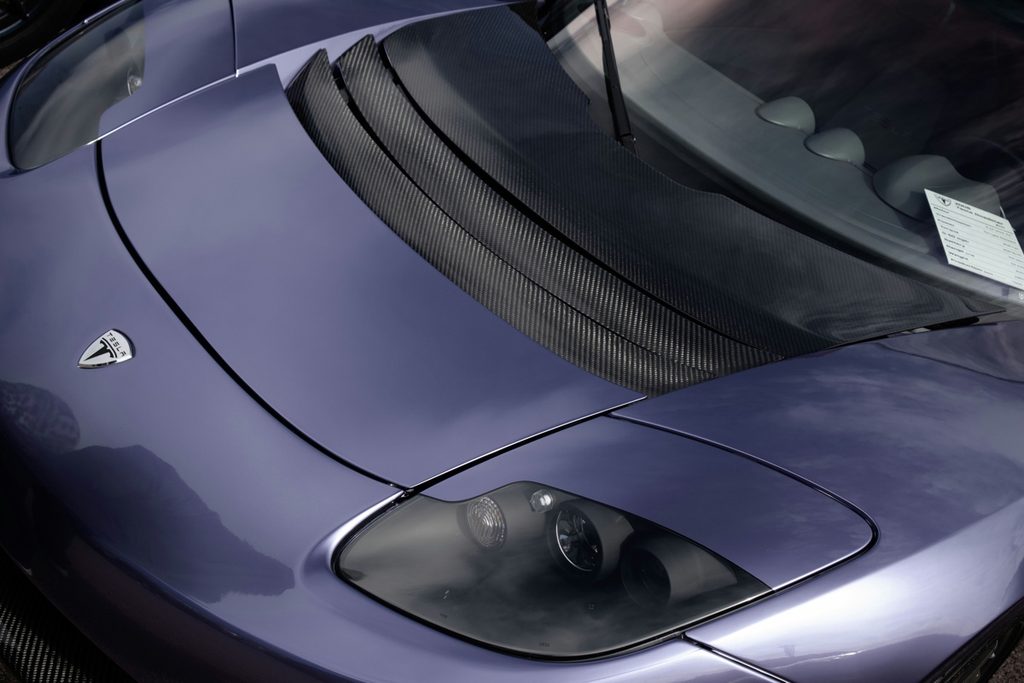
The original Lotus-based Tesla Roadster that launched the brand has nothing in common with the flying Tesla we saw at the demo.
A Completely Different Tesla Roadster
When Tesla first announced its second-generation Roadster in November 2017, the vehicle looked like a natural evolution of the company’s design language. Its flowing surfaces, aggressive proportions, and familiar Tesla styling suggested a high-performance electric grand tourer.
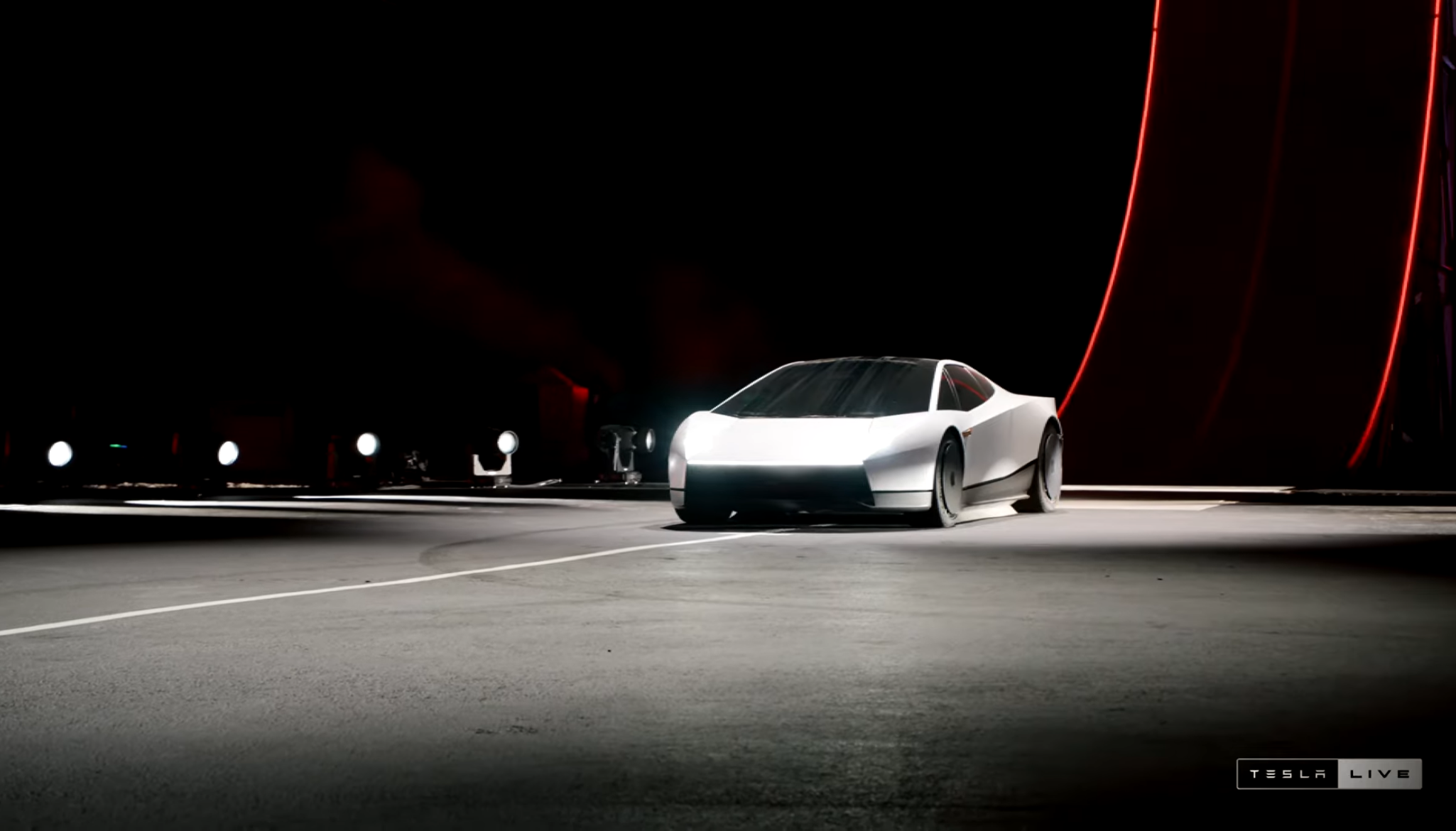
The newly revealed Roadster is an entirely different animal. Presented in white, the latest design embraces the sharp, futuristic lines of an aircraft-inspired supercar. Its pronounced wedge profile, compact cabin, and dramatically reworked surfaces are more reminiscent of a 1970s Italian concept car than the original Tesla prototype.
Tesla says aircraft including the Lockheed SR-71 Blackbird and F-35 fighter jet influenced the design. The car features distinctive upward-opening doors, a dramatic active rear wing, sophisticated aerodynamic surfaces, and a low-slung cockpit dominated by a driver-oriented display and yoke-style steering control.
There are some decidedly unconventional engineering decisions beneath its sculpted exterior. Tesla has developed a system of electrically powered fans that create negative pressure beneath the vehicle, effectively pulling it toward the pavement. The concept is not entirely new. Racing enthusiasts will remember the legendary Chaparral 2J and Brabham BT46B, both of which experimented with fan-generated downforce decades ago.
Tesla’s application, however, takes the idea to an entirely different level. According to the company, the Roadster’s suction system can generate enough downforce to keep the vehicle attached to an inverted surface, even at very low speeds.
The system was central to the upside-down driving demonstration in Texas and could also provide extraordinary traction during acceleration, braking, and cornering. Combined with the car’s adjustable aerodynamics and electronically controlled driving systems, it suggests Tesla is interested in considerably more than simply winning the horsepower wars.
SpaceX Technology Gives the Roadster an Unusual Advantage
The most extraordinary feature of the new Tesla Roadster is its integration of SpaceX-developed technology. Rather than relying solely on electric motors and tire traction for performance, Tesla has incorporated cold-gas thrusters that can produce additional directional force.
These are not traditional rocket engines burning chemical propellant. Instead, the system stores gas at extremely high pressure in specialized tanks and releases it through carefully controlled nozzles. Tesla engineering executive Lars Moravy explained that the full flight-capable system incorporates ten nozzles and approximately 600 liters of compressed-gas storage.
The technology can produce thrust independently of the vehicle’s driven wheels, potentially allowing it to accelerate harder, change direction, and briefly lift off the ground. During the reveal, Tesla demonstrated how the system could move the Roadster through the air and control its orientation before landing.
The result was unlike anything a major passenger-car manufacturer had previously demonstrated. Still, describing the Roadster as a flying car requires some perspective. What Tesla demonstrated was controlled, short-duration airborne movement, not sustained aviation comparable to an airplane or helicopter. The distinction matters, especially when considering battery capacity, vehicle weight, air storage, safety, and regulatory requirements.
Tesla has shown that the Roadster can take off. It has not established that owners will be permitted to repeat those maneuvers on public roads.
Tesla Roadster Performance Claims: Zero to 60 MPH in Less Than One Second
As extraordinary as the flying demonstrations were, Tesla’s acceleration figures may be just as significant for the automotive industry. During the unveiling, the company showed a Roadster prototype reaching 60 mph from a standing start in approximately 0.81 seconds.
Tesla says the combination of electric propulsion, extreme traction, and cold-gas thrusters makes acceleration figures below one second achievable. The company has outlined even more aggressive performance targets for its most extreme configuration, with a claimed zero-to-60-mph time below 0.59 seconds. That is an astonishing number.
For perspective, even the fastest contemporary production hypercars have typically required well over one second to reach 60 mph. The Rimac Nevera and other electric performance machines have already demonstrated the potential of electric propulsion, but Tesla is proposing an entirely different solution to the fundamental problem of traction.
Instead of asking the tires to do all the work, the Roadster can supplement conventional acceleration with additional thrust. Tesla has also discussed a top speed exceeding 230 mph, while Elon Musk floated an even more ambitious goal of reaching approximately half the speed of sound. Those figures should be treated as development targets rather than established production specifications.
No independent automotive publication has yet validated the Roadster’s acceleration figures under standardized testing conditions. The production vehicle’s weight, power output, battery configuration, charging performance, and repeatability also remain important unanswered questions. Tesla has demonstrated something extraordinary. Proving that those results can be delivered reliably to customers is another matter.
Three Versions: Performance, Thrust, and Rocket
Tesla has outlined three configurations for the next-generation Roadster, each representing a different level of performance and technical complexity.
- Roadster Performance: The entry point to the new lineup is designed as a two-seat, road-oriented electric sports car. It includes the company’s active aerodynamic systems and fan-generated downforce technology. Tesla claims acceleration from zero to 60 mph in less than 1.6 seconds.
- Roadster Thrust: The second configuration adds rear-mounted cold-gas thrusters intended to supplement acceleration. Tesla describes it as a track-oriented variant and claims zero-to-60-mph capability in less than 0.9 seconds.
- Roadster Rocket: The flagship version adds thrusters around the vehicle, allowing limited upward and rotational movement. Its more extensive gas-storage system reduces it to a single-occupant vehicle. Tesla claims acceleration below 0.59 seconds, while making the configuration available by invitation only.
Across the lineup, Tesla has discussed a driving range of more than 300 miles and top speeds beyond 230 mph for the highest-performance models. However, there is a notable departure from Tesla’s original 2017 presentation.
At the time, the company promoted an estimated 620-mile range, a top speed exceeding 250 mph, and 0-60 mph acceleration in 1.9 seconds. The newly revealed car emphasizes different priorities, with far greater emphasis on active aerodynamics and compressed-gas propulsion. The Roadster has evolved from an electric grand tourer with supercar performance into something considerably more experimental.
How Much Will the New Tesla Roadster Cost?
Tesla did not announce final retail pricing during the October 2026 unveiling, leaving one of the most important questions unanswered. The company’s updated reservation program, however, offers some indication of how exclusive it intends the new Roadster to be.
Reservations for the Performance version require a $50,000 deposit, while the Thrust configuration requires $250,000. The Rocket variant is available by invitation only. These are reservation deposits, not confirmed vehicle prices. When Tesla first unveiled the second-generation Roadster in 2017, it discussed a starting price of approximately $200,000. Nearly a decade later, and with substantially more complicated engineering, it would be unwise to assume that figure still applies.
Until Tesla publishes official pricing, final equipment specifications, and contractual delivery terms, prospective buyers should view the reservation program as an expression of interest in a future product rather than a conventional new-car purchase.
Can Tesla Finally Deliver the Roadster in 2028?
Perhaps the evening’s most important announcement had nothing to do with flying. Elon Musk said Tesla intends to begin Roadster production in 2028. If that timeline holds, the car will arrive more than a decade after the second-generation Roadster was first introduced and eight years after its originally anticipated 2020 arrival.
Tesla has repeatedly postponed the program while concentrating its resources on mass-market electric vehicles, manufacturing expansion, autonomous driving, and robotics. The new Roadster also arrives at an interesting moment in the company’s history.
Tesla increasingly presents itself as an artificial intelligence, autonomy, and robotics business rather than simply an automobile manufacturer. Yet the Roadster is being promoted as an enthusiast-focused machine meant to be driven by a human. Musk has suggested that the Roadster could eventually become the only Tesla designed primarily for manual driving.
That is a remarkable position for a company whose original Roadster helped establish electric vehicles as legitimate performance machines. It also returns Tesla to the idea that launched the brand’s automotive ambitions.
The Roadster’s Biggest Challenge Is No Longer Imagination
Manufacturers have long built extravagant machines to prove what their engineers can accomplish. The automotive world has celebrated everything from racing prototypes and turbine-powered concepts to the first generation of genuine 200-mph production supercars.
Many of those vehicles were commercially impractical. Some were enormously influential. Tesla’s latest Roadster deserves consideration within that tradition. The engineering demonstrated in Texas is fascinating. Fan-generated downforce, active aerodynamic systems, compressed-gas propulsion, and electronic vehicle controls offer intriguing possibilities, even if their most extreme applications never become commonplace.
Yet several questions remain. How will the systems perform after thousands of miles? What will maintenance involve? How much will the vehicle weigh? What happens to its useful driving range when the additional systems are running? And perhaps most importantly, which of the dramatic capabilities demonstrated at McGregor will actually appear on a customer-delivered vehicle?
Regulatory questions also surround road legality and any attempt to operate the vehicle in the air. The Roadster remains a prototype, not a certified production automobile. Nevertheless, Tesla has accomplished something significant: it has put its most ambitious promises into motion and given automotive enthusiasts a genuinely unusual machine to debate.
In an industry increasingly dominated by shared platforms, software subscriptions, and vehicles designed around autonomous transportation, it’s refreshing to see a manufacturer pursue a car whose primary purpose is to be entertaining. The new Tesla Roadster may be one of the most extraordinary sports cars of its generation. First, Tesla has to build it.
Tesla Roadster Quick Facts
| Specification | Details |
|---|---|
| Reveal date | October 15, 2026 |
| Reveal location | SpaceX test facility, McGregor, Texas |
| Vehicle type | Battery-electric sports car |
| Configurations | Performance, Thrust, Rocket |
| Seating | Two, or one in Rocket configuration |
| Demonstrated 0-60 mph | Approximately 0.81 seconds, Tesla-reported |
| Claimed 0-60 mph | Under 1.6 seconds (Performance); under 0.9 seconds (Thrust); under 0.59 seconds (Rocket) |
| Claimed top speed | Over 230 mph for highest-performance variants |
| Claimed range | More than 300 miles |
| Special technology | Fan-generated downforce, active aerodynamics, cold-gas thrusters |
| Reservation deposits | $50,000 Performance; $250,000 Thrust |
| Rocket availability | Invitation only |
| Production target | 2028 |
| Final MSRP | Not announced |
Performance specifications are manufacturer claims. Final production specifications and independent testing results are not yet available.
Frequently Asked Questions About the New Tesla Roadster
When will the new Tesla Roadster be released?
Tesla says production of the second-generation Roadster is targeted for 2028. The company has not announced a firm customer delivery date.
Can the new Tesla Roadster actually fly?
Tesla demonstrated a prototype performing short airborne maneuvers using compressed-gas thrusters. However, the vehicle has not demonstrated sustained flight, and the flight-capable Rocket version is not approved for public road use.
How fast is the 2028 Tesla Roadster?
Tesla claims the Thrust configuration can accelerate from zero to 60 mph in less than 0.9 seconds, while the Rocket version is targeting less than 0.59 seconds. A prototype displayed an approximately 0.81-second run during the October 2026 reveal. These figures have not been independently verified.
How much does the new Tesla Roadster cost?
Final pricing has not been announced. Tesla currently lists reservation deposits of $50,000 for the Performance configuration and $250,000 for Thrust, while the Rocket version is invitation-only.
What is the new Tesla Roadster’s range?
Tesla is claiming more than 300 miles of driving range for the new Roadster. Official independently verified driving-range results are not yet available.
What makes the Tesla Roadster different from other electric supercars?
Beyond its electric powertrain, the Roadster incorporates fan-generated downforce and, on higher-level versions, compressed-gas thrusters that can supplement acceleration or briefly propel the vehicle into the air. These systems distinguish it from conventional battery-electric performance cars.
Is the Tesla Roadster street legal?
Tesla intends to offer road-oriented versions of the Roadster, but the newly demonstrated prototype is not yet a certified production vehicle. The full flight-capable Rocket configuration is not approved for public roads, and the legality of particular features will depend on applicable regulations.