

 Michael Satterfield
At the 2026 Rolex Monterey Motorsports Reunion, a striking white-and-gold Bizzarrini reminded enthusiasts of an era when Italian engineering, American horsepower, and a determination to challenge Ferrari could produce something extraordinary.
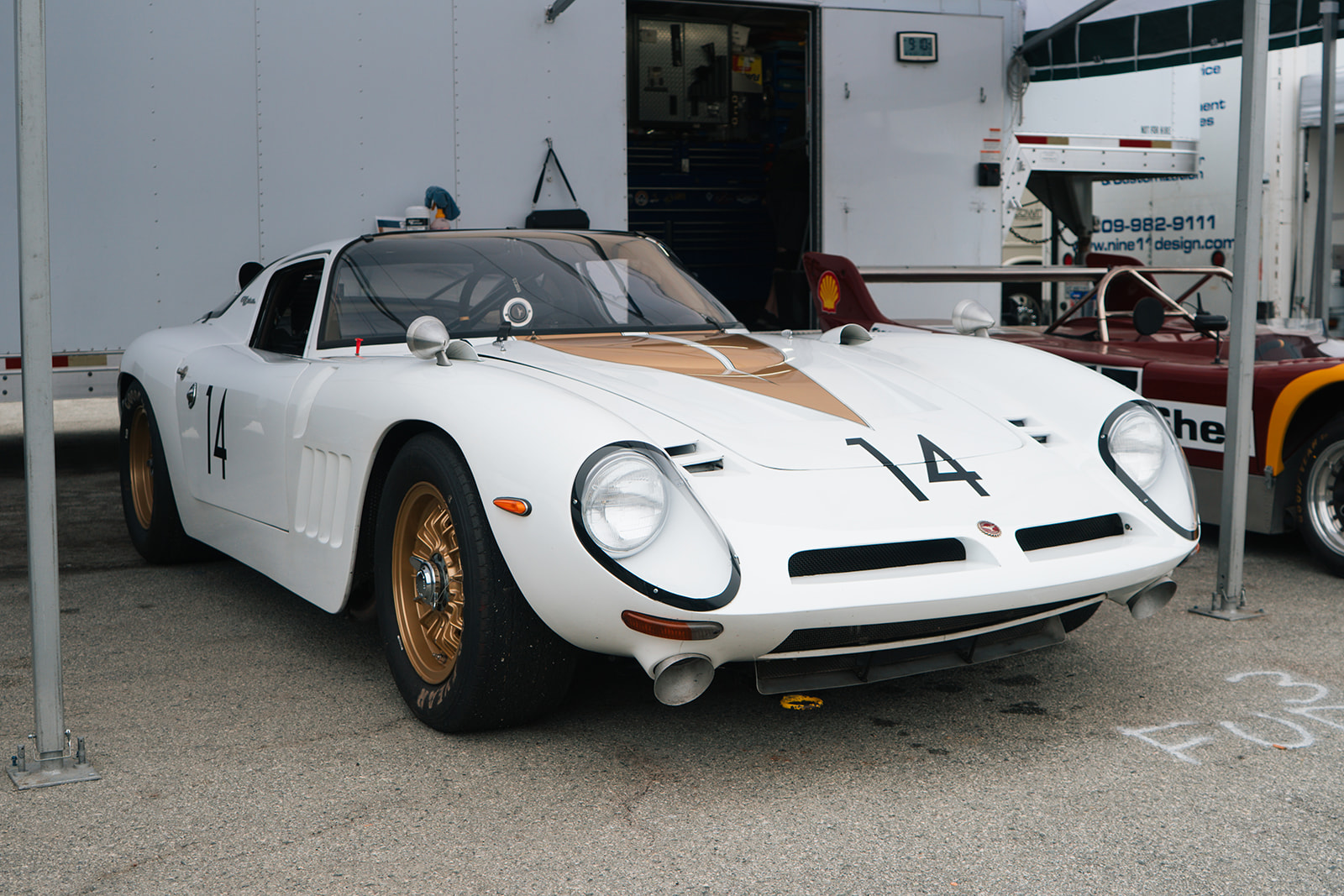
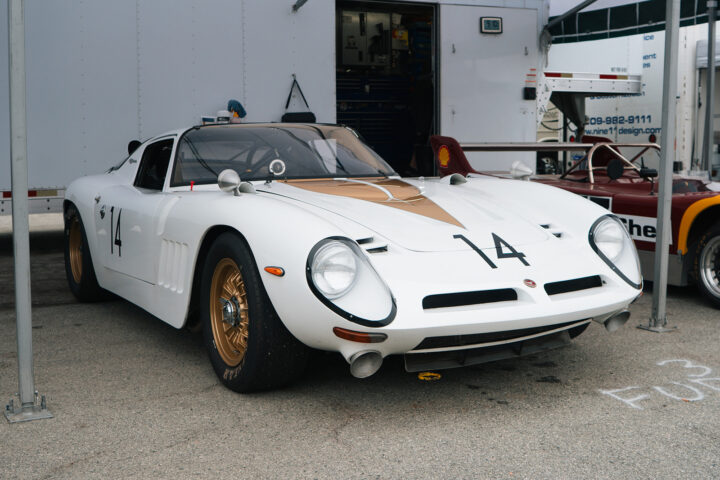
Among the Ferraris, Porsches, Shelbys, and Jaguars filling the paddock at WeatherTech Raceway Laguna Seca during the 2026 Rolex Monterey Motorsports Reunion, one low-slung Italian sports car deserved a second look. In white with gold accents, matching gold wheels, and the number 14, John “Chip” Fudge’s Bizzarrini 5300 GT Strada represented one of the more fascinating chapters in 1960s sports car history. It had the unmistakable proportions of an Italian grand tourer, the mechanical character of an American muscle car, and a pedigree that reached directly back to Ferrari’s legendary 250 GTO.
Officially entered in the 1955-1967 SCCA Large Displacement Production Cars group as a 1966 Bizzarrini 5300 GT Strada, the car looked perfectly at home among its period competitors. Its dramatic front fenders, unusually low roofline, long hood, and short rear deck came from a time when aerodynamics were explored through intuition, experimentation, and the occasional willingness to ignore convention. But the greatest story behind this particular Bizzarrini is not simply its appearance. It is the history of the engineer who created it, the unlikely combination of parts that made it competitive, and the remarkable journey that brought this individual chassis back to Monterey.
From Ferrari’s Engineering Department to Building a Ferrari Rival
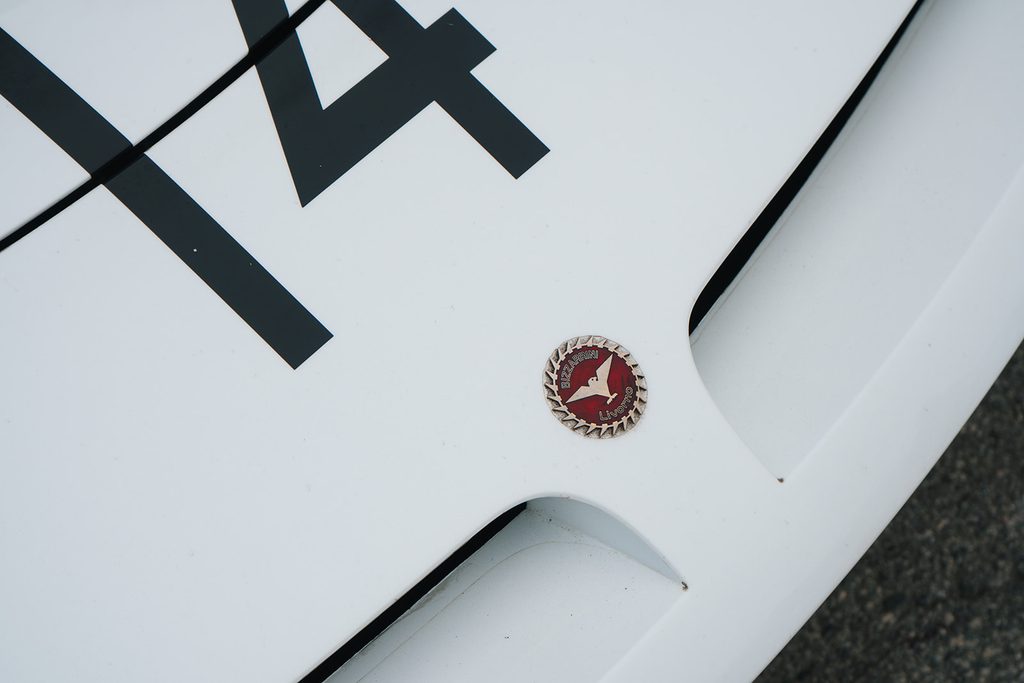
Before Giotto Bizzarrini put his own name on a sports car, he had already helped shape some of the most important competition machines of the 1950s and 1960s. Born in Livorno, Italy, Bizzarrini graduated from the University of Pisa with an engineering degree in 1953 and began his automotive career with Alfa Romeo before joining Ferrari. There, he became deeply involved in developing the 250 Testa Rossa, 250 GT SWB, and the legendary Ferrari 250 GTO, a car that would become one of the most celebrated racing machines ever built.
His relationship with Ferrari ended abruptly in 1961 during the internal upheaval commonly known as the Palace Revolt. Bizzarrini was among several key employees who left Maranello after disagreements with Enzo Ferrari and company leadership. Rather than quietly returning to a conventional engineering career, he joined the ambitious Automobili Turismo e Sport project, better known as ATS, and established his own consultancy, Autostar. During this period, he worked on Count Giovanni Volpi’s radical Ferrari 250 GT SWB Breadvan and helped develop the V12 engine that would power Lamborghini’s earliest production cars.
His relationship with Italian industrialist Renzo Rivolta, however, would provide the foundation for the car bearing his name. Rivolta had built a successful business producing refrigerators, motorcycles, and the little Isetta before turning his attention toward luxurious high-performance automobiles. He wanted Italian sophistication without the mechanical complications often associated with exotic cars. Bizzarrini understood the appeal, especially when the solution lay on the other side of the Atlantic.
The Iso Grifo and the Birth of the Bizzarrini 5300 GT
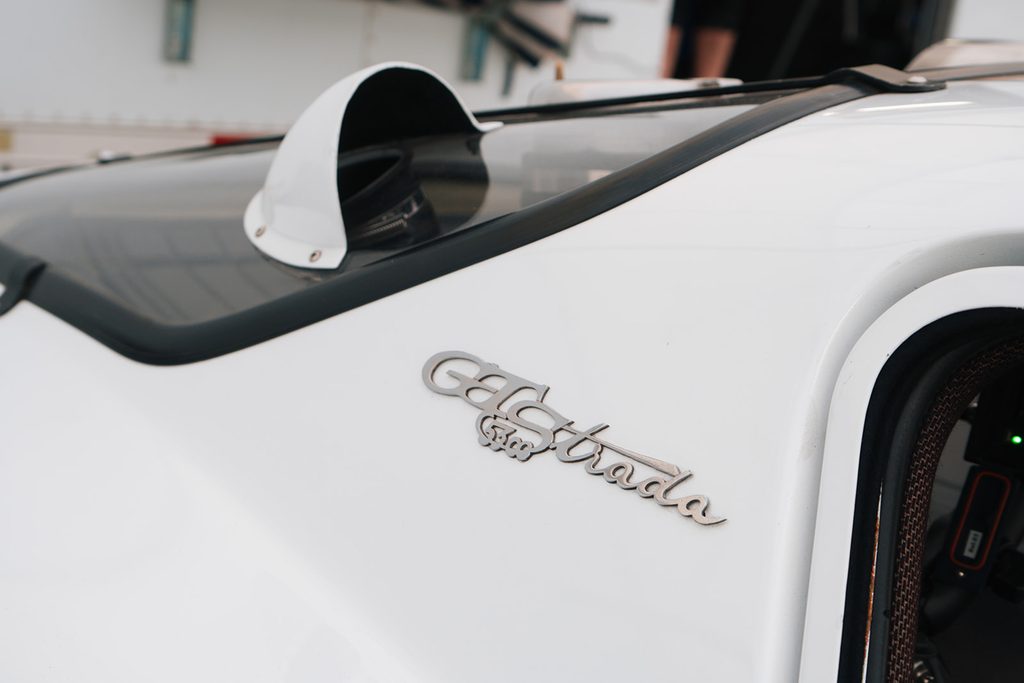
The partnership between Rivolta and Bizzarrini initially produced the Iso Rivolta GT, an elegant four-seat grand tourer powered by a Chevrolet small-block V8. The combination was logical: Italian coachwork and sophisticated chassis engineering could be paired with an engine that offered tremendous performance, comparatively simple maintenance, and an established supply of replacement parts. It was the same basic philosophy that helped make the Shelby Cobra such a formidable competitor, although Bizzarrini approached the idea with distinctly Italian sensibilities.
In 1963, the partners introduced two versions of their next sports car at the Turin Motor Show. The Iso Grifo A3/L was conceived as a luxurious road-going grand tourer, while the Iso Grifo A3/C was developed specifically for competition. Giorgetto Giugiaro, then at Bertone, designed the spectacular styling, while Bizzarrini focused on the mechanical engineering and racing development. The A3/C placed its Chevrolet V8 unusually far back in the chassis, creating a front-mid-engine arrangement intended to improve weight distribution and handling. With its lightweight body, extremely low profile, and substantial American horsepower, it offered a credible alternative to the best GT racers from Maranello.
The concept proved itself almost immediately. The Iso Grifo A3/C competed at major international events, including Sebring and Le Mans, and achieved GT class victories at the 24 Hours of Le Mans in both 1964 and 1965. The latter performance was especially impressive. Driven by Régis Fraissinet and Jean de Mortemart, chassis B-0222 finished ninth overall and first in the over-5.0-liter class at the 1965 race. According to Bizzarrini’s own historical account, Giotto even drove the car back to Livorno following its victory. Few demonstrations of a racing car’s road-going credentials are more convincing than completing one of the world’s most demanding endurance races and then driving home.
Despite that success, the relationship between Bizzarrini and Rivolta deteriorated. Rivolta wanted to concentrate on producing and selling luxurious road cars, while Bizzarrini remained fascinated by racing and continued development. When the partnership ended in 1965, the engineer retained the ability to produce his competition-derived machine, although Iso kept the Grifo name. The resulting automobile became the Bizzarrini 5300 GT, offered primarily as the Strada road car, with competition-oriented Corsa versions and the later America variant also contributing to the model’s history.
Italian Coachwork, American Horsepower
At the center of the 5300 GT was Chevrolet’s 327-cubic-inch small-block V8, displacing approximately 5.3 liters. Depending on specification and tuning, period cars produced roughly 350 to 400 horsepower, substantial output for a comparatively lightweight grand tourer in the mid-1960s. The engine typically drove a four-speed manual transmission, sending power to the rear wheels through a limited-slip differential. In an era when European manufacturers were pursuing increasingly elaborate overhead-cam engines, Bizzarrini’s decision to use a relatively simple pushrod V8 was both pragmatic and effective.
The engineering beneath the coachwork was equally impressive. The original design used a steel platform structure with semi-monocoque characteristics, independent front suspension, a de Dion rear axle arrangement on conventional alloy-bodied examples, and four-wheel disc brakes. The engine’s rearward placement improved the distribution of weight, while the low body helped reduce aerodynamic drag and kept the car’s center of gravity close to the pavement. Together, these features gave the 5300 GT exceptional high-speed stability and acceleration, with period claims suggesting maximum speeds approaching 180 mph in suitably prepared versions.
The bodywork was perhaps the car’s most memorable feature. Giugiaro’s design gave the Bizzarrini a long, flowing nose, pronounced wheel arches, covered headlights, and a tight greenhouse that appeared almost impossibly low. Many examples featured aluminum coachwork, while the America variant incorporated fiberglass construction and different rear suspension engineering. The Strada was intended for road use, but little about its proportions or mechanical layout suggested a conventional luxury car. The cabin required its occupants to climb over substantial sills and settle low into the chassis, surrounded by instruments and controls that reflected its competition origins.
It was an automobile built around the driver and the demands of performance, not convenience. Its appeal was not that it could match a Ferrari feature for feature. It was that Bizzarrini had taken the lessons learned while developing Ferrari’s best competition cars and arrived at a different answer to the same engineering questions.
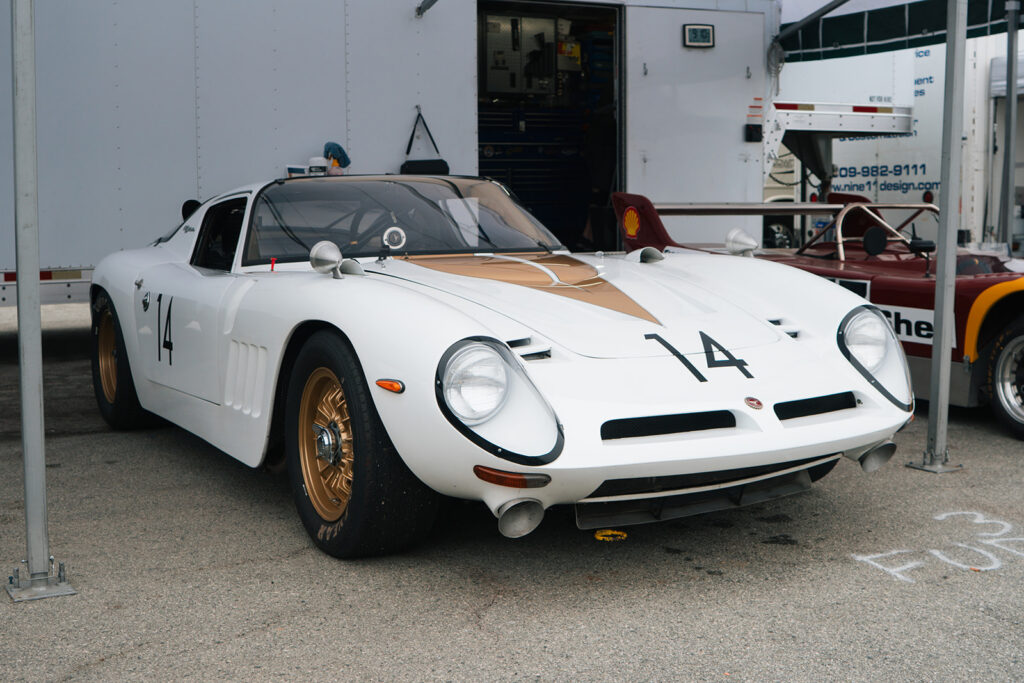
John Fudge’s No. 14 Bizzarrini at Monterey
The Bizzarrini photographed at the 2026 Rolex Monterey Motorsports Reunion has an intriguing history of its own. Associated with chassis IA3-0329, the car has been campaigned by John “Chip” Fudge for well over a decade, with photographic and entry records linking the driver and chassis to the Monterey event as early as 2012. A 2013 entry list again identifies Fudge with IA3-0329, while subsequent historic racing appearances establish a continuing relationship between the driver and the Italian grand tourer.
The car’s construction history also includes an unusual chapter. Although the Bizzarrini has regularly been entered in historic competition as a 1966 model, historical documentation published by Conceptcarz identifies chassis IA3-0329 as a 1968 car. According to that account, construction began at the original Bizzarrini factory in 1968, but the company encountered financial difficulties before the car could be completed. The unfinished machine remained dormant until 1977, when Laboratorio Automotori di Bizzarrini, a new venture associated with Giotto Bizzarrini, reportedly completed the automobile. The records do not fully explain the discrepancy between its historical construction dates and its modern racing classification, reminding us how complicated the histories of low-volume Italian sports cars can become.
The car’s appearance has also changed over the years. In the 2023 Rolex Monterey Motorsports Reunion results, Fudge’s No. 14 Bizzarrini was listed as red, a finish documented in earlier racing photographs. By the 2025 event, the car was photographed in white, and at the 2026 Reunion it appeared in the striking white-and-gold combination seen here. The new presentation complements the elegant Bertone-influenced bodywork, although the available documentation does not establish whether the finish reflects an original factory color or a more recent interpretation.
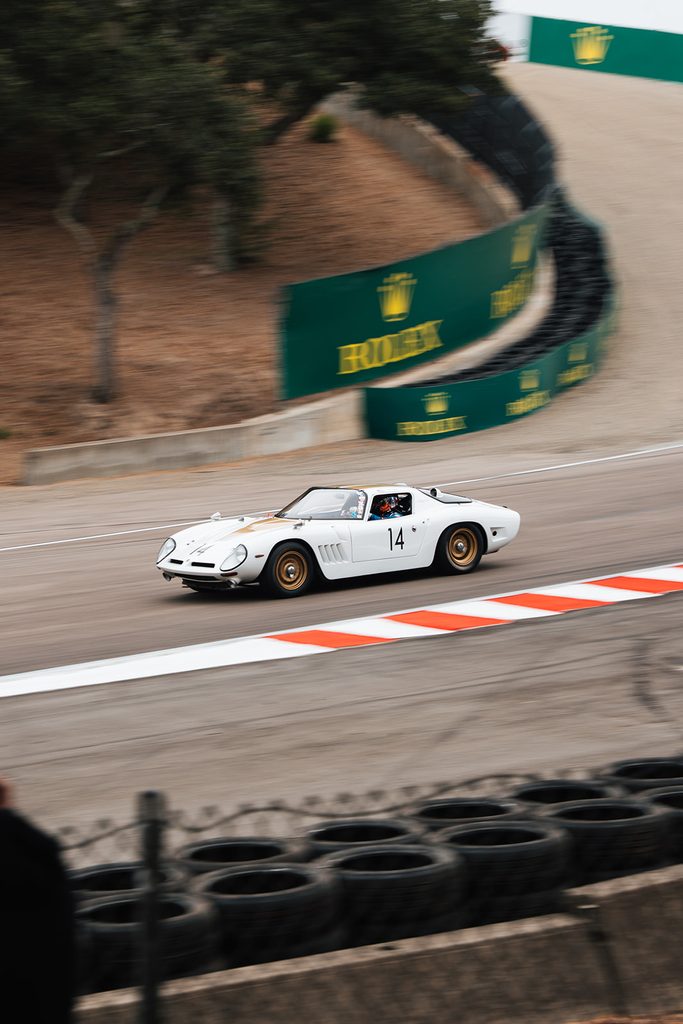
At Laguna Seca in 2026, Fudge once again put the car to work rather than simply displaying it as an automotive artifact. Competing in Group 3 against Shelby Cobras, Corvettes, Mustang GT350s, and other large-displacement production racers, the Bizzarrini represented a period when European chassis sophistication and American V8 horsepower frequently met on the same starting grid. Unofficial race timing records show Fudge recording a 1:43.842 lap in one session, an impressive reminder that the 5300 GT remains a serious performance machine six decades after its original development.
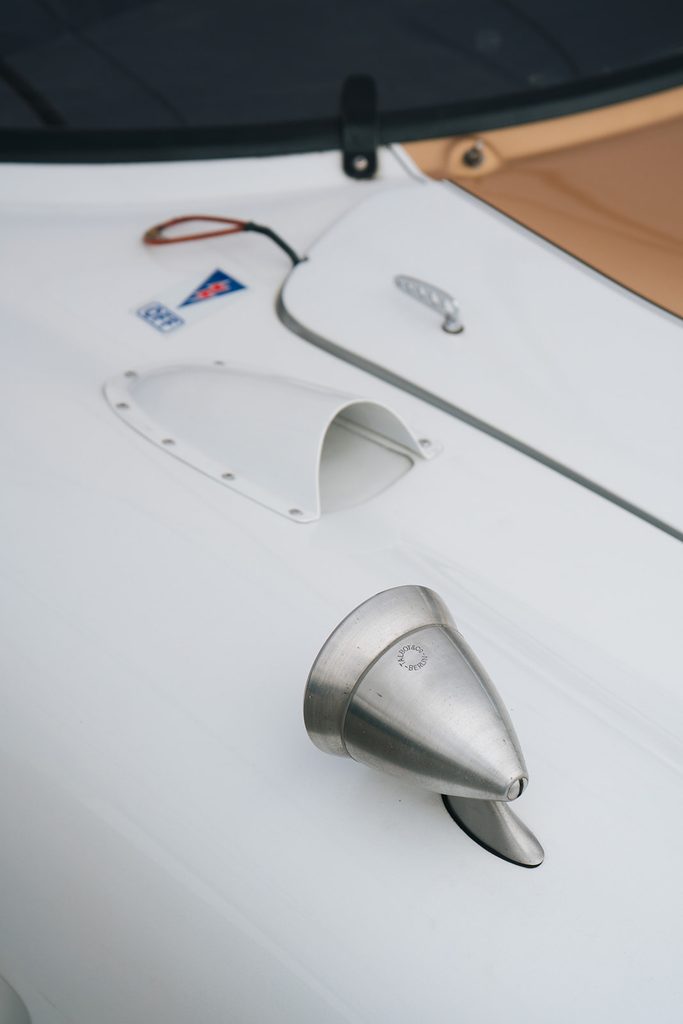
A Rare Survivor of an Extraordinary Automotive Experiment
The original Bizzarrini company never enjoyed the commercial success of the better-established Italian marques. Although its cars were mechanically impressive and could challenge far more expensive competition, limited financial resources, production difficulties, and the cost of developing new racing machinery created a challenging business environment. The marque’s own historical account places total 5300 GT production at approximately 133 examples across the Strada, America, and Corsa families, although estimates differ among historians because of inconsistent factory records and the number of incomplete cars and components that survived the company’s closure.
By 1968, the original operation was in serious financial trouble, and Bizzarrini’s dream of establishing a sustainable Italian sports car manufacturer had effectively ended. What remained was a small collection of remarkable automobiles, each representing an engineer who believed that racing provided the ultimate test of a car’s design. The 5300 GT was never intended to be merely an attractive machine for wealthy collectors. It was built to perform, and its underlying engineering was shaped by a man who had spent much of his career pursuing speed and reliability at the highest levels of competition.
That is what makes John Fudge’s No. 14 such an appealing sight at the Rolex Monterey Motorsports Reunion. While many of the cars that define the golden age of motorsport have become too valuable or too delicate to be driven with enthusiasm, the Bizzarrini continues to do what its creator intended. It arrives in the paddock, joins a field of historic competitors, and returns to the racetrack with a Chevrolet V8 beneath its long Italian hood.
For a marque that began as one engineer’s determination to build something capable of challenging the finest sports cars in the world, there could hardly be a more appropriate way to keep the story alive.
Quick Facts: Bizzarrini 5300 GT Strada
| Specification | Details |
|---|---|
| Manufacturer | Bizzarrini, Livorno, Italy |
| Model | 5300 GT Strada |
| Original production era | Mid-1960s to 1968 |
| Designer | Giorgetto Giugiaro, Bertone |
| Engineering | Giotto Bizzarrini |
| Engine | Chevrolet 327 cubic-inch V8 |
| Displacement | Approximately 5,358 cc |
| Period power | Approximately 350-400 hp, depending on specification |
| Transmission | Four-speed manual |
| Drivetrain | Front-mid-engine, rear-wheel drive |
| Chassis | Steel semi-monocoque/platform construction |
| Front suspension | Independent wishbones |
| Rear suspension | De Dion on conventional alloy-bodied versions |
| Brakes | Four-wheel disc |
| Claimed period top speed | Up to approximately 180 mph |
| Estimated total production | Approximately 133 across 5300 GT variants, according to the marque |
| Historic racing driver | John “Chip” Fudge |
| Race number in 2026 | 14 |
| Associated chassis | IA3-0329 |
| 2026 race classification | 1966 Bizzarrini 5300 GT Strada |
| Event | 2026 Rolex Monterey Motorsports Reunion |
| Location | WeatherTech Raceway Laguna Seca, California |
| Race group | Group 3, 1955-1967 SCCA Large Displacement Production Cars |
Technical figures are representative of period 5300 GT specifications and should not be interpreted as a verified mechanical specification for Fudge’s individual racing chassis.
Frequently Asked Questions
What is a Bizzarrini 5300 GT Strada?
The Bizzarrini 5300 GT Strada is a rare Italian grand touring sports car developed by former Ferrari engineer Giotto Bizzarrini. It combines styling by Giorgetto Giugiaro with a Chevrolet V8 engine and competition-derived chassis engineering.
What engine powered the Bizzarrini 5300 GT Strada?
The original 5300 GT used a 327-cubic-inch Chevrolet small-block V8 displacing approximately 5.3 liters. Period output varied by configuration, with approximately 350 to 400 horsepower cited for different versions.
How many Bizzarrini 5300 GTs were produced?
Bizzarrini’s marque history estimates approximately 133 examples across the Strada, America, and Corsa versions. Exact production totals remain disputed because of incomplete factory documentation and unfinished vehicles.
Did the Bizzarrini 5300 GT race at Le Mans?
Yes. The closely related Iso Grifo A3/C achieved class victories at Le Mans in 1964 and 1965. The 1965 class-winning car, driven by Régis Fraissinet and Jean de Mortemart, finished ninth overall. Those victories belong to the model’s competition lineage, not to John Fudge’s individual chassis.
Who drives the No. 14 Bizzarrini at the Rolex Monterey Motorsports Reunion?
John “Chip” Fudge has raced the No. 14 Bizzarrini 5300 GT Strada at Monterey. Historic photographs and racing records associate him with chassis IA3-0329 dating back to at least 2012.
Was John Fudge’s Bizzarrini originally red?
The car was documented wearing red at the 2023 Rolex Monterey Motorsports Reunion and appeared in white by the 2025 event. Its original factory paint color has not been independently verified.
Is John Fudge’s Bizzarrini really a 1966 model?
It is entered in historic racing as a 1966 Bizzarrini 5300 GT Strada. However, a published chassis history identifies IA3-0329 as having been started in 1968 and completed in 1977. The available records do not resolve the difference between those dates and the racing entry classification.













More of this please!