
 TGR Staff
There are few automobiles in the world that money simply cannot buy. Given enough determination, connections, and an appropriately extravagant bank account, even the rarest Ferraris, historic racing cars, and one-off coachbuilt masterpieces eventually find their way into private collections. But for more than half a century, one of Mercedes-Benz’s most fascinating creations has remained firmly out of reach. The C 111, a futuristic experimental supercar that first stunned audiences in 1969, was never offered to the public, despite reportedly attracting prospective buyers willing to send blank checks to Stuttgart. Now, after 56 years, Mercedes-Benz is finally allowing one to leave its collection.
On February 3, 2027, RM Sotheby’s will offer a 1970 Mercedes-Benz C 111-II at the Palais du Louvre in Paris during Rétromobile. The car, known internally as Car 33, is a fully functioning experimental prototype powered by a 345-horsepower, four-rotor Wankel engine. It has spent its entire life under the ownership of Mercedes-Benz, serving first as an engineering development vehicle and later as one of the most important exhibits in the company’s museum. To make the occasion even more remarkable, Mercedes-Benz has contractually committed not to sell another C 111 for at least 25 years, effectively guaranteeing that whoever wins the auction will possess something no other private collector has ever owned.
For Mercedes-Benz, the sale represents an unusual decision to part with a significant piece of its engineering history. For collectors, it represents an opportunity that would have seemed almost unimaginable a few years ago. And for anyone fascinated by the era when automotive manufacturers were willing to experiment with radical technologies and outrageous designs, the C 111 remains one of the most compelling cars ever created.
The Mercedes-Benz Supercar That Never Was
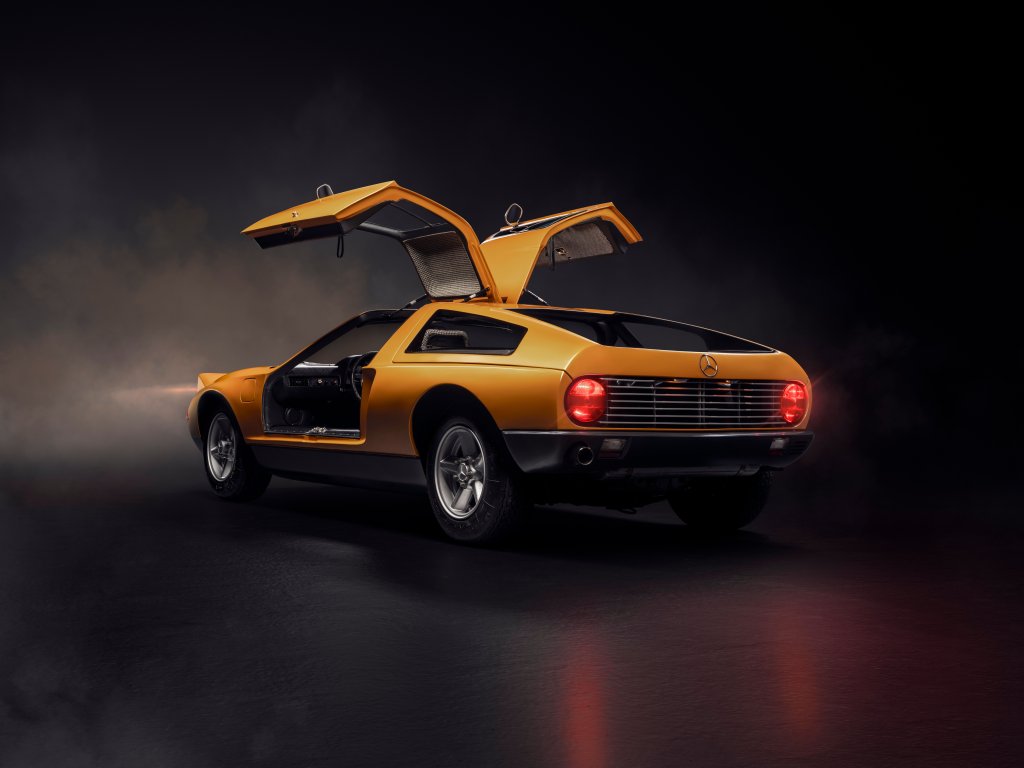
When Mercedes-Benz unveiled the original C 111 at the Frankfurt Motor Show in September 1969, the automotive landscape was undergoing a dramatic transformation. Lamborghini had introduced the Miura, Ferrari was producing the Daytona, and the world’s leading manufacturers were increasingly willing to challenge conventional thinking about what a sports car could be. Mercedes-Benz, whose reputation had been built on technical sophistication and engineering excellence, wanted to explore the possibilities of a new generation of high-performance automobiles. Its answer was a mid-engine experimental machine with gullwing doors, striking wedge-shaped bodywork, and an engine unlike anything the company had previously put into a sports car.
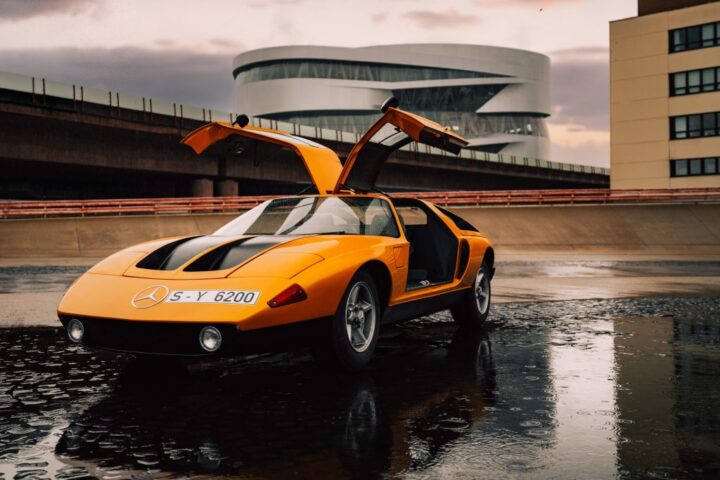
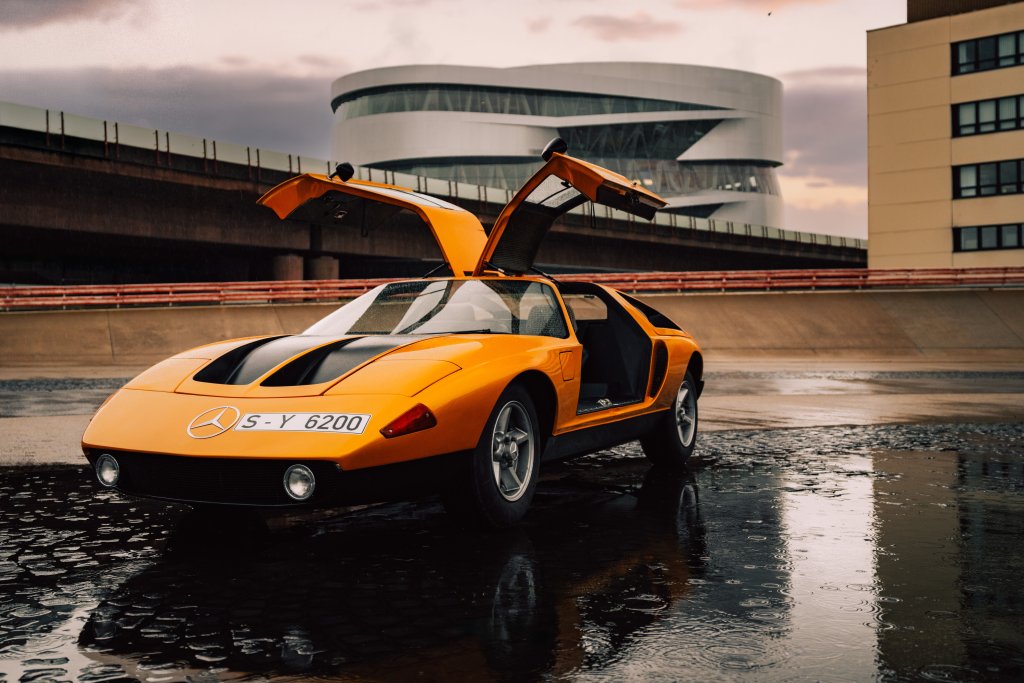
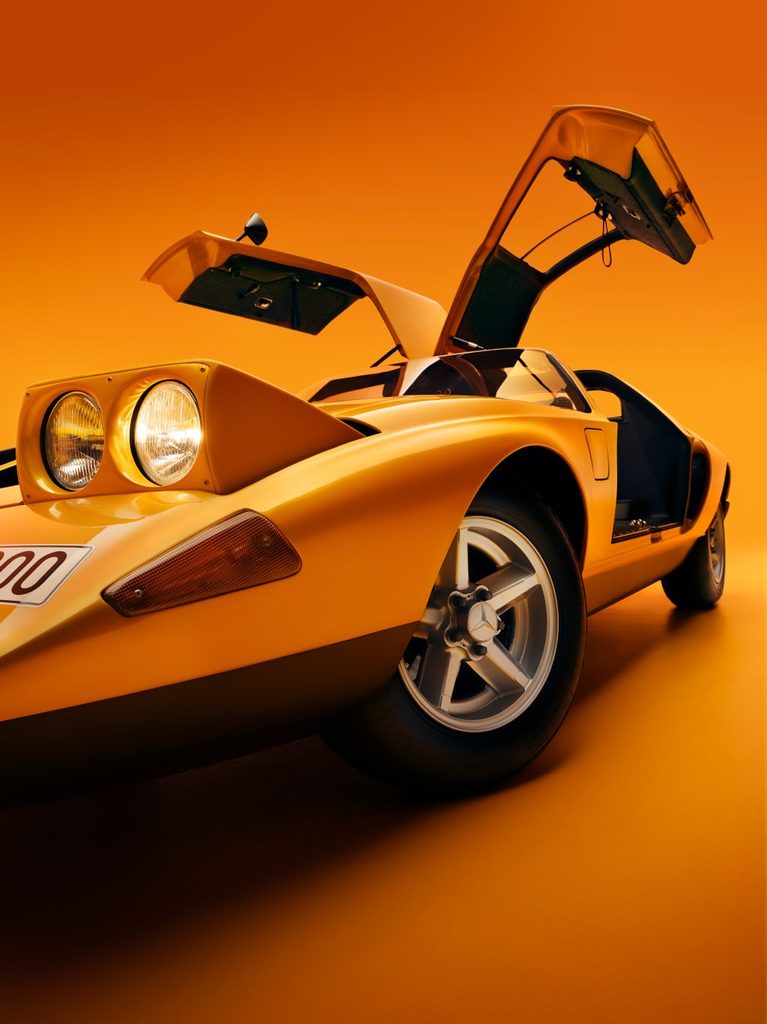
The C 111 was an immediate sensation. Its low, angular profile and distinctive orange finish made it look more like a vision of the 1980s than something developed in the late 1960s. The gullwing doors paid homage to the legendary 300 SL, but almost everything else represented a departure from Mercedes-Benz tradition. Beneath the glass-fiber-reinforced plastic bodywork was a sophisticated experimental platform designed to investigate everything from high-speed aerodynamics and suspension systems to lightweight construction and alternative engine technology. The original version was powered by a three-rotor Wankel engine, but Mercedes-Benz quickly pushed the concept further, unveiling the revised C 111-II at the Geneva Motor Show in March 1970 with a more powerful four-rotor configuration.
At a time when most sports cars relied on relatively conventional piston engines, the rotary powerplant represented a tantalizing alternative. Its compact dimensions, smooth operation, and impressive power output offered engineers the possibility of producing exceptional performance without the weight and complexity of a traditional large-displacement engine. In the C 111-II, the 2.4-liter four-rotor engine produced 345 horsepower at 7,700 rpm and 289 lb-ft of torque, delivering its power through a five-speed ZF manual transmission. With a curb weight of just 2,734 pounds, the experimental Mercedes-Benz could accelerate from 0 to 62 mph in 4.8 seconds and reach a claimed top speed of 186 mph. These were extraordinary figures for 1970, placing the C 111 in the same conversation as the world’s most exotic performance cars.
Yet despite its obvious appeal and the considerable public demand, Mercedes-Benz never put the C 111 into production. The challenges of meeting increasingly stringent emissions regulations, concerns over the fuel consumption and durability of rotary engines, and the high cost of development ultimately undermined the business case. The oil crisis of 1973 only reinforced those concerns, and the company gradually shifted its attention toward other technologies. What might have become one of the most desirable production supercars of the 1970s instead remained an extraordinary engineering experiment. Just 17 C 111 vehicles were constructed across the program’s various versions, and only 13 survive today, all retained by Mercedes-Benz until this historic sale.
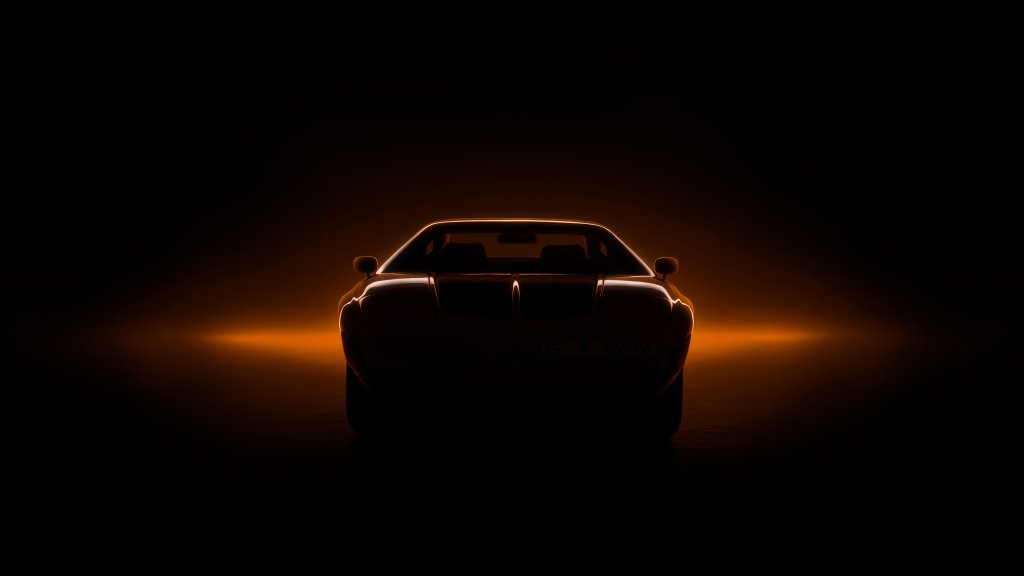
Car 33: A Remarkable Piece of Mercedes-Benz History
The C 111-II heading to Paris is especially noteworthy because it is not simply a preserved show car. Identified by Mercedes-Benz as Car 33, the vehicle began construction in March 1970 and received its four-rotor M 950 W 48 engine in August of that year. It was finished in the distinctive orange shade known as Weißherbst, a color that became almost inseparable from the C 111’s identity. Inside, the car featured gray-and-white houndstooth sports seats, a four-spoke safety steering wheel, and a vertically mounted Becker Europa radio, details that offer a fascinating glimpse into how Mercedes-Benz envisioned a futuristic sports car during the early 1970s. Even by modern standards, its interior appears surprisingly restrained, with the focus clearly directed toward the driving experience rather than unnecessary ornamentation.
Registered as S-Y 6200, Car 33 became part of the company’s engineering test fleet, where it served as a rolling laboratory for a variety of development projects. Mercedes-Benz engineers used the vehicle to evaluate fuel distribution between its two side-mounted tanks, which held a combined 30.6 gallons, and to measure temperatures within the rear luggage compartment. The car also participated in testing at the Hockenheimring and was used during early experiments with anti-lock braking systems. According to the detailed history provided by RM Sotheby’s, legendary Mercedes-Benz engineer Rudolf Uhlenhaut even employed a rather unconventional method of evaluating the insulation around the rear luggage compartment, placing butter inside to determine whether engine heat would melt it during testing. For a company exploring the future of automotive technology, there was still something to be said for a simple, practical experiment.
The car also enjoyed an unusual life beyond the engineering department. In 1971, it was demonstrated to renowned conductor and automotive enthusiast Herbert von Karajan, while the following year it appeared in the inaugural issue of the German edition of Playboy. By then, the C 111 had become far more than an experimental Mercedes-Benz. It was a cultural icon, a car whose extraordinary appearance captured the imagination of enthusiasts who might never have understood the intricacies of its rotary engine but could certainly appreciate its dramatic styling. In 1975, Car 33 was transferred into the manufacturer’s historical collection, and when the modern Mercedes-Benz Museum opened in Stuttgart in 2006, it became a prominent fixture of the museum’s design exhibition.
Despite spending much of its life on display, the car has not been allowed to deteriorate into a static relic. In 2024, the Mercedes-Benz Classic Center in Fellbach carefully returned Car 33 to running condition, undertaking a comprehensive mechanical overhaul while deliberately preserving the original patina of the exterior and interior. The project included servicing the original rotary powertrain and installing a fire-extinguishing system within the engine compartment, recognizing both the historical importance of the vehicle and the practical considerations of operating a prototype more than five decades old. Later that year, the freshly recommissioned C 111 appeared at the Pebble Beach Concours d’Elegance as part of a special exhibition celebrating wedge-shaped concept cars and prototypes, bringing it back into the international spotlight. When Mercedes-Benz photographed the car in October 2026, its odometer showed just 24,766 kilometers, or approximately 15,389 miles.
The auction will include both the 15-inch alloy road wheels currently fitted to the vehicle and the wider magnesium wheels used during period track testing. Mercedes-Benz cautions that the original magnesium racing wheels are now suitable only for display, while the experimental anti-lock braking system is no longer operational. These limitations are reminders of the C 111’s origins as a research vehicle rather than a production automobile. It is a drivable piece of history, but one that demands the care and understanding appropriate to an irreplaceable prototype.
An Experimental Program That Changed Automotive History
Although the C 111 never reached production, the engineering program continued long after Mercedes-Benz abandoned its rotary-engine ambitions. In many respects, the car’s greatest contributions were still to come. During the mid-1970s, Mercedes-Benz engineers began using the experimental platform to explore the possibilities of high-performance diesel engines, a technology more commonly associated with economy and durability than outright speed. In 1976, the C 111-II D, powered by a turbocharged five-cylinder diesel engine, established 16 records during endurance testing at the Nardò proving ground in Italy. Over a distance of 10,000 miles, the vehicle maintained an astonishing average speed of 156.46 mph, demonstrating that diesel technology could deliver levels of sustained performance few would previously have considered possible.
The program continued with the C 111-III in 1978, a dramatically modified, aerodynamically optimized machine developed to push diesel performance even further. The following year, Mercedes-Benz introduced the final evolution, the C 111-IV, fitted with a 494-horsepower twin-turbocharged V8 engine. At Nardò, the car achieved a circuit speed record of 251.02 mph, an almost unbelievable figure considering that the original C 111 had been introduced only a decade earlier. Through these experiments, Mercedes-Benz explored technologies and engineering principles that would influence future production vehicles, proving that the C 111 program was never simply about building an exotic sports car. It was about understanding what automobiles might be capable of becoming.
The influence of the C 111 also extended well beyond its mechanical achievements. Its unmistakable proportions, gullwing doors, and striking bodywork helped establish an enduring design language that would inspire generations of automotive designers. Mercedes-Benz returned to those themes in 2023 with the Vision One-Eleven concept, a modern interpretation that demonstrated how relevant the original design remains more than fifty years after its debut. Few experimental vehicles from the period have maintained that sort of cultural recognition, particularly those that never entered production. The C 111 became a legend without ever appearing in a showroom, something that makes the opportunity to acquire one all the more extraordinary.
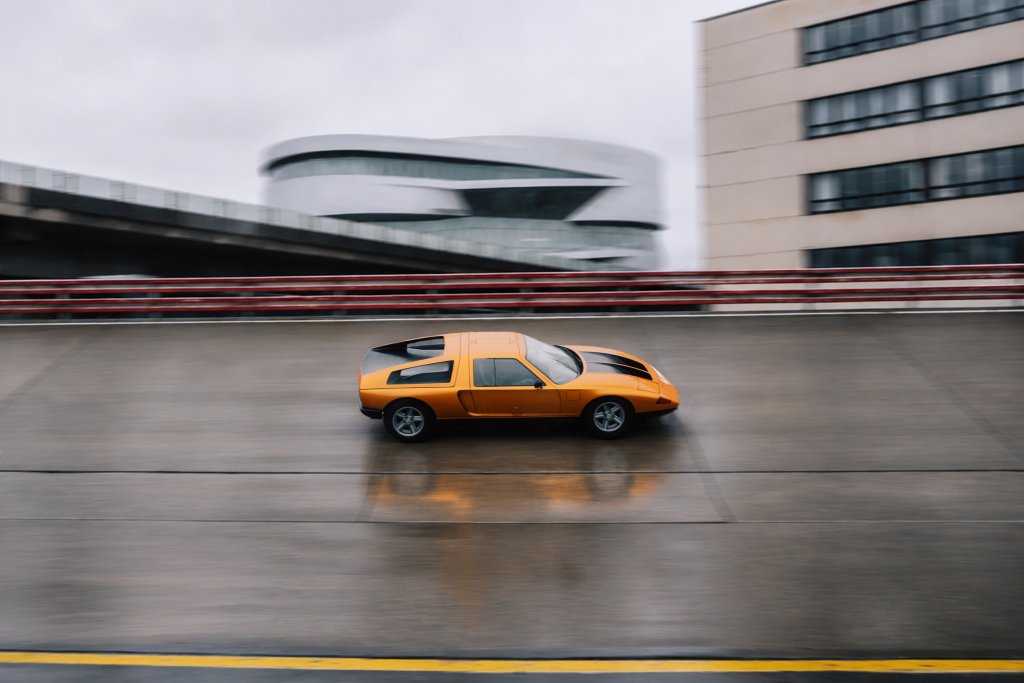
A Once-in-a-Generation Collector Car Auction
There is little doubt that the C 111 will attract serious interest from the world’s leading collectors, although predicting its eventual selling price would be little more than an educated guess. RM Sotheby’s has not published a public estimate for the car in its current online listing, but the auction house has considerable experience handling some of the most important Mercedes-Benz automobiles ever offered for sale. In 2022, a Mercedes-Benz 300 SLR Uhlenhaut Coupe sold for an extraordinary €135 million, setting a record for the most expensive automobile sold at auction. That was followed in 2025 by the sale of a Mercedes-Benz W 196 R Streamliner from the Indianapolis Motor Speedway Museum collection for €51,155,000, once again demonstrating the extraordinary prices that historically significant Mercedes-Benz automobiles can command.
The C 111-II occupies a different position in the manufacturer’s history than either of those competition machines, but its significance is difficult to overstate. It is an original factory prototype with an extraordinary engineering history, documented use by Mercedes-Benz, and a remarkably complete specification. It retains the rare four-rotor engine that helped make the C 111 famous, and it has never been privately owned. Most importantly, Mercedes-Benz’s commitment not to sell another example for 25 years establishes a level of exclusivity that few automobiles can match. Unlike a limited-production Ferrari or a particularly rare racing Porsche, the C 111 has no established private market because it has never had one.
The reason Mercedes-Benz has chosen to part with such an important vehicle is almost as interesting as the auction itself. Rather than directing the proceeds toward its general business operations, the company intends to invest the money in the development of Mercedes-Benz Museum 2.0, an initiative designed to expand the museum’s physical and digital experiences. Working with The Classic Car Trust and its Roarington platform, Mercedes-Benz is developing a digital twin of its museum in Stuttgart, allowing enthusiasts worldwide to explore the company’s history and key vehicles without necessarily traveling to Germany. The project also includes plans for new exhibitions and interactive experiences, with the first results expected in 2027.
There is something rather fitting about using an automobile created to explore the future of motoring to finance the future of automotive preservation. The C 111 was never intended to be a commercial success, and for decades Mercedes-Benz treated it as an invaluable part of its historical collection. Now, the company is allowing one example to enter private ownership in order to make the rest of its remarkable history more accessible to the public. This unusual approach to heritage management underscores the evolving relationship between manufacturers, collectors, and the institutions responsible for preserving automotive history.
The auction will take place on February 3, 2027, in the Salles du Carrousel at the Palais du Louvre in Paris, coinciding with Rétromobile, one of the world’s most important annual gatherings for classic automobiles. Interested collectors must register in advance, with bidding available in person or by telephone. Internet bidding will not be permitted for this particular lot, and prospective buyers are encouraged to contact RM Sotheby’s regarding the specific conditions of sale and opportunities to inspect the car before the auction.
For more than five decades, the Mercedes-Benz C 111 has occupied a special place in automotive history, representing an era when manufacturers were willing to pursue ambitious ideas without knowing whether they would ever reach production. Its rotary engine, radical styling, and extraordinary performance made it one of the defining experimental automobiles of its generation, while its subsequent evolution into a series of record-breaking machines demonstrated the value of that same spirit of engineering exploration. The fact that Mercedes-Benz never sold one only added to the mystique, transforming the C 111 from an unusual prototype into one of the great unobtainable automobiles.
Now, for the first time, that will change. Whoever places the winning bid in Paris will acquire more than an exceptionally rare Mercedes-Benz. They will become the first private owner of a machine that was never supposed to leave the factory collection, a car that once represented the future and has since become one of the most fascinating reminders of automotive history.
It is difficult to imagine a more appropriate automobile to make collectors reconsider what the word rare really means.
For further details and bidder information, visit the official RM Sotheby’s Mercedes-Benz C 111-II auction listing.
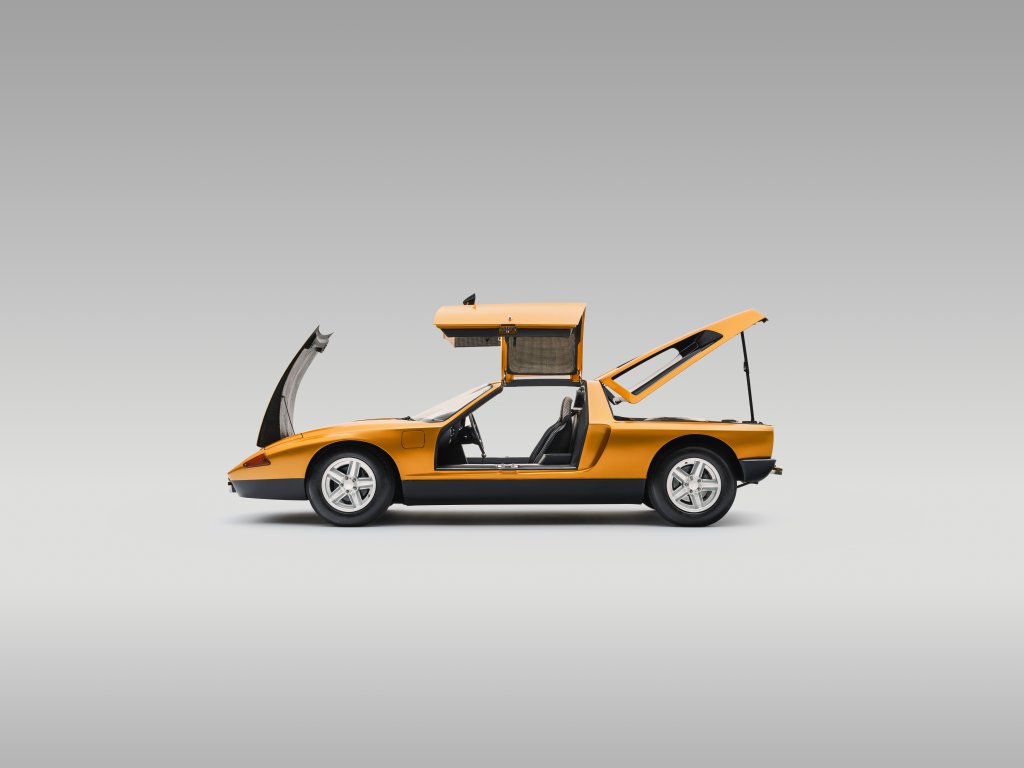
Every C 111s Ever Built
| No. | Model | Color | Completion | First engine | Notes |
| 21 | “Hobel” (slicer or plane) | White, later orange | 04/1969 | Three-rotor Wankel engineM 950 | First prototype vehicle with a provisional body |
| 22 | C 111-I | Mother-of-pearl white, later Weißherbst | 07/1969 | Three-rotor Wankel engineM 950 | The first “proper” C 111; converted to a four-rotor Wankel engine in July 1970 |
| 23 | C 111-I | Mother-of-pearl white, later Weißherbst | 08/1969 | Three-rotor Wankel engineM 950 | Converted to a four-rotor Wankel engine in June 1970 |
| 24 | C 111-I | Mother-of-pearl white | 08/1969 | Three-rotor Wankel engineM 950 | Side-impact tests in June 1970 |
| 25 | C 111-I | Weißherbst | 08/1969 | Dummy engine | IAA exhibition car; fitted with an M 117 V8 engine in July 1970 and a four-rotor Wankel engine in April 1972 |
| 26 | C 111-I | Mother-of-pearl white, later Weißherbst | 09/1969 | Four-rotor Wankel engineM 950 | First C 111 with a four-rotor Wankel engine |
| 31 | C 111-II | Weißherbst | 03/1970 | Four-rotor Wankel engineM 950 | First C 111-II; converted into a diesel record-breaking car in 1975/76; record-breaking run in Nardò in June 1976 |
| 32 | C 111-II | Weißherbst | 03/1970 | Dummy engine | Exhibition vehicle at the Geneva Motor Show |
| 24a | C 111-II | Weißherbst | 07/1970 | Three-rotor Wankel engineM 950 | Replacement for Car 24, built to C 111-II specifications; used for bodywork testing and fitted with a three-rotor Wankel engine; converted to a four-rotor Wankel engine in 1973 |
| 33 | C 111-II | Weißherbst | 08/1970 | Four-rotor Wankel engineM 950 | Second C 111-II in the test fleet, fitted with a four-rotor Wankel engine |
| 34 | C 111-II | Weißherbst | 10/1970 | Four-rotor Wankel engineM 950 | Third C 111-II in the test fleet, fitted with a four-rotor Wankel engine |
| 35 | C 111-II | Weißherbst | 12/1970 | M 116 V8 gas engine | Final C 111-II from the original series; converted to a four-rotor Wankel engine in May 1972 and refitted with an M 116 V8 gas engine in 2013/14 |
| 36 | C 111-II | Weißherbst | 07/1975 | Four-rotor Wankel engineM 950 | First C 111 with a plastic floor assembly |
| 37 | C 111-II | Weißherbst | 10/1975 | Five-cylinder turbodieselOM 617 A | Second C 111 with a plastic floor assembly; originally intended for diesel record-breaking runs, but never used for that purpose |
| 41 | C 111-III | Metallic silver | 10/1977 | Five-cylinder turbodieselOM 617 A | Record-breaking run in Nardò in April 1978; converted into a C 111-IV at the end of 1978; further record-breaking run in Nardò in May 1979 |
| 42 | C 111-III | Metallic silver | 02/1978 | Five-cylinder turbodieselOM 617 A | Record-breaking run in Nardò in April 1978 |
| 43 | C 111-III | Metallic silver | 07/1978 | Dummy engine | C 111-III Exhibition Vehicle |
Technical specifications: C 111-II Car 33, as of 1970
| Model | C 111-II |
| Year of construction | 1970 |
| Internal number | 33 |
| Engine | Four-rotor Wankel engine |
| Engine type | M 950 W 48 |
| Fuel | Premium gasoline |
| Displacement | 2,400 cc (equivalent to a 4,800 cc reciprocating piston engine) |
| Output | 345 hp (257 kW) at 7,700 rpm |
| Torque | 289 lb-ft (392 Nm) at 4,000–5,500 rpm |
| Compression ratio | 9.3:1 |
| Engine weight | 478 lbs (217 kg) |
| Clutch | Dual-disc clutch, Fichtel & Sachs MF 215/2 |
| Transmission | ZF 5-speed manual transmission DS-25/1 |
| Ratios 1st/2nd/3rd/4th/5th/Reverse (:1) | 2.857/1.72/1.21/0.92/0.705/2.86 |
| Final drive ratio (:1) | 4.22 |
| Overall gear ratio in 5th gear (:1) | 2.975 |
| Wheels (road) | 8 J × 15 H, ET 20 |
| Wheels front/rear (racetrack) | 10 × 15 H, ET 0 / 13 × 15 H, ET 30 |
| Tires (road) | 215/70 VR15 90W TL Michelin XWX |
| Tires front/rear (racetrack) | 430/1160 × 15 / 530/1360 × 15 Dunlop CR82 Comp 204 Racing |
| Fuel tank capacity | 30.6 gal (116 l) |
| Maximum speed | 186 mph (300 km/h) |
| Acceleration 0–62 mph (0–100 km/h) | 4.8 sec |
| Wheelbase | 103.1 in (2,620 mm) |
| Front/rear track width | 55.5/55.3 in (1,410/1,405 mm) |
| Track width with road tires, front/rear | 56.9/54.7 in (1,445/1,390 mm) |
| Length × Width × Height | 174.8 x 71.9 x 44.1 in (4,440 × 1,825 × 1,120 mm) |
| Curb weight | 2,734 lbs (1,240 kg) |
Frequently Asked Questions About the Mercedes-Benz C 111
Is the Mercedes-Benz C 111 for sale?
Yes. Mercedes-Benz will offer an original 1970 C 111-II prototype, known as Car 33, through RM Sotheby’s in Paris on February 3, 2027. It will be the first C 111 ever offered for public sale by the manufacturer.
How much is the Mercedes-Benz C 111 worth?
RM Sotheby’s has not published a public price estimate for the 1970 Mercedes-Benz C 111-II in its current online listing. Given its rarity, originality, and historical significance, the vehicle is expected to attract interest from major collectors, although its final value will be determined at auction.
How many Mercedes-Benz C 111 cars were made?
Mercedes-Benz constructed 17 experimental C 111 vehicles across several configurations between 1969 and 1979. Thirteen survive, and until the announced 2027 auction, all remained in the manufacturer’s historical collection.
What engine does the Mercedes-Benz C 111-II have?
The C 111-II being auctioned features a 2.4-liter, four-rotor M 950 W 48 Wankel engine producing 345 horsepower and 289 lb-ft of torque, paired with a five-speed ZF manual transmission.
How fast is the Mercedes-Benz C 111?
The four-rotor Mercedes-Benz C 111-II was capable of a claimed 186 mph, with acceleration from 0 to 62 mph in 4.8 seconds. The later C 111-IV record-breaking prototype achieved a circuit record of 251.02 mph in 1979.
Why was the Mercedes-Benz C 111 never produced?
Mercedes-Benz abandoned plans for series production because of rotary-engine emissions and fuel consumption challenges, increasing development costs, and changing market conditions. The 1973 oil crisis further reinforced the decision.
Can the Mercedes-Benz C 111 still be driven?
Yes. The C 111-II offered for auction was mechanically recommissioned by the Mercedes-Benz Classic Center in 2024 and returned to running condition. Its experimental ABS system is no longer operational, and it remains a prototype rather than a conventional roadgoing production car.
Where will the Mercedes-Benz C 111 be auctioned?
RM Sotheby’s will offer the car on February 3, 2027, at the Palais du Louvre in Paris, France, during Rétromobile. Bidders must register in advance, and internet bidding is not available for this lot.