

 Jesus Garcia
Welcome to Reno
The turbulence coming into Reno had me shaken like a martini and breathing heavy into the courtesy vomit bag. Willpower and an empty stomach kept the bag unused as I stumbled out of the aircraft, cold sweat down my face, into the sunny, elevated skies of Reno, Nevada.
In my career, I’ve visited Las Vegas several times to cover the Mint 400 off-road race, but this was my first time in the biggest little city in the world. Invited by Can-Am to partake in the 30th annual Vegas to Reno Legends Rally, a pre-running off-road event across the Nevada desert.
My job was simple: to experience the family-oriented lifestyle of desert racing from the driver’s seat of a brand-new Can-Am UTV. To live the life and chew the same dust as professional off-road racers.

Desert Racing, it’s a Family Thing
If there’s one thing the aliens observing our planet can conclude, it’s that humans will race anything over any terrain.
Motorsport, much like the automotive community, is a galaxy of subcultures and lifestyles. Within this cosmic spectrum, you have the posh, yacht-setting F1 Teams with caviar burning budgets and millisecond margins. NASCAR with good ol’boys in corporate-backed stock cars running circles on superspeedways. Rally drivers giving death the middle finger without ever taking their foot off the gas. Drifters sanding the paint off their bumpers on cement barriers while huffing Yokohama tire smoke. Drag racers who react to green lights like a raging bull seeing red.
That’s not including all the niche motorsports in between. Yet among all these motorsports, few offer the family-oriented “vibe” of desert racing. This became apparent during the driver’s meeting the night before the rally.
One can identify a desert racer by their unofficial uniform: an often-faded black t-shirt representing a shop or aftermarket brand, black shorts (cargo not required), sandals, and a black baseball cap. The only designer clothing you’ll find in this crowd is their racing suits and helmets.
Being an outsider and an introvert by nature, being welcomed by this group of sun-kissed strangers was a warm surprise. This welcoming atmosphere is more than just sportsmanship. Out in the desert, these competitors look out for one another. Yes, they are all battling for the podium, but if someone needs help, they’ll stop because the desert is fair in its brutality. It doesn’t offer mercy or tolerance. It merely provides the battleground, and the rule of desert racing is never leave a man behind.
Everyone I talked to, or sat next to, or accidentally bumped into sparked conversations that felt like I was talking to an old friend I hadn’t seen in a while. Many of these professional drivers, co-drivers, and crew members were happy to take time off their full-time lives and jobs to be here and indulge in the vice of motorsport.
People like veteran off-road racer and UTV champion Phil Blurton, whose career in desert racing started through his day job as a fabricator. Building roll cages for UTVs led to an opportunity to test the products he was building, and like a prodigy, Blurton discovered he had a knack for winning.
Among a growing list of achievements, one of Phil Blurton’s most notable claims in motorsport fame is winning the UTV World Championship during his rookie year in 2017 and coming back to win again in 2018 and 2019! In addition to taking class podium wins at the Baja 1000 in 2021 and 2024, including winning the 2026 Parker 400 Limited Race earlier this year.
Of course, speaking to the man, you get the feeling he sees winning as a garnish to what really matters, the challenge – the drive. Some racers only care about winning, but for some drivers, the action is the juice (Heat 1995).
Can-Am and the 30th Running of Vegas to Reno
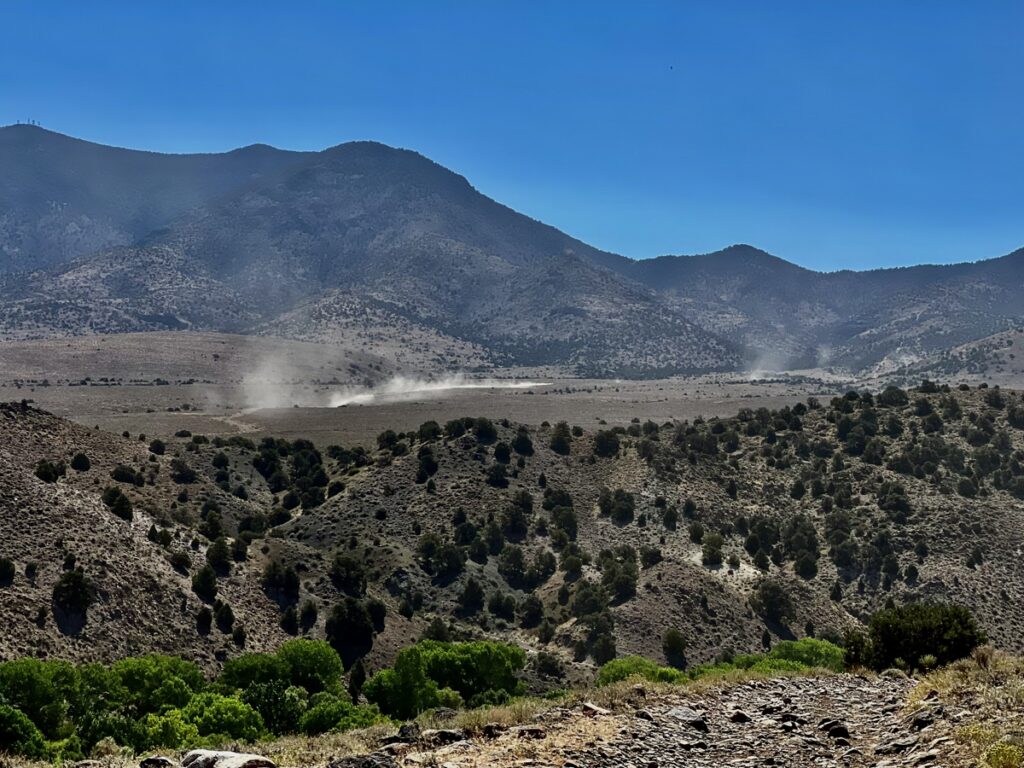
The Vegas to Reno Off-Road Race, organized by Best in the Desert, is exactly what it sounds like—an off-road race across hundreds of miles of Nevada landscape between the two cities. For 2026, BITD wanted to do something different in honor of the event’s 30th anniversary.
This year, the 2026 Vegas to Reno race will run in reverse for the first time in the event’s history. Instead of starting in Vegas and ending in Reno, racers will start in Reno and end in Las Vegas. That means the course will be over familiar terrain but offer a completely different challenge. This forces the teams to reorganize their game plan and pace notes.
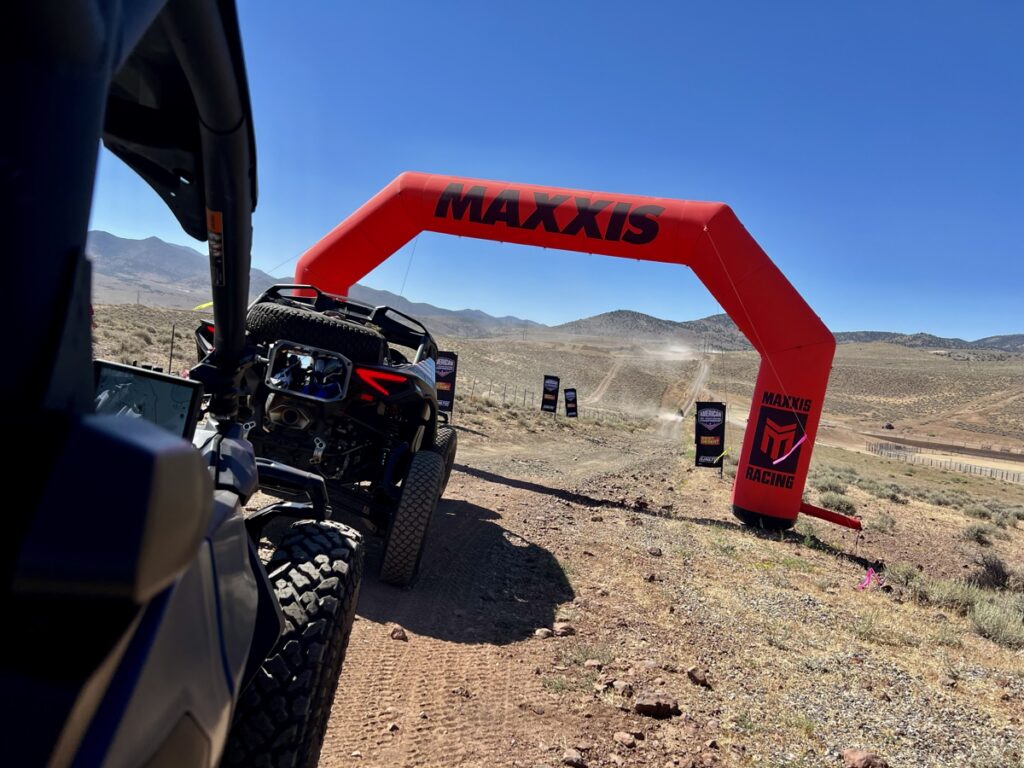
The Vegas to Reno Legends Rally offers competitors and enthusiasts the chance to pre-run the course a couple of weeks before the actual event.
During the driver’s meeting, Best in the Desert Co-Owner/CMO Bryan Folks wasted no time in pointing out the elephant in the room. Events like this are not getting any easier to host, which is a common theme in motorsports across the board. The irony is that as racing has gotten safer and smarter, it suddenly became too dangerous, too loud, or too close for fragile-minded bureaucrats and city council members, but I digress.
This Legends Rally is a pre-run, not a race. Everyone would be limited to 55 mph, enforced by the honor system. Tough but fair considering the course is on public lands and runs across highways, ranches, and small desert towns with potential hazards like livestock and children.
Bryan Folks pleaded with the competitors not to leak the course layout or their pace notes to people who didn’t make the pre-run. Don’t share notes on the final exam. Folks ended his speech by expressing how happy the city of Reno was to host this event, and he appreciated their support.
What I took from the driver’s safety meeting is that desert racing is still, and probably one of the last forms of Wild West motorsports. Out here, you’re measured by your skill and the value of your word.
Pre-Running Across Nevada with Can-Am
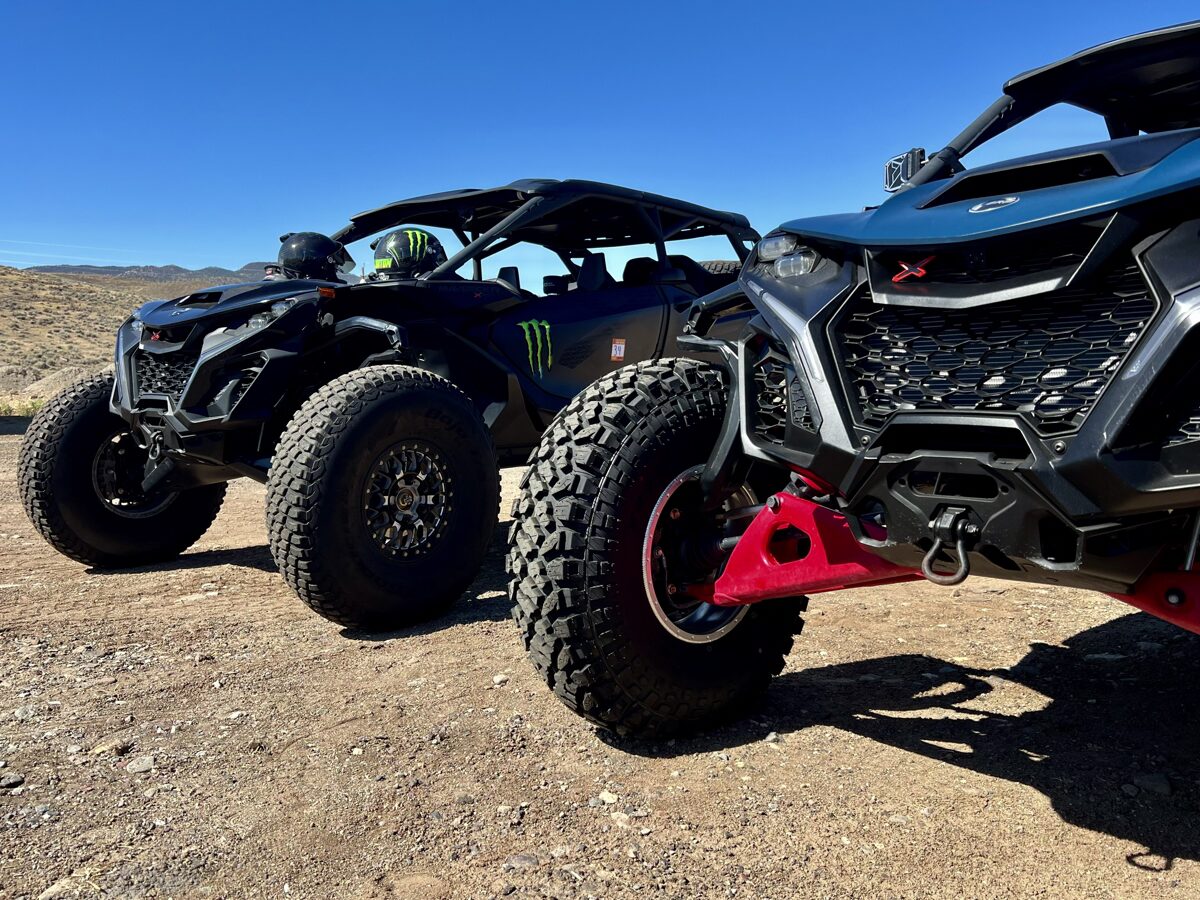
The media group consisted of one professional photographer, Justin Coffey, one staff writer from New York, Ryan King, who’d never driven a Can-Am, and myself. Tim Olson from Can-Am’s Global PR team was also along for the ride as we strapped into two Maverick R Max X RS side-by-side UTVs for the Legends Rally.
We would be pre-running a leg of the full course, approximately 100 miles, starting in Reno and ending in the small, haunting town of Tonopah, Nevada.
The start of the course took us up and over a rocky mountain range, allowing us to get a proper feel of the Can-Am’s suspension.
It was surreal watching the Maverick R Max X RS’s upper control arms vibrating like rocker arms on an engine as we sped over the unforgiving terrain. The UTV’s sophisticated suspension absorbed the harsh bumps before the jolt reached our spines.
It was a real test of durability as we saw other vehicles on the side of the road with either their hoods up or jacks out within the first few miles of the course.
After the rocky mountainous terrain came long sweeping runs of soft sand and sharp rocks, and it was here where it was my turn to drive. Given that I had passengers, including the man who invited me, I was on my best behavior, picking the smoothest line, keeping it under 55, and changing gear well before the redline.
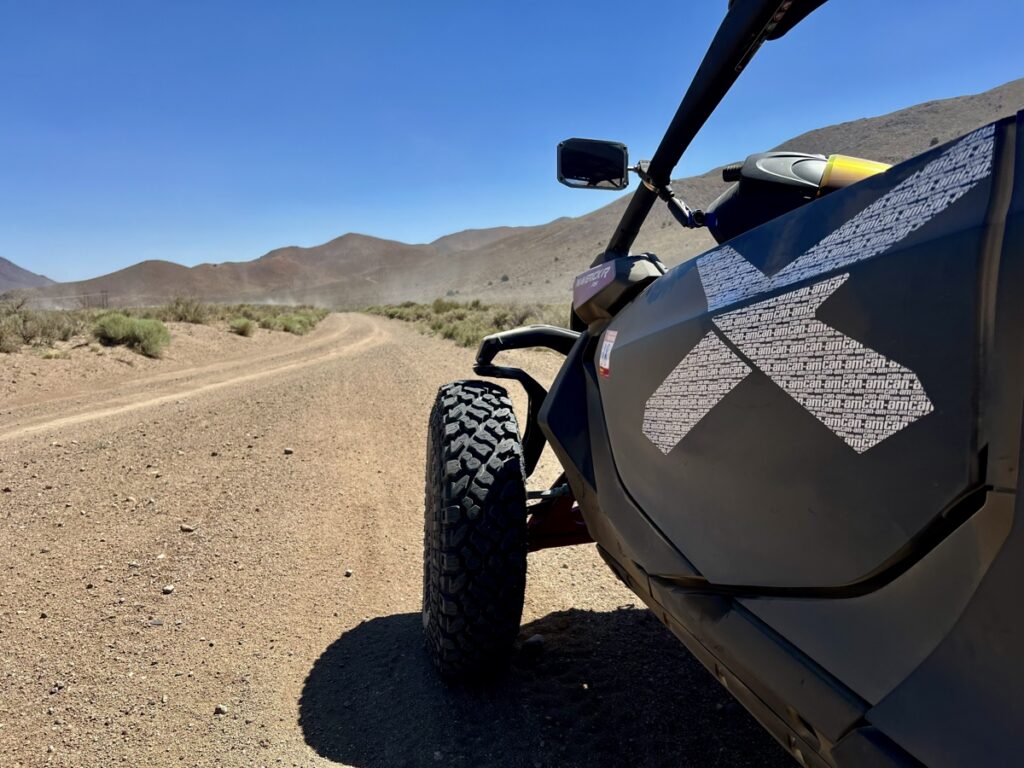
That being said, the Can-Am Maverick R MAX X RS handled wonderfully. Probably too good because after I gave up the driver’s seat, my confidence was overinflated. My ego started chatting in my inner ear that I could take on a desert race of this magnitude and hold my own.
That thought was wiped off when I sat in the car driven by Phil Blutron. In a dusty section of the course that zig-zagged around ruts of soft sand like a rattlesnake, I saw what these UTVs can really do in the hands of a professional driver.
Watching the terrain speed past with Phil anticipating every move as co-driver Jeff Galloges relayed critical details of what’s coming up. I learned my brain needs more cardio training if it wants to react to off-road terrain at triple-digit speeds like a pro.
Lastly, I rode shotgun and warned the driver when dangerous sections on the course came up. These hazards ranged from large boulders near the edge of the road, cattle crossings, rolling ruts, or hills sharp enough to send a vehicle airborne. During the last few miles, blazing across the dusty plains, we had been on the run for about seven hours, and the heat and sun were getting to me.
I started to feel my eyes getting heavy. But surely there was no way I would fall asleep on a speeding UTV charging across wild terrain – right? Wrong.
Resting my eyes for only a second turned into a full-on siesta. Waking up, wondering if I had fallen asleep for a few minutes or a few miles. That alone says a lot about the Can-Am’s ride quality.
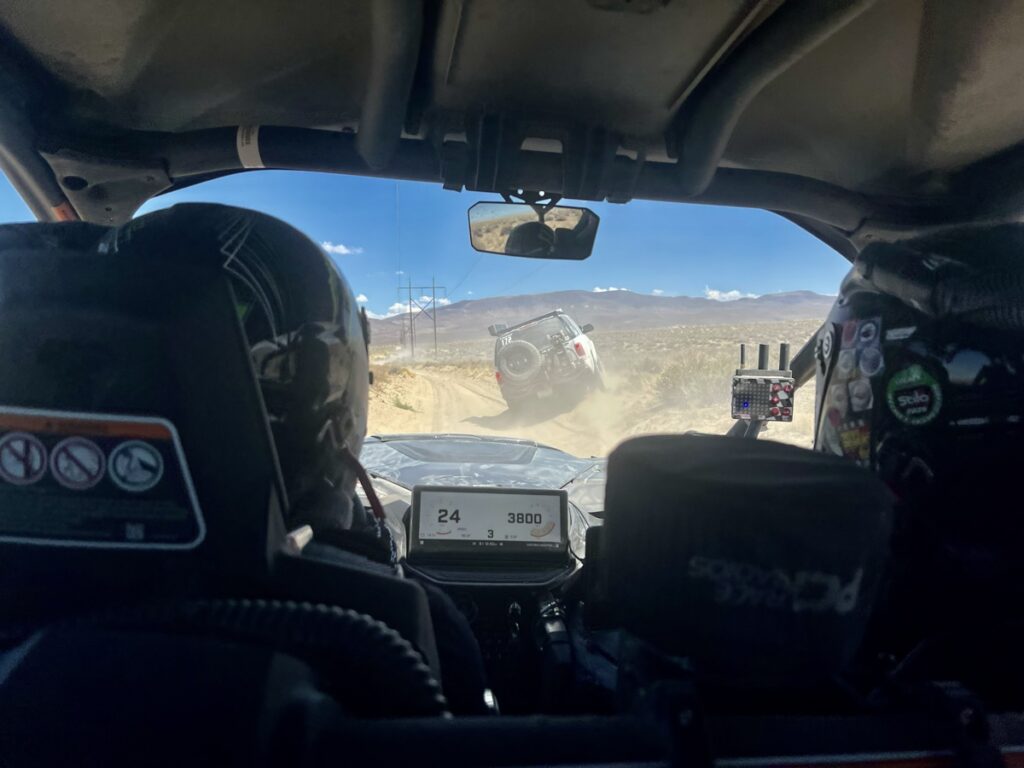
The Can-Am Maverick R Max X RS Side by Side
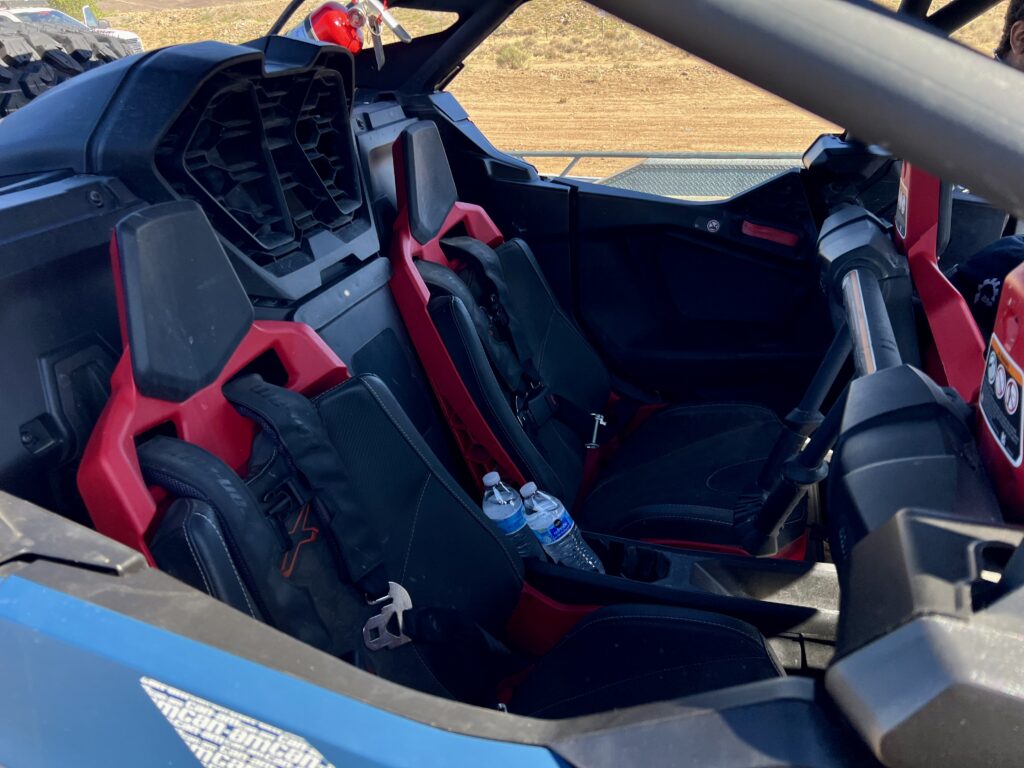
The Can-Am we used during the Vegas to Reno Legends Rally was the 2026 Maverick R Max X RS. This is a four-passenger side-by-side UTV. It is powered by a 999cc, turbocharged, three-cylinder, liquid-cooled engine with an integrated intercooler and a high-performance air filter. Managing its power output is a dual-clutch 7-speed automatic transmission with high and low gearing that you can select on the fly.
The result of all this engineering is a powerful 240-horsepower engine capable of reaching a top speed of around 118 mph. Which I can tell you is faster than most production model pickup trucks. Moreover, it has a dry weight of under 2,700 pounds, so it can be towed by most pickup trucks as well.
Off-road, the Maverick R Max X RS offers 24 inches of suspension travel and 17 inches of ground clearance. It can drink 13.2 gallons of fuel, which comes in handy if you’re planning several hundred miles in an area far away from gas stations.
More importantly, this UTV has power steering, a touch screen to select multiple drive modes, paddle shifters, cup holders, storage space, and USB-A charging ports. If you know how to drive a car, you will have no trouble driving a Can-Am UTV. It is a very intuitive machine, but driving one at speed does require focus and skill – like with any vehicle.
With the amount of power and features this UTV has, one can joke that the only thing keeping it from being road legal is a set of turn signals and wiper blades.
How Can-Am Changed the Game in Off-Road Racing
I learned a lot on this trip. I learned that the desert racing community will greet you with an open bear hug. That I can literally fall asleep anywhere. And that Can-Am has evolved the UTV into something far more valuable than a recreational “toy”.
Because, as anyone in motorsport will tell you, racing is anything but cheap. Speed costs money. A Can-Am UTV isn’t cheap, but it is affordable in the context of racing. When compared to the cost of building and running a desert trophy truck that starts at six figures and knows no direction but up, a UTV offers accessibility where it didn’t exist.
Someone with a full-time job, career, family, and life can partake in these historic off-road races by using a UTV. Become legit, race to win, battle alongside racers they look up to for the same podium, without spending a million dollars on a rig and equipment. I’m not going to say it’s the poor man’s desert racecar, but it is a game changer, an affordable contender, not a pretender.
If you need another vice in your life, I’d recommend desert racing. It’ll give the rush you want, the thrill of an adventure, a challenge to overcome, and a good group of people to call friends.
Personally, I think it’s a damn better way to spend your time and money than playing golf.









You consistently deliver cool stories
This is exactly the kind of content the industry needs.
Always love these stories, needs to be a series “The Adventures of Jesus”