

 Michael Satterfield
I did not plan for this little Healey to become a long-term relationship, but it has become the one car I have owned the longest. It started as a shoestring idea in 2014, a budget experiment that would be fun to tinker with, teach a few lessons, maybe run a track day or two, then move along. The first receipts told the whole story. Car, one hundred dollars. DMV VIN verification, sixty. DMV fees, forty-six. POR-15 laid down on the floorboards and a debate with myself about painting the engine bay body color or black. In other words, the kind of honest, garage-floor project that always seems to start with optimism and a milk crate full of parts.

By late summer that year, the pile of parts got more intentional. The missing headlamp buckets for $20 at the Pomona Swapmeet. A bolt-in roll bar cost thirty bucks the same day. An aluminum racing seat joined the stack. The running tally crept up to three hundred fifty-six dollars, but the name stuck. The Hundred Dollar Healey kept its identity because the soul of the thing was never the math. It was the idea that you could build a purposeful, period-flavored driver in a normal garage with basic tools and patience.
The hook that makes this little car special sits right up front. In the 1960s, a fabricator named J Giddens in Manhattan Beach, California, created a distinctive fiberglass front bonnet for Austin-Healey Sprites and MG Midgets. Years later, photos of my car’s unique nose found their way to a Sprite historian’s site, where that origin was noted. If you know Southern California’s postwar car culture, you can feel the sunlight and salt air in that detail. The beaches, the speed shops, the guys who hammered out ideas in metal and fiberglass after clocking out from aerospace jobs. This car wears that heritage on its face.

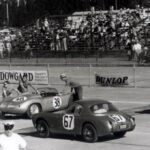
Original Promotional Photo of a J Giddens Healey Special on a 1960 Sprite
I did not find the car in a tidy workshop. I found it tucked away in an airplane hangar, a quiet corner with dust motes in the light, the kind of place where projects go to die. It had a past and the scars to prove it. Somewhere in that Manhattan Beach timeline, it picked up the parts it needed for club racing and time trials, then drifted into storage as so many cars do when families, jobs, and moves shuffle the deck. I bought it because I liked the story and the shape. I kept it because it felt like a promise I should keep.
Then life did what life does. Over the next years, everything changed for me. I found myself without a shop, on the road, and looking for a new home base. During that time, I had to sell most of my automotive collection, the ’67 Gulf Fairlane, the ’69 Mini Cooper, and even my old Yamaha dealership sign. But the Healey stayed. It moved with me to Texas in 2018 and promptly disappeared into a storage unit while other priorities, like rebuilding a 150-year-old building, took the front seat. I thought about selling the car many times over the years, partly because it was from what seemed like another life, but each time I considered it, I just couldn’t part ways with the unique little car.

Bodywork before the currently bad blue paint job went on over 8 years ago
This week the door rolled up and the car blinked into the Texas sun for the first time in a while. We loaded it and sent it to Apex Auto Works, a race and restoration shop based in the Houston area. Apex lives in that sweet spot where craftsmanship meets track reality. They build, fix, improve, and they spend plenty of time making sure people can put in clean laps. The plan is straightforward. Return the car to the kind of competition style it would have worn in the 1960s, keep it honest to its SoCal origins, and give it the safety and reliability, as well as much reliability as you can build into an A-Series.

If you are new to Healey Sprites and Midgets, a quick primer explains why this platform makes sense. The Austin-Healey Sprite and its MG twin were born to be simple, light, and mischievous. They thrived in SCCA Production classes and club paddocks because they delivered fun per dollar like few cars before or since. They are tiny, tunable, and happiest when driven with momentum. Decades later they still draw a crowd because they represent a clear idea of sports car purity.
So what does a 1960s competition style revival look like for a budget-born Healey with a Manhattan Beach nose and a Texas zip code? First, safety sets the baseline. The old bolt-in roll bar gets upgraded, harnesses and seat mounts get replaced or re-engineered, and the fuel system earns a careful inspection. Soft lines, hard lines, master cylinder, wheel cylinders or calipers, drums or discs, everything gets attention. Brake friction gets chosen for predictable bite rather than drama. The cooling system gets a shakedown because time and neglect are hard on radiators and water pumps. Electrical grounds get refreshed. The goal is not over-restoration. The goal is a reliable, track-legal car that looks and feels period correct at ten paces and makes the right noises by turn two.

Suspension on these cars rewards small, thoughtful updates. Bushing materials, alignment settings, and ride height will be tuned for our Texas tracks. Nothing flashy, nothing that spoils the character. Tires will be sized to keep the car lively but controlled, mounted on wheels that would look at home in a 1960s paddock. The J Giddens front end is the calling card. It will be repaired and refinished with the same restraint used on everything else. You should be able to picture this car at Riverside or Willow Springs in 1966 and not find a single visual note out of key.

Under the hood, the A-series motor will get the care it deserves. Honest compression, no shortcuts on gaskets, attention paid to the head and valves, and a cam choice that does not turn it into a diva. Twin SUs tuned correctly are a joy, and reliable ignition makes the whole package feel modern without looking it. Period correct breathers, proper heat shielding, neat wiring, and tidy hardware go a long way toward that right-for-the-era engine bay. It is the sort of detail that makes judges nod and fellow drivers peek under the bonnet when you park.
What do we want to do with it? Drive it. The target is to have the car ready for Groesbeck Sports Car Club time trials and select shows by the end of the year.. You do not need a full race program to experience a car like this the way it was meant to be used. You need a tech-inspected, safe car, a helmet, and a healthy respect for momentum.
The other half of the goal is to celebrate the story. A car that began in Manhattan Beach with a hand-laid front end by a local maker, bounced through owners, slept in an airplane hangar, and survived multiple moves deserves to be seen. A few tasteful shows and cars-and-coffee mornings will let people get close to that unusual nose and hear the background. These cars pull memories out of folks. Someone’s neighbor raced one in H Production. Someone learned to heel-and-toe in a Bugeye. Someone still remembers the smell of hot oil and canvas from a high school road trip. The best part of driving old cars is the community that blooms around them.

There is a reason the project stayed with me when other cars came and went. It is light, cheap to run, and exactly the sort of machine that turns a weekday into a story. It also represents a way of working. Do what you can yourself. Save your pennies for the parts and processes that really matter. Bring in trusted hands when the job calls for experience and proper equipment. Apex Auto Works will handle the heavy lifting and fabrication while I keep my hands involved wherever that makes sense. The end result should feel like a handshake between 1966 and 2025.
For those who followed along a decade ago, the spirit of the build has not changed, only the setting. The early work with POR-15 is still paying off. The junkyard finds that made the budget possible taught me to be patient and keep showing up. The receipts will continue to be honest. You will see if I decide to splurge on something a little shiny. If a part is used because it fits the period and the wallet, that will be plain too. The Hundred Dollar Healey is still the little car with the big idea, now with Texas plates and a second act.

I will keep the reports coming as Apex progresses through the punch list. I expect the car to come back with that right-sized stance, a smarter safety setup, brakes that inspire confidence, and an engine that feels eager. The first time it fires in the shop will be a moment. The first time it rolls onto grid will be better. And the first lap at speed will remind me why I never let this one go.
If you see it in the paddock this fall, come say hello. I will be the one checking tire pressures with a grin on my face, mentally calculating whether I can shave another second without scaring the corner workers. If you are new to these cars and curious about the Sprite world, there is a rabbit hole that runs from SCCA history to modern time attack, with every flavor of club in between. Texas makes it easy to get hooked.
Cars like this reward attention and seat time more than money. That was true when a Manhattan Beach fabricator laid up the nose on my car and it is true today. The Hundred Dollar Healey is out of hibernation. The plan is set. Now comes the best part. We drive.





Those little Spridgets are a lot of fun, can’t wait to see it finished.
This is really interesting, wish more companies today were making new looks for cars.
Is it going to have a passenger seat???
Never seen one like this
This is going to be such a fun car it looks much more exotic with the frontend.
Thanks!
What are you planning to race it in?
This is going to look super cool.
Can’t wait to see the car on track – maybe we need some videos?
All the best Mike
For sure! Hoping to get some new stuff shot at Apex later this month.
Update??????
It is at the shop for paint!
New to this site. Wish I had pics of my ‘62 Sprite. Did rebuilds and conversions on it when young in 1970. Swapped original 948cc for a complete MGB engine and drivetrain with electric overdrive, custom headers,and complete interior redo with cherrywood dash and gold-brown Naugahyde upholstery.Cosmic wheels and Semperet 185 radials under flared fenders.Not the most ideal conversion but worked really well and was lots of fun. Painted chocolate brown with black ragtop. Looked stock except for the fender flares and a teardrop on the hood to accommodate the SU’s.Was 22 yrs old when did the conversion, honeymoon was in ‘’78; still married after all these years.
Sounds like a great ride, just got a picture from the shop that is doing the paint, should have it back by the time it is warm.