
 Michael Satterfield
I do a lot of reading of old automotive content, vintage magazines, old books, and club newsletters as I research some of my longer historical stories. But while working on a story about sports car dealerships, I ran across one of the more revealing artifacts from America’s golden age of the sports car: it is not a photograph from Sebring, a Shelby Cobra race result, or a glossy advertisement from Road & Track. It is a tiny classified advertisement printed in The Battalion at Texas A&M. “Are you sports car minded?”
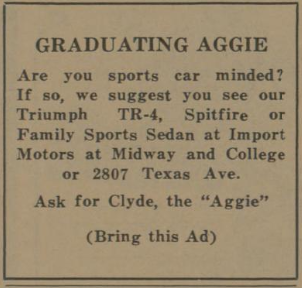
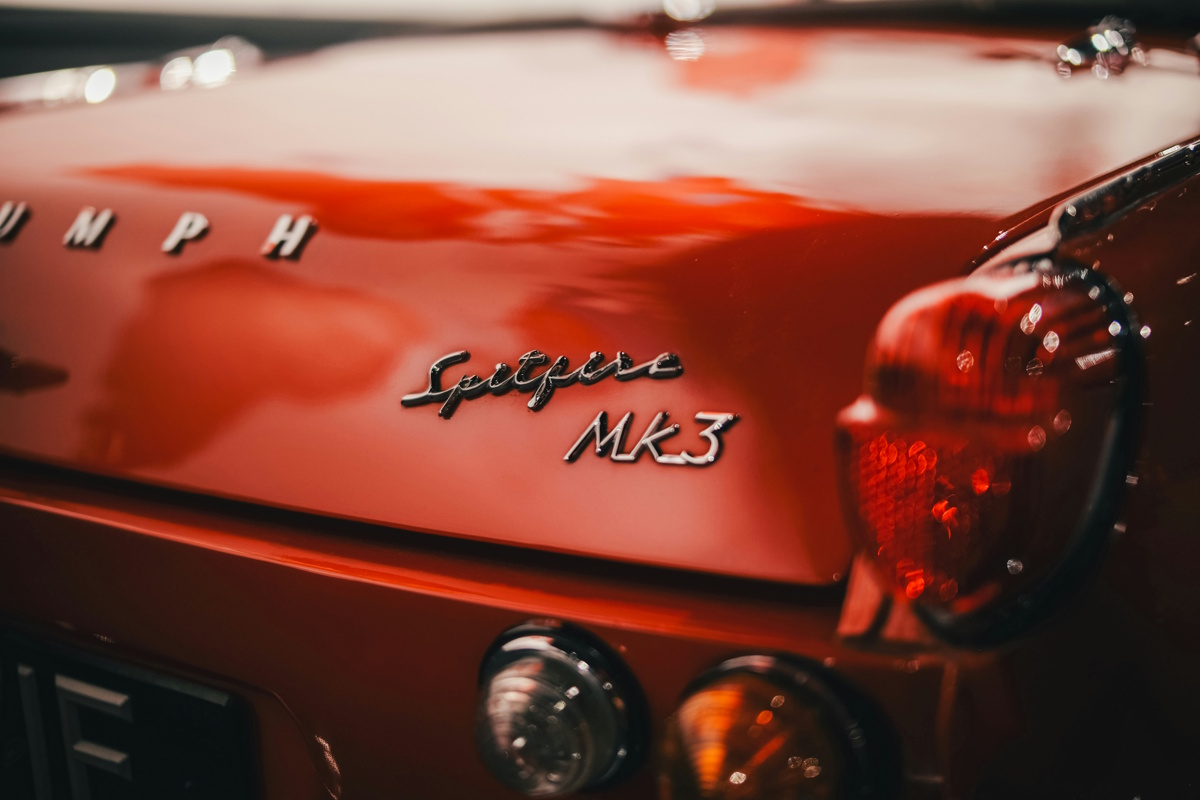
For a graduating Aggie in early 1964, Import Motors in Bryan had a tempting proposition. Come see a Triumph TR-4, Spitfire, or what the dealership called its “Family Sports Sedan.” Better yet, bring the advertisement and “Ask for Clyde, the ‘Aggie.'” Living in Bryan, Texas, and being married to an Aggie means the little reference to a dealership in Bryan jumped out. I started looking for more ads and ended up losing most of an afternoon scrolling through archives of student publications from the 1960s.
It is an almost impossibly charming piece of automotive advertising today. No lifestyle photography. No focus-grouped slogan. No QR code. Just a few lines of type, a couple of British sports cars and a local guy named Clyde. But the little ad tells a much bigger story.
In 1960, Bryan had just 27,542 residents, while neighboring College Station had 11,396. Even including the surrounding area, the Bryan-College Station metropolitan population was only 44,895. This was not Houston or Dallas. Yet during the first half of the 1960s, Bryan supported multiple businesses dedicated to imported automobiles, including at least two selling or servicing European and British cars at the same time. The sports-car craze had come to Texas Avenue.
Sports Cars on Texas Avenue
Before Import Motors began pitching TR-4s and Spitfires to graduating Aggies, another Bryan business was already catering to the foreign-car crowd. Advertisements for Sports Car Center appear in The Battalion as early as March 1961. The business identified itself as a dealer for Renault, Peugeot and “British Motor Cars,” offering sales, parts and service at 1416 Texas Avenue. Its most important promise may have been the simplest: “We Service All Foreign Cars.”
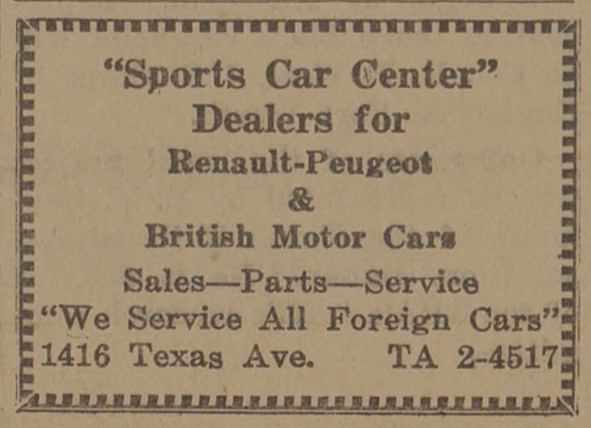
That service department mattered. Buying an imported automobile in 1961 was one thing. Finding someone in a relatively small Texas town who could keep it running was another. Sports Car Center remained at 1416 Texas Avenue into late 1962. By March 1963, its advertisements listed 1422 Texas Avenue, only a few doors away, and the business continued advertising there through at least March 1965. The surviving advertisements do not make clear whether that represented a physical move or simply a change in address numbering.
Then came Import Motors. By January 1964, the dealer was specifically targeting Texas A&M students with Triumphs. A few months later, its advertisements identified the dealership as an authorized Triumph dealer at 2807 Texas Avenue, promising “100% Financing To Graduating Seniors,” along with new and used sports and economy cars and a complete service department. By late 1964, Volvo had joined Triumph on the sign.
That financing offer is interesting because sports cars in the 1960s were not exotic toys reserved for wealthy enthusiasts. It was pitching one as a young man’s first new car. Graduate from A&M. Get a job. Buy a Triumph. And Import Motors did not replace Sports Car Center. The two businesses overlapped. A December 9, 1964 issue of The Battalion contains advertisements for both dealers on the same page. Import Motors offered Triumphs and Volvos at 2807 Texas Avenue, while Sports Car Center continued promoting Renault, Peugeot, and British cars at 1422 Texas Avenue.
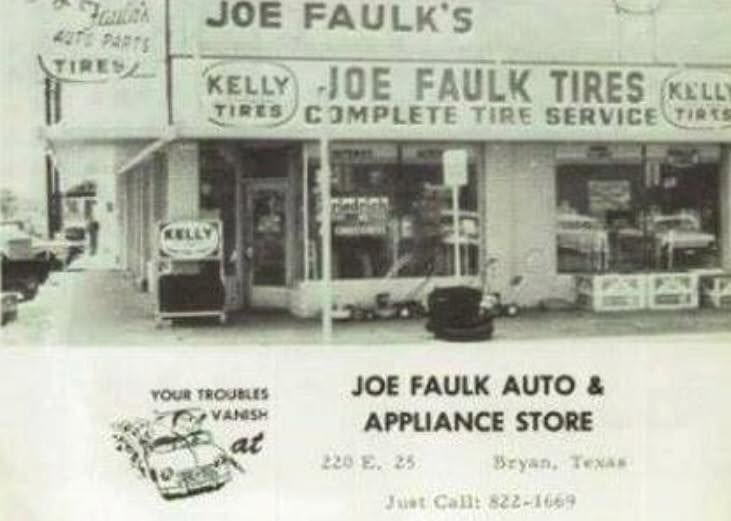
On that very same page, Joe Faulk Auto Parts advertised bearings, seals, filters, and ignition components for Jaguar, MG, Renault, Triumph, and Volkswagen. By February 1965, Stubblefield’s Imported Cars at 3219 Texas Avenue was advertising itself as an authorized Chrysler-Simca dealer with general foreign-car repair service.
For a community of fewer than 40,000 people, it is remarkable that it had so many foreign-car dealers and service providers. Unlike the East and West Coasts, where imports landed in big cities, the middle of the country was dominated by domestic cars. But Bryan had developed a miniature imported-car ecosystem: competing dealers, specialized service departments, parts suppliers, and enough owners to support them. A few hints remain: there is a TR4 in town, a Spitfire sitting under a tarp, and my Austin Healey, but the sports craze isn’t completely dead. My event: Wheels | Watches | Whiskey® draws the local sports car owners out, but today the field is Aston Martin, McLaren, Porsche, and even a BAC Mono, but the daily driver sports cars, are a thing of the past.
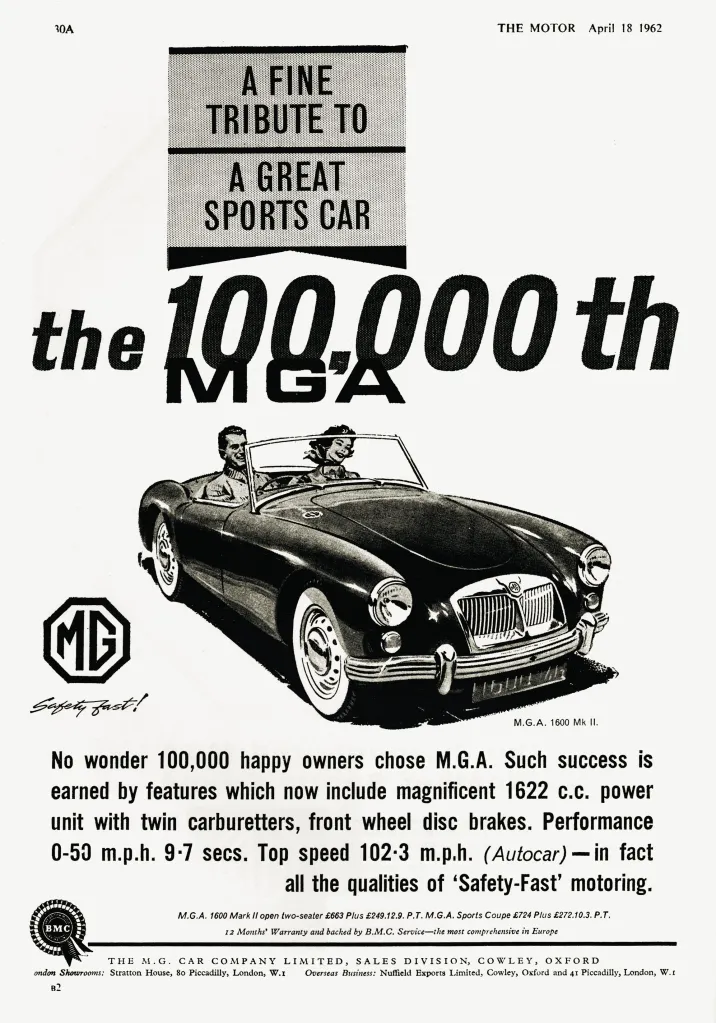
America Discovers the Little British Sports Car
Bryan was unusual only in its size. What was happening there reflected something happening across America. The American fascination with European sports cars had accelerated rapidly after World War II. By the early 1950s, sports-car clubs and amateur road racing were expanding dramatically. The Sports Car Club of America had only 588 members in January 1950. A year later, membership had more than doubled to 1,243.
MGs, Jaguars, Triumphs and Austin-Healeys offered something Detroit generally did not. They were small, lightweight, relatively inexpensive, and unapologetically impractical. They asked the driver to participate. They also got better gas mileage and often a lower price point. Detroit noticed. By the beginning of the 1960s, Chevrolet had the Corvette, Ford was experimenting with performance on several fronts, and domestic compact cars were pressuring ordinary European imports. But sports cars survived because they sold something harder to duplicate.
In 1961, Time reported that the successful imports were increasingly those positioned either below Detroit on price or specifically aimed at luxury and sports-car buyers. British Motor Corporation told the magazine that an extraordinary 75 percent of its American sales were sports cars.
By 1964, the numbers were substantial. U.S. International Trade Commission figures show American dealers sold 24,282 MGs, 20,840 Triumphs and 8,339 Austin-Healeys that year. Combined, those three British marques moved more than 53,000 cars in the United States in a single year. Jaguar added another 3,956 automobiles. Suddenly the little advertisements in The Battalion make perfect sense.
A Triumph dealership in Bryan was not some eccentric side business. It was a local outpost of a national obsession. A young engineer leaving Texas A&M could reasonably aspire to a TR-4 or Spitfire in much the same way another graduate might buy a Chevrolet Impala. The British car was still unusual enough to make a statement, but common enough that Joe Faulk could stock parts for one.
Sports-car ownership was becoming a culture rather than merely a curiosity.
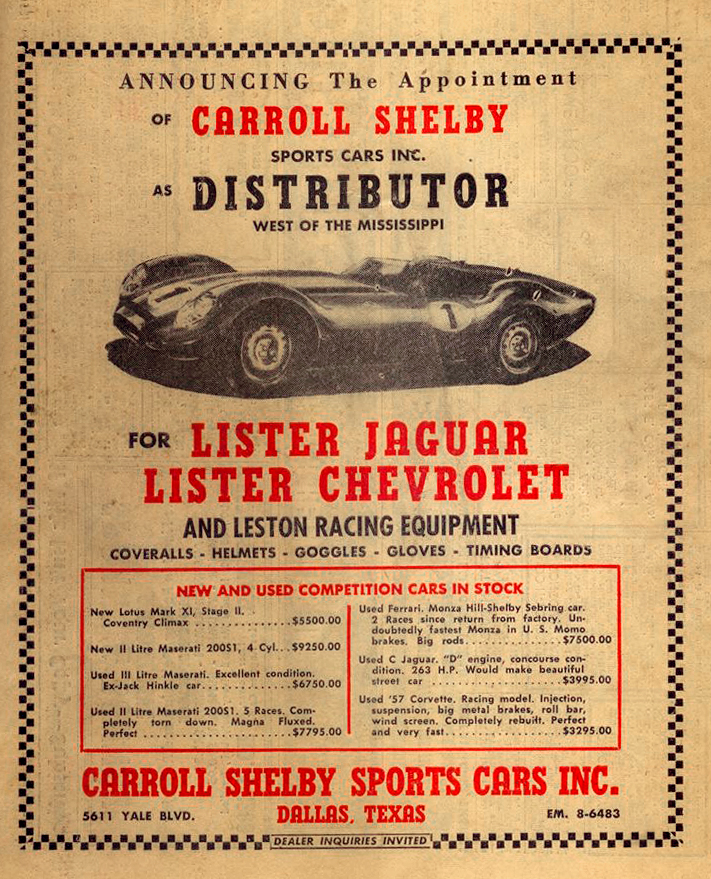
Carroll Shelby Sports Car Inc. advertisement showcases a good example of how independent dealers helped grow sports car sales in the US.
Before Shelby American, There Was a Sports Car Dealership in Dallas
Nowhere is the relationship between the Texas sports-car dealer and America’s growing performance culture more obvious than in Dallas. Before Carroll Shelby became synonymous with Cobras, GT350s and Ford’s assault on Le Mans, he was an automobile dealer.
In early 1957, Shelby partnered with West Texas oilman and racing enthusiast Dick Hall to establish Carroll Shelby Sports Cars of Dallas. Shelby’s dealership was at 5611 Yale in Dallas, which today has been replaced by an apartment complex. The dealership carried MG, Austin-Healey, Jaguar, Maserati, Rolls-Royce and Bentley. Hall’s younger brother Jim joined the operation, gaining experience around Shelby and the burgeoning Texas sports-car scene before creating the revolutionary Chaparral racing cars in Midland.
A Texan could walk through the door and encounter an MG and an Austin-Healey alongside a Jaguar or Maserati. Racing drivers, wealthy enthusiasts, mechanics, businessmen, and young men with ambitions congregated around the same emerging culture. The showroom and the racetrack were not separate worlds. They fed each other. Shelby’s later breakthrough followed the same philosophy that made imported sports cars attractive in the first place: light weight, simplicity and performance. He simply added something Americans understood rather well: a big V8.
By 1963, Shelby American Cobras were competing in the SCCA’s newly created U.S. Road Racing Championship. Shelby’s Cobras won the series’ GT Manufacturers’ title in both 1963 and 1964. The Cobra soon entered the same Texas retail network that had been selling European sports cars.
Records show the first Texas Cobra CSX 2065 was sold to Smith Motor Imports in San Antonio on March 8, 1963. Smith Motor Imports, located at 1820 Broadway, also appears in period Jaguar dealer information as part of the Texas territory supplied by Overseas Motor Corporation in Fort Worth.
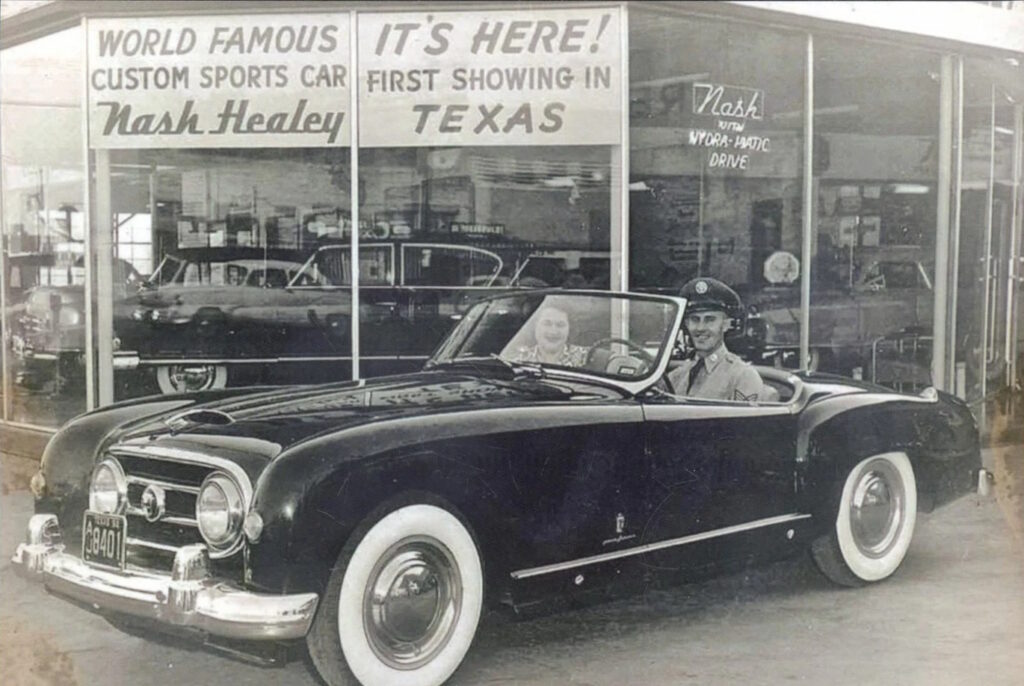
Texas Was Full of Little Sports Car Dealers
Dallas may have produced the most famous name, but the same story unfolded across Texas. In Lubbock, Dave Fawcett Import Motors was already calling itself “West Texas’ Oldest Import Car Dealer.” A 1960 advertisement offered the Austin-Healey 3000 for $3,095, the little Sprite for as little as $1,995 and an MGA for $2,595. The dealership also represented Rolls-Royce, Bentley, Jaguar, Morris-Minor, Fiat and Alfa Romeo. By 1961, the Lubbock shop was promoting the upcoming Triumph TR-4 alongside Jaguar, MG, Austin-Healey and Alfa Romeo, while offering service to drivers of imported cars.
In 1965, Ira Young advertised an almost comically broad collection of franchises. A customer could apparently shop Imperial, Chrysler, Dodge, Plymouth and Rambler, then wander over and consider an MG, Austin-Healey, Jaguar, Renault or Simca. The advertisement specifically promoted “BMC Sports Cars.” That combination may look bizarre today, but it captures the 1960s perfectly. Imported cars had not yet been sorted into the tightly controlled, multimillion-dollar franchise facilities of the modern automobile business. A local dealer could sell Detroit iron on one side of the lot and a 948cc British roadster on the other.
Fort Worth’s Overseas Motors Corporation became important enough to serve as a regional distributor for marques including Jaguar. The company’s involvement went beyond selling cars. In 1963, Overseas Motors had created a division producing add-on air-conditioning systems primarily for Jaguar, Rolls-Royce and Volkswagen automobiles. That operation eventually became Delanair Engineering.
Overseas Motors also became involved in SCCA racing, with its Mini Coopers appearing at Texas circuits such as Green Valley later in the decade. The relationship between dealership, service shop, and race team was common in an era when the people selling sports cars were often the same people racing them on Sunday. In the port city of Houston, by 1965, Yokom Datsun was promoting the Datsun 1600 roadster as a direct competitor to British offerings.