
 Michael Satterfield
Some cars make considerably more sense when you encounter them in the right place. During Motor Valley Fest in Modena, Italy, the streets surrounding the city’s historic center were filled with the sort of machinery that makes this corner of Emilia-Romagna unlike almost anywhere else on earth. Ferrari, Lamborghini, Pagani and Maserati are not simply exotic badges here. They are part of the local landscape.
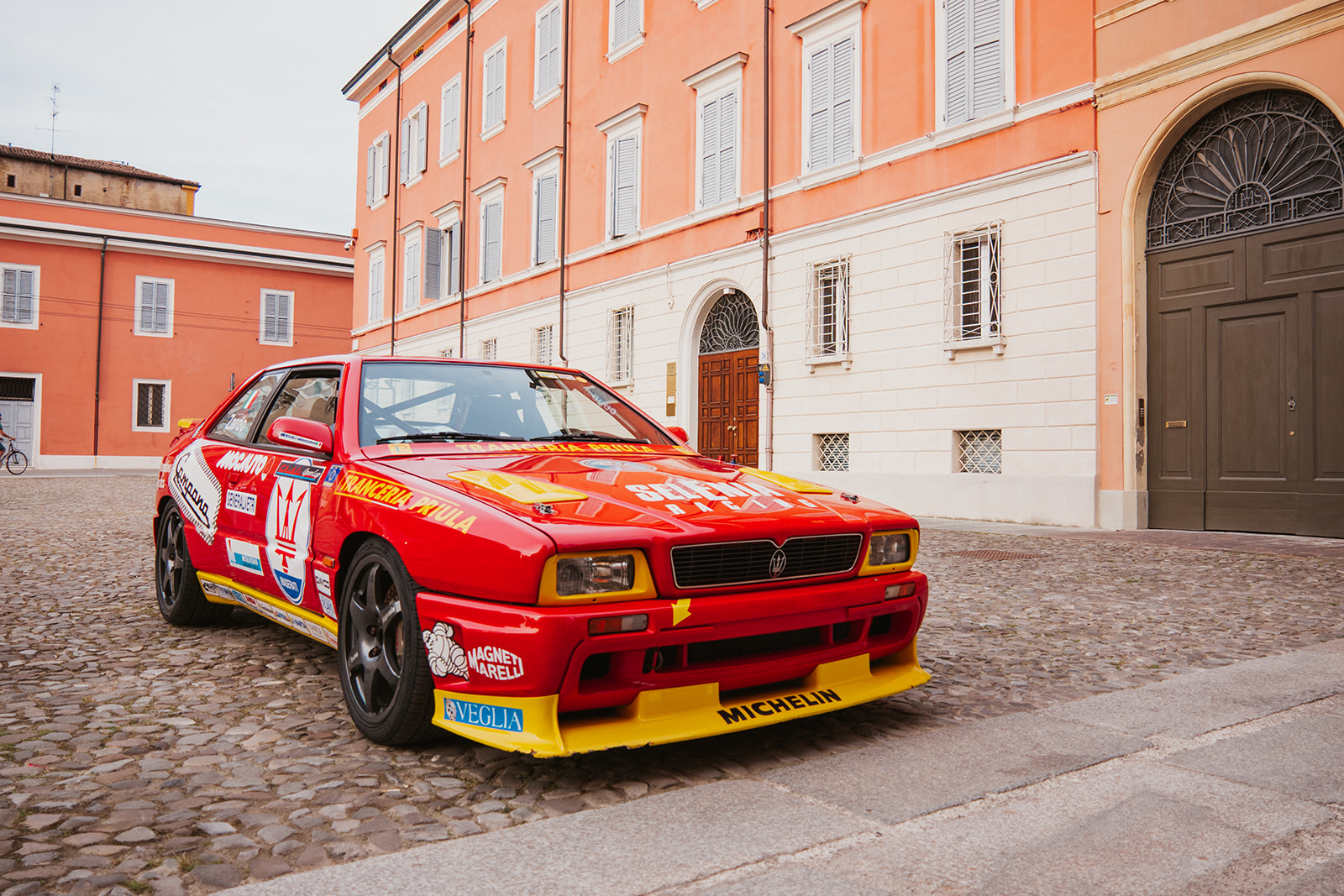
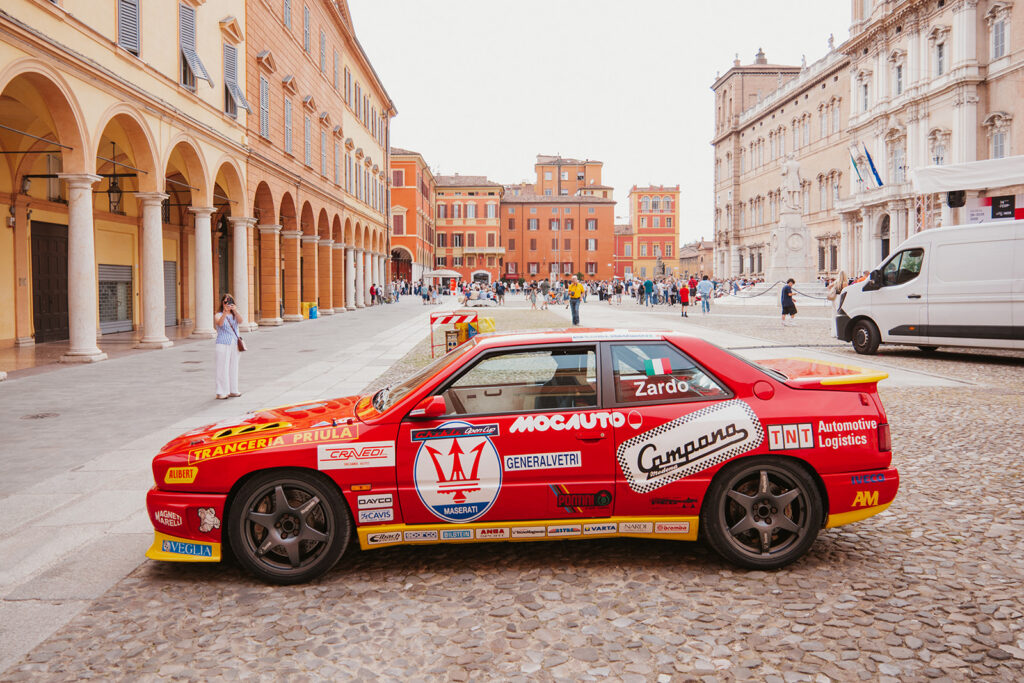
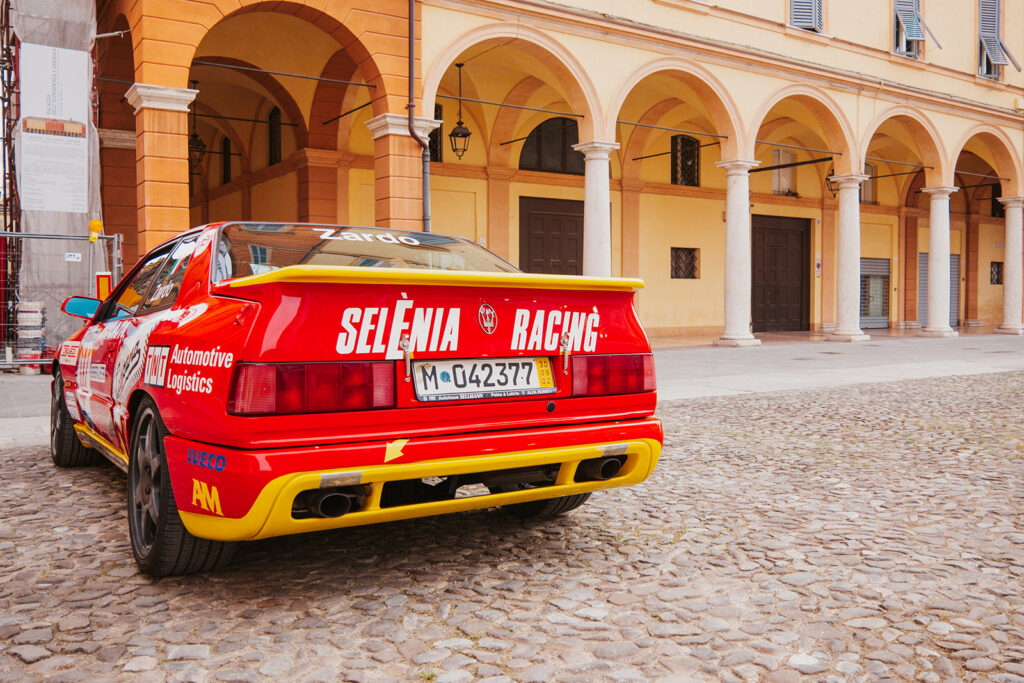
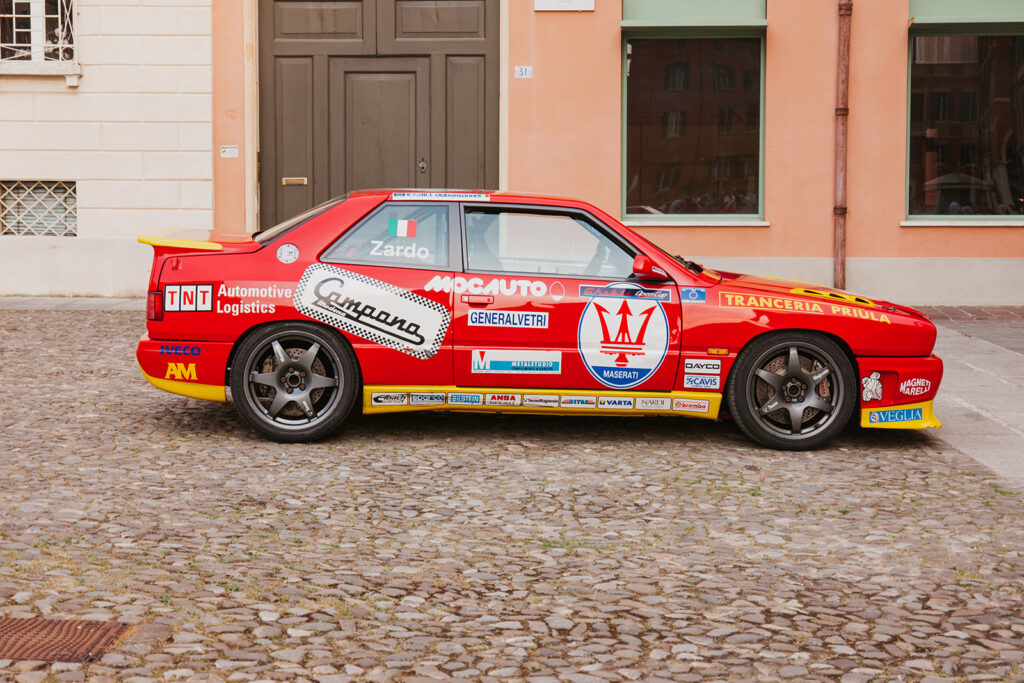
Off in a corner of the plaza, parked on Modena’s cobblestones was a bright red Maserati that initially looked like a particularly ambitious 1990s tuner car. It was anything but. Covered from splitter to spoiler in period sponsor graphics, wearing a full roll cage and displaying the name “Zardo” on its rear side glass, the car was a Maserati Ghibli Open Cup, one of fewer than 30 competition cars constructed for Maserati’s short-lived but fascinating one-make racing championship.
It represents a period when Maserati was attempting to rediscover its competition identity and, in the process, created one of the wildest versions of the Biturbo platform ever built. As someone who owned a late 80s BiTurbo, this was really cool to stumble upon in person.
Maserati Returns to Racing
By the early 1990s, Maserati’s glory days in international motorsport seemed increasingly distant. This was, after all, the company that had won Grands Prix, produced the legendary 250F and helped Juan Manuel Fangio claim the 1957 Formula One World Championship. But by the Biturbo era, Maserati had largely stepped away from serious factory-backed competition.
The second-generation Maserati Ghibli provided an opportunity to change that. Introduced in 1992, the Tipo AM336 Ghibli was an extensively developed descendant of the Biturbo family. Italian-market cars received a compact 2.0-liter twin-turbocharged V6, while export versions generally used a larger 2.8-liter engine.
The little two-liter was already remarkably powerful. Maserati eventually extracted more than 300 horsepower from an engine displacing less than many modern family-car four-cylinders. In late 1994, plans were developed for something more ambitious: a European one-make championship based around the Ghibli. The result was the Ghibli Open Cup.
Organized with involvement from Adolfo Orsi and with race preparation handled through Alfa Corse, the championship was intended to put Maserati back in front of European racing fans while giving private drivers a relatively accessible path into serious GT-style competition. The Open Cup debuted in 1995.
Enjoying this story?
Join The Gentleman Racer email list to continue reading.
Occasional updates. Unsubscribe anytime.
Building the Ghibli Open Cup
The race car began with the Italian-market 1,996cc twin-turbo V6, but Maserati turned the already potent road car into a proper competition machine. Power was approximately 320 horsepower in the original 1995 specification, delivered through a six-speed Getrag manual transmission to the rear wheels. Roller-bearing turbochargers, revised engine management and a freer-flowing exhaust helped generate the extra power.
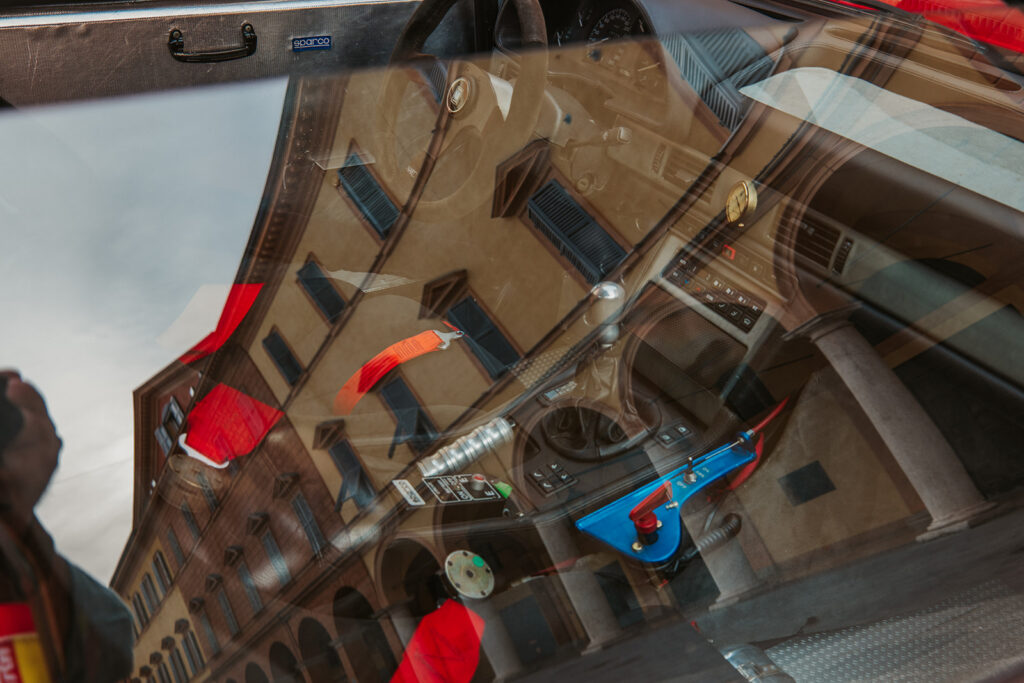
Inside, much of the Ghibli’s gentlemanly road-car character disappeared. A roll cage, Sparco racing seat, multi-point harness, competition steering wheel, fire-suppression equipment and other safety hardware took its place. Yet traces of the road car remained, giving the Open Cup an unusual character. This was not a purpose-built prototype dressed to resemble a Maserati. It was recognizably a Ghibli that had been sent to finishing school at a racetrack.
The suspension was heavily revised with Bilstein dampers and Eibach springs, while large ventilated brakes attempted to contain the roughly 2,800-pound coupe. Around 26 competition cars were constructed (some sources say 25 others say 27), making genuine examples extremely rare today.
A Championship Filled With Serious Drivers
The Open Cup may have been conceived partly for wealthy amateur racers, but the entry lists quickly became more interesting. Drivers associated with the series included former Formula One competitor Arturo Merzario, rally legend Miki Biasion, former Grand Prix driver Patrick Tambay, IndyCar star Paul Radisich, television racer Tiff Needell and others.
At the center of the story, however, was a young Italian named Denny Zardo. Just 19 years old during the championship, Zardo emerged as the inaugural Ghibli Open Cup champion in 1995, beating considerably more experienced competitors including Merzario. Remarkably, period reporting indicates Zardo secured the championship without winning a race, relying instead on consistency across the season.
The 1996 Maserati Ghibli Open Cup Evoluzione
Maserati wasn’t finished with the car after the first season. For 1996, engineers created an updated Ghibli Open Cup generally referred to as the Evoluzione or Evolution specification. The changes included revised aerodynamics, different gear ratios, suspension development and improved Michelin racing tires. Contemporary reports put output at approximately 330 horsepower.
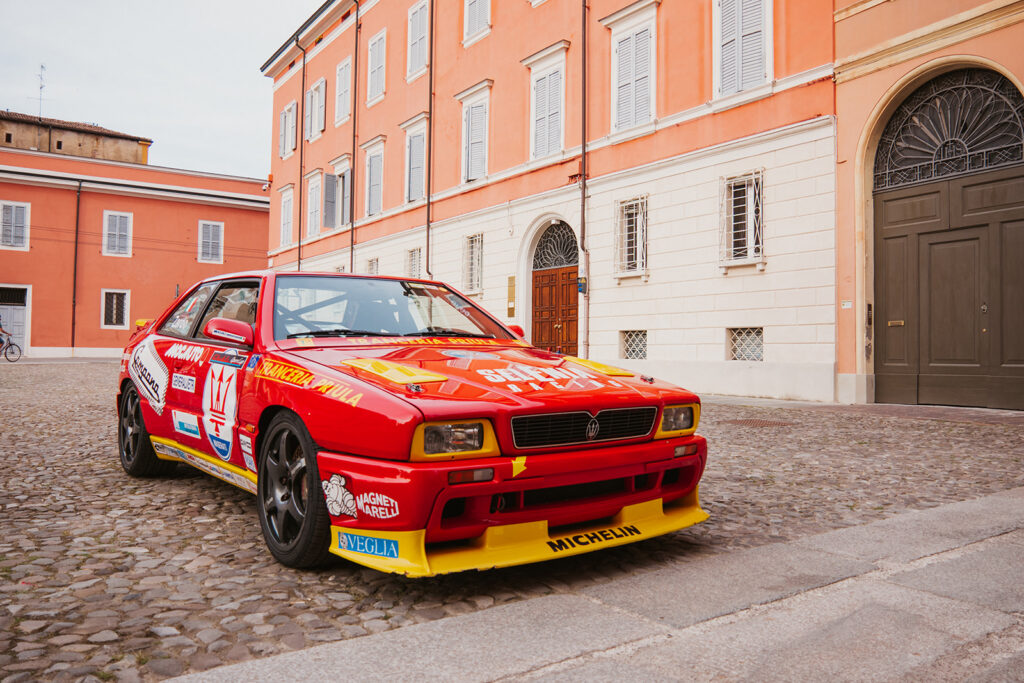
The larger front splitter, more aggressive bodywork and 18-inch wheels seen on the car photographed in Modena are characteristic of this later configuration. Period testing showed just how capable the revised Maserati had become. During development, the Evolution Ghibli reportedly circulated Misano only two-tenths of a second slower than the existing Ferrari F355 benchmark lap recorded by the same driver.

That put a boxy twin-turbo Maserati descended from the Biturbo in essentially the same neighborhood as one of Ferrari’s defining mid-engine sports cars. Not bad for a car whose dashboard architecture could still remind you of an executive coupe from the 1980s.
Unfortunately, the racing program was running out of time. Although a full 1996 championship had been planned, the series ended after only a handful of appearances. Maserati itself was entering another period of corporate change, ultimately coming under Ferrari’s direction. The Maserati Ghibli Open Cup quietly disappeared.
From Race Car to Road Car
The racing program did leave one important legacy. Maserati developed a street-legal version of Ghibli Cup using technology derived directly from the Open Cup racer. Introduced at the Bologna Motor Show in December 1995, the road-going Cup produced 330 horsepower from just 1,996cc. At the time, Maserati promoted it as the world’s most powerful production two-liter automobile.
The figures remain impressive three decades later. Maserati says the production Ghibli Cup could reach approximately 270 km/h, or about 168 mph, while producing more than 350 Nm of torque across a remarkably broad section of the rev range. Only 60 two-liter Maserati Ghibli Cup road cars were officially produced, making the street version rare in its own right.
The surviving Ghibli Open Cups have occasionally surfaced publicly. At its 2016 Pebble Beach auction, Gooding & Company sold chassis 361220, the 11th Ghibli Open Cup constructed. That car had competed in all nine races of the 1995 season with Federico D’Amore, winning the professional class and finishing second overall in the championship. It was subsequently upgraded with Maserati’s Evolution kit. Gooding estimated the car at $60,000 to $80,000, but it ultimately sold for just $27,500.
Looking back from today’s collector-car market, that price feels almost absurd. The car combined extraordinary rarity, documented factory competition history, period European racing provenance and one of the most outrageous Maserati liveries of the 1990s. Sometimes the collector market takes a while to wake up.
A Maserati From a Forgotten Era
The Ghibli Open Cup occupies a strange and wonderful place in Maserati history. It isn’t associated with Fangio, Le Mans or the great Italian sports racers of the 1950s. Nor does it belong to the Ferrari-controlled Maserati revival that produced the 3200 GT, Coupe, GranSport and MC12. Instead, it comes from the uncertain middle.
Maserati was trying to find its way forward while still carrying the architecture and attitude of the Biturbo years. The company took an aging platform, added enormous turbo boost, racing suspension, proper brakes, a six-speed gearbox and enough sponsor decals to wallpaper a small apartment and went racing.
Today, that makes the Ghibli Open Cup one of the most interesting Maseratis of its era. Finding one sitting casually on the cobblestones of Modena during Motor Valley Fest was exactly the sort of discovery that makes exploring Italy’s Motor Valley worthwhile. In another city, the car would have been the centerpiece of a museum display. In Modena, it was simply parked outside.
Quick Facts: Maserati Ghibli Open Cup
- Model: Maserati Ghibli Open Cup
- Model Code: Tipo AM336
- Introduced: 1995
- Engine: 1,996cc twin-turbocharged V6
- Valvetrain: DOHC, 24-valve
- Power: Approximately 320 hp in 1995 specification
- Evolution Power: Approximately 330 hp
- Transmission: Six-speed Getrag manual
- Drivetrain: Rear-wheel drive
- Race Weight: Approximately 1,270 to 1,295 kg depending on specification and source
- Suspension: Competition Bilstein dampers and Eibach springs
- Brakes: Ventilated competition discs with Brembo calipers
- Original Race Cars Built: Fewer than 30, generally reported as approximately 25 to 27
- Championship: Selenia Ghibli Open Cup
- Inaugural Champion: Denny Zardo
- 1996 Version: Ghibli Open Cup Evoluzione
- Road-Car Offshoot: Maserati Ghibli Cup
- Road Ghibli Cup Production: 60 two-liter examples according to Maserati
Frequently Asked Questions
What is a Maserati Ghibli Open Cup?
The Ghibli Open Cup is a factory-developed competition version of the second-generation Maserati Ghibli built for a European one-make racing championship beginning in 1995. It featured a twin-turbocharged two-liter V6, six-speed Getrag transmission, racing suspension, roll cage and extensive competition equipment.
How many Maserati Ghibli Open Cup race cars were built?
Historical sources vary slightly, but fewer than 30 competition cars were produced. Sources commonly cite between approximately 25 and 27 examples.
What engine does the Ghibli Open Cup use?
The Open Cup uses Maserati’s 1,996cc twin-turbocharged V6. Original 1995 competition cars produced approximately 320 horsepower, while the updated 1996 Evolution specification produced around 330 horsepower.
Who won the 1995 Maserati Ghibli Open Cup championship?
Italian driver Denny Zardo won the inaugural 1995 championship. Period reports indicate the 19-year-old secured the title through consistent finishes despite not winning an individual race.
What was the Maserati Ghibli Open Cup Evoluzione?
The Evoluzione was an updated version developed for the 1996 season. Changes included revised aerodynamics, altered gear ratios, suspension improvements, updated tires and approximately 330 horsepower.
Is the Maserati photographed in Modena Denny Zardo’s actual race car?
The car photographed during Motor Valley Fest wears Denny Zardo’s championship livery and appears to be a genuine Ghibli Open Cup upgraded to later specification. However, its exact period racing history cannot be confirmed without verifying the chassis number against historical competition records.
Was there a road-legal Maserati Ghibli Cup?
Yes. Maserati created the road-going Ghibli Cup directly from the Open Cup racing program. The production version developed 330 horsepower from its two-liter twin-turbo V6, and Maserati produced only 60 examples with that engine.
How fast was the Maserati Ghibli Cup?
Maserati lists a top speed of approximately 270 km/h, or 168 mph, for the road-going Ghibli Cup. The racing Open Cup was capable of similar or greater speeds depending on gearing and circuit configuration.
Why is the Maserati Ghibli Open Cup important?
The Open Cup marked a rare return to factory-supported competition for Maserati during the 1990s. It also helped develop technology used in the road-going Ghibli Cup and represents an important bridge between the Biturbo era and Maserati’s later revival under Ferrari influence.


Never knew a boxy biturbo could look this cool
Such a cool random find you would only see in a city like Modena
The colors on this are amazing
So great to find a site that takes the time to write about these random bits of car history
I was at Motor Valley Fest as well and only saw it driving away, glad someone got photos of it.
Giving me ideas for that old Biturbo parked behind the barn.
The Open Cup is a cool ride
Now I have to start looking for old beater Maserati BiTurbos on Facebook marketplace.
These were weird times for Maserati in the 80s and 90s it feels like they are just getting back to being a serious car company
Never even heard of these, didn’t know Maserati did any racing from like 1975-2005
Great find
Maserati High-Performance history I never heard of
You should do classic car reviews with cars like this.
So,I like it