
 Michael Satterfield
A narrow strip of asphalt climbs through the Sicilian mountains, lined by stone walls, village buildings, trees, spectators, and countless opportunities for a small mistake to become a very large one. Charging through it all is a silver-blue Shelby Cobra, its red stripe and the number 146 flashing between the shadows.
Dan Gurney is at the wheel. A 289-cubic-inch Ford V8 is working hard beneath the hood, and there are still hundreds of miles remaining. The image (which we will link to because we can’t share it due to copyright) has become one of the defining photographs of the Shelby Cobra’s European racing campaign. It captures everything that made the Targa Florio fascinating and terrifying. The road is narrow, the scenery is beautiful, and the car appears to be moving far too quickly for either.
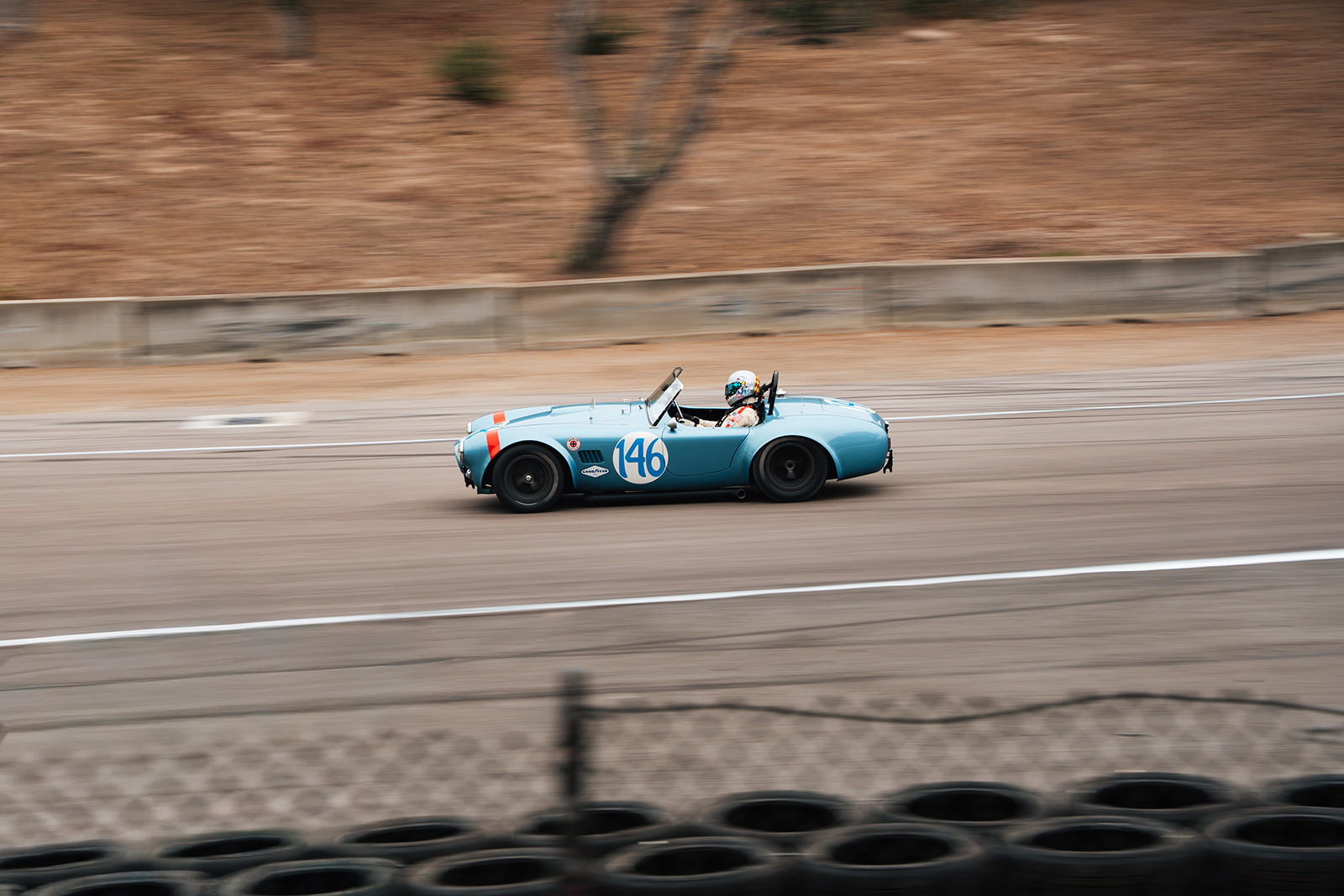
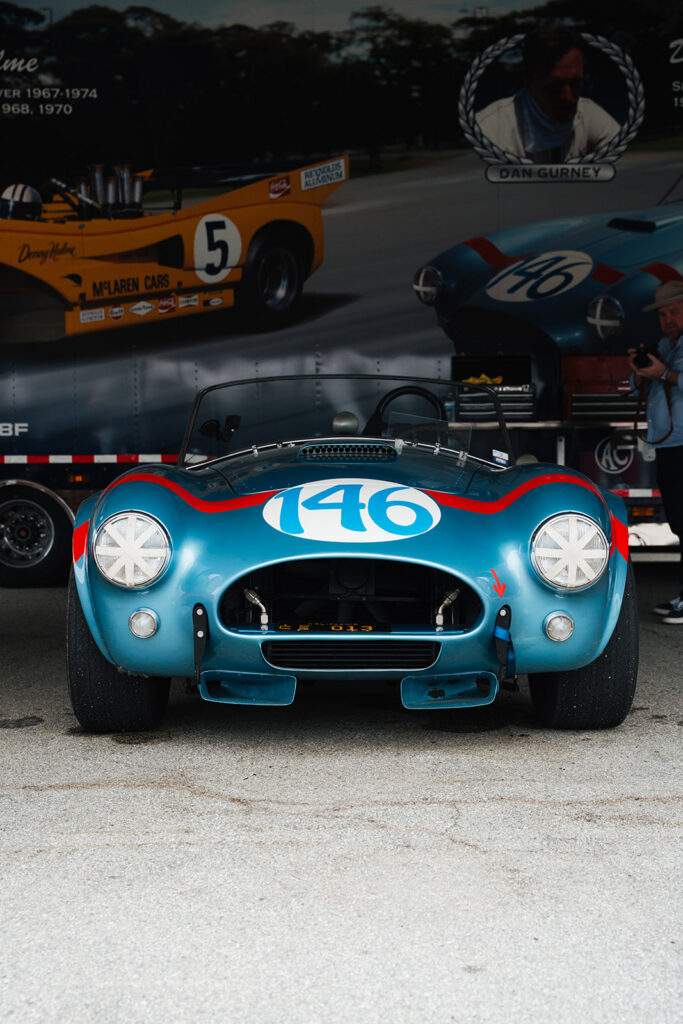
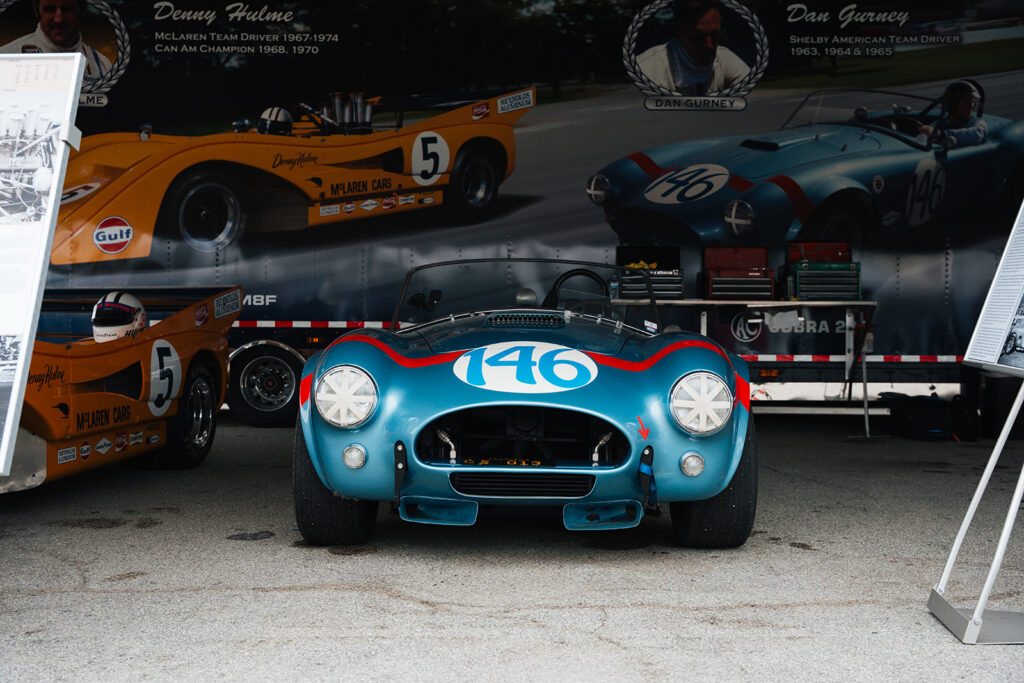
More than six decades later, that same Cobra was back on a racetrack at the 2026 Rolex Monterey Motorsports Reunion. Chassis CSX2323 returned to competition at WeatherTech Raceway Laguna Seca against a field of Cobras, Corvettes, Jaguaurs and Healeys. Wearing its familiar number 146, the car was driven by Alex MacAllister in the Group 3 races for SCCA large-displacement production cars from 1955 through 1967. This was not a replica, continuation car, or modern Cobra dressed in vintage colors. It was the FIA roadster Gurney and Jerry Grant drove across Sicily in 1964.
Shelby Takes the Fight to Europe
By 1964, Carroll Shelby had already demonstrated the effectiveness of a simple idea: place a lightweight British sports car around a small-block American V8 and go hunting for trophies.
The earliest Cobras had been devastating in American competition. Their combination of low weight, strong Ford power, four-wheel disc brakes, and independent suspension gave Shelby American a formidable weapon. Racing in Europe, however, presented a different challenge.
Shelby wanted to defeat Ferrari in the FIA World Championship for Makes. The principal opponent was the Ferrari 250 GTO, a car developed for fast European circuits and long-distance road races. Although the open Cobra had tremendous acceleration, its aerodynamics made it less effective on long, high-speed tracks.
Peter Brock’s Cobra Daytona Coupe was the ultimate response, but the new coupe was not yet available in sufficient numbers for every championship round. Shelby consequently prepared a group of competition roadsters to support the Daytona program.
Only five FIA-specification Cobra roadsters were constructed: CSX2259, CSX2260, CSX2301, CSX2323, and CSX2345.
These cars were developed beyond the standard competition Cobra. Changes included widened fender flares, six-spoke alloy wheels, a more steeply raked windshield, additional cooling openings, a larger fuel tank, and modified bodywork. The peculiar depressions in the trunk lid were not decorative. They helped the cars satisfy FIA luggage-space regulations by providing room for the required suitcase.
Racing rules have always inspired a particular form of creativity. If a sanctioning body demands room for luggage in a race car, a determined engineer will find a way to accommodate the suitcase without slowing down.
CSX2323 was one of the final FIA roadsters completed, and its first major assignment could hardly have been more demanding.
Enjoying this story?
Join The Gentleman Racer email list to continue reading.
Occasional updates. Unsubscribe anytime.
The 1964 Targa Florio
Held on April 26, 1964, the Targa Florio followed the Piccolo Madonie circuit through the mountains of northern Sicily. The course measured approximately 72 kilometers, or nearly 45 miles, and competitors completed 10 laps. That meant more than 440 miles of racing across a public-road circuit containing hundreds of corners.
The start and finish were located near Cerda. Cars departed individually at 30-second intervals, making the event part road race and part enormous timed special stage. Drivers passed through villages, climbed into the mountains, crossed rough pavement, and raced past spectators who stood alarmingly close to the road.
Local knowledge mattered almost as much as horsepower. Drivers had to remember an extraordinary number of corners, elevation changes, landmarks, and hazards. The lap was so long that learning every inch of the course was practically impossible for a newcomer.
Shelby American arrived with four FIA Cobras. Dan Gurney and Jerry Grant shared CSX2323, carrying race number 146. The other factory cars were assigned to Phil Hill and Bob Bondurant, Masten Gregory and Innes Ireland, and Sicilian drivers Vito Coco and Vincenzo Arena. A privately entered Cobra brought the total number of Shelby roadsters in the race to five.
The Cobra was not an obvious choice for the Targa Florio. Its acceleration and torque were useful when leaving slow corners, but its stiff competition setup had to withstand hundreds of miles of broken, uneven roads. The powerful American roadsters would also face a strong collection of Ferrari 250 GTOs and lighter Porsche 904s.
According to the Klemansaski Collection’s account of the race, Grant was new to the circuit, as was Bob Bondurant. Slow pit work added to Shelby’s difficulties, while the rough roads steadily eliminated cars through mechanical failures and accidents. Gurney nevertheless attacked.
Period accounts credit him with establishing a class lap record in CSX2323. The sight of a 289 Cobra being worked through the Sicilian countryside became one of the lasting images of the event, but speed was only half the job. At the Targa Florio, surviving was a competitive advantage. Of the Shelby team cars, only CSX2323 reached the finish.
After 10 laps, Gurney and Grant were classified eighth overall and first in the GT category over three liters. Some historical records list the result as second among all GT cars, since the fifth-place Ferrari 250 GTO/64 competed in a different displacement category. The clearest description is that the Cobra won its class and finished eighth overall.
Porsche won the race with the 904 GTS driven by Colin Davis and Antonio Pucci. Another Porsche 904 finished second, followed by two Alfa Romeo Giulia TZs and the Ferrari. For a big-engined Anglo-American roadster on a course that punished suspension, brakes, transmissions, and drivers, eighth overall was a remarkable achievement.
What Made CSX2323 Different?
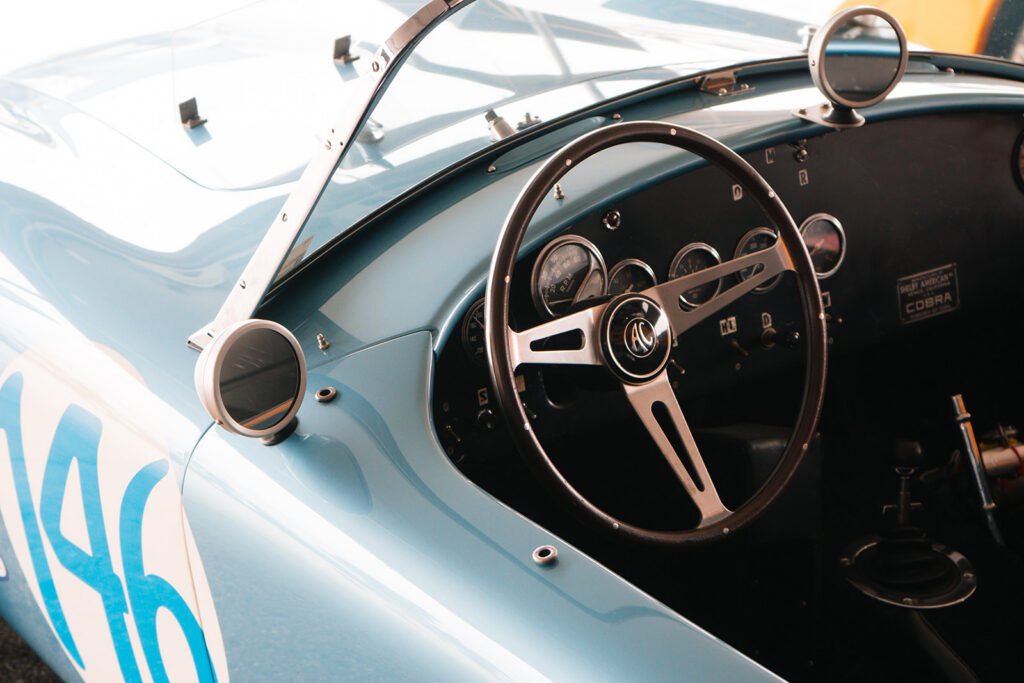
The FIA Cobra retained the basic formula that made Shelby’s creation so effective. Its lightweight aluminum body covered a tubular steel chassis, while a 289-cubic-inch Ford V8 sent power to the rear wheels through a four-speed manual transmission.
Exact period power figures vary by source and race specification. Contemporary descriptions commonly place the Weber-carbureted competition engine near 380 to 400 horsepower. That output was delivered in a car weighing roughly half as much as many modern performance cars.
There was no power steering, traction control, anti-lock braking system, sequential gearbox, or aerodynamic downforce to rescue an ambitious driver. Managing a competition Cobra required physical effort, mechanical sympathy, and a well-developed sense of self-preservation.
The independent suspension used transverse leaf springs at both ends, with four-wheel disc brakes providing stopping power. The Cobra could accelerate violently, but on a course like the Targa Florio, controlling its weight transfer and keeping the rear tires beneath the car mattered more than its top speed.
CSX2323 also carried the larger fuel capacity required for long-distance competition. The wide bodywork accommodated greater tire width, while the revised windshield and cooling openings distinguished the FIA cars from ordinary 289 Cobras.The result was arguably the ultimate racing development of the open, small-block Cobra.
Life After Sicily
The Targa Florio was only the beginning of CSX2323’s period competition career.
Innes Ireland subsequently drove the Cobra at Spa, finishing 15th. Shelby also took the car to the Nürburgring, where it was damaged during practice and withdrawn. Records indicate that it later competed at Daytona and Sebring in 1965 under the Shaw Racing Team.
Its career placed it directly inside Shelby American’s campaign against Ferrari during one of the most consequential periods in American racing history.
The roadster did not ultimately win the championship for Shelby. The limitations of the open Cobra on fast circuits helped prove why the Daytona Coupe was necessary. The aerodynamic coupe gave Shelby the weapon it needed to defeat Ferrari and capture the 1965 FIA GT Manufacturers’ Championship.
But the FIA roadsters fought the earlier battles. They raced at Sebring, the Targa Florio, Spa, the Nürburgring, and other European events while Shelby American developed its international program. CSX2323 was one of the cars that carried the campaign into Ferrari’s backyard.
Number 146 at Laguna Seca
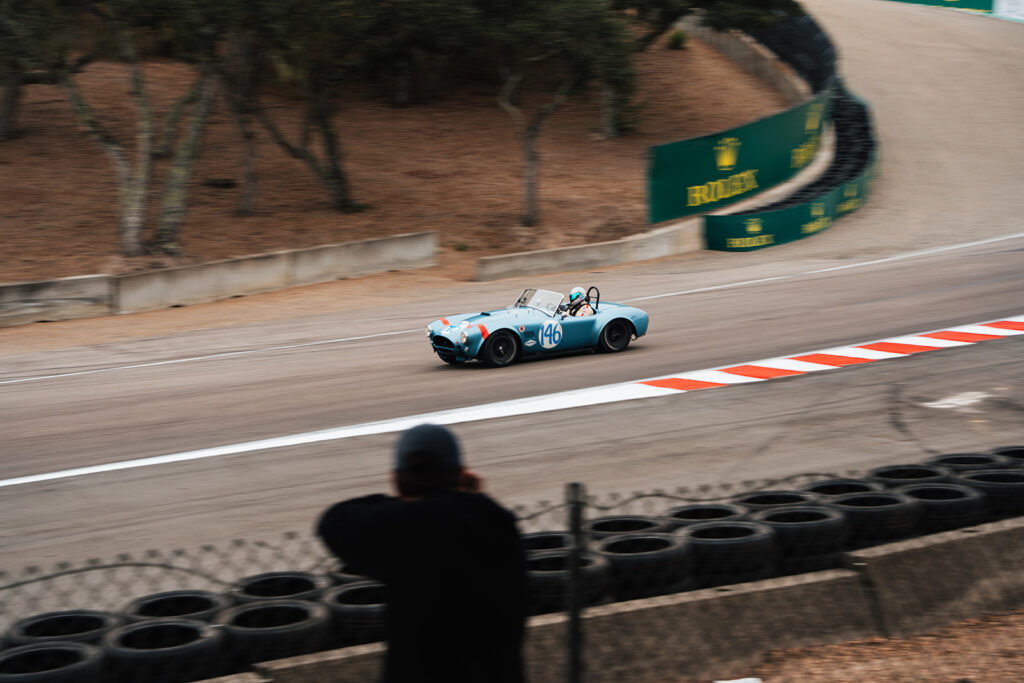
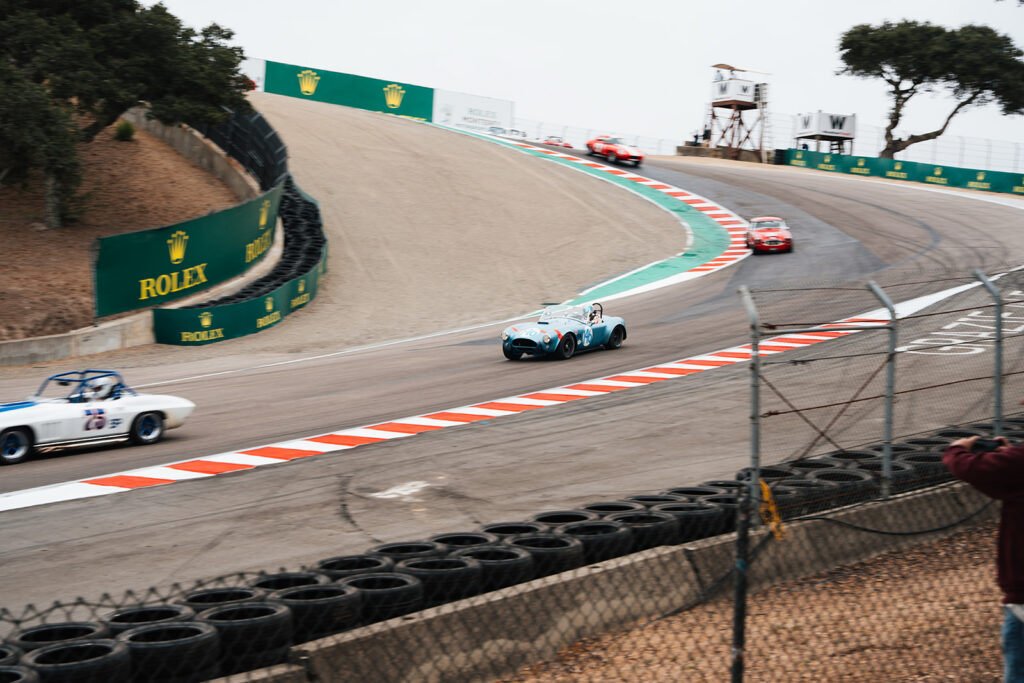
At the 2026 Rolex Monterey Motorsports Reunion, CSX2323 appeared in Group 3 for large-displacement production cars built between 1955 and 1967. The field included other Shelby Cobras, GT350s, Chevrolet Corvettes, Jaguar E-Types, a TVR Griffith, a Sunbeam Tiger, and a Bizzarrini 5300 GT. Driven by Alex MacAllister, number 146 was not treated as a static artifact.
The Cobra completed nine laps in one race session and recorded a best lap of 1:40.812, the fastest individual lap shown in that session’s unofficial results. In the following 10-lap race, MacAllister brought CSX2323 home fourth overall, just 6.250 seconds behind the winning Cobra. Its best lap was a 1:42.151.
The leading cars finished remarkably close together. Billy Johnson won in the number 89 Shelby Cobra, followed by James Farley in another Cobra and Patrick Byrne’s 1963 Corvette. CSX2323 crossed the line less than two seconds behind the Corvette.
For a car built in 1964 and carrying some of the most significant Cobra racing history in existence, fourth place was almost beside the point. The meaningful detail was that the car was still being driven as intended.
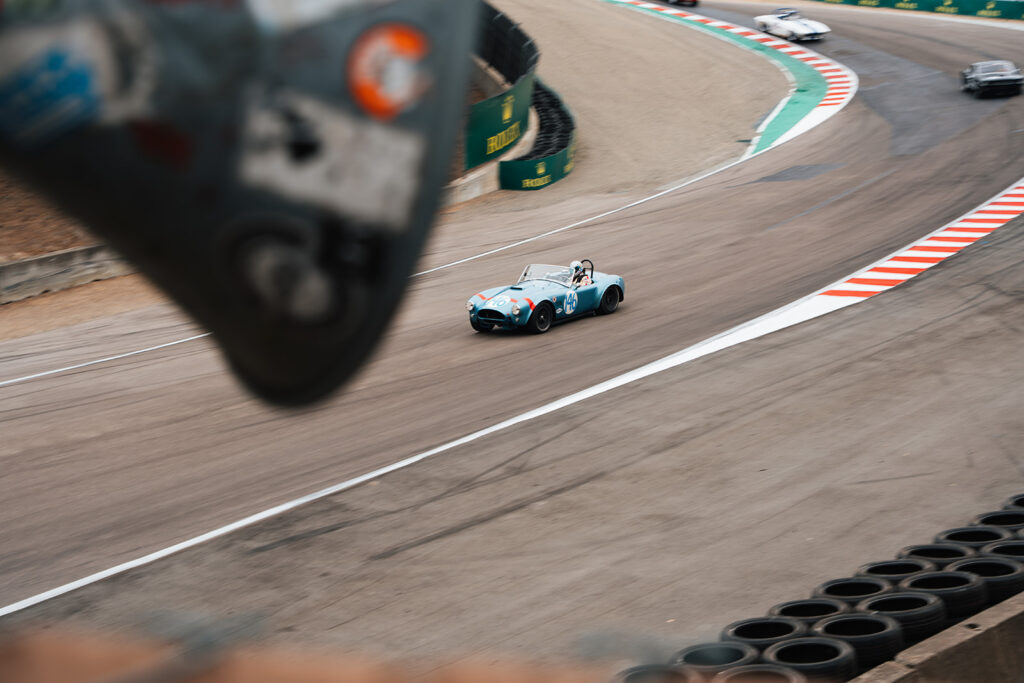
Laguna Seca presented a very different challenge from Sicily. Instead of a 45-mile road course passing through villages and mountains, the Cobra faced the 2.238-mile California circuit’s elevation changes, fast corners, heavy braking zones, and famous Corkscrew.
Yet the essentials remained unchanged. The driver still had to manage a short-wheelbase car with considerable V8 power, limited aerodynamic assistance, and no electronic safety net. The same qualities that made the Cobra exciting in 1964 remained plainly visible in 2026.
There is an understandable argument for preserving historically important racing cars in museums. CSX2323 is irreplaceable, and competition carries risk. A mechanical failure, contact with another car, or an off-track excursion could damage something that survived the Targa Florio, Spa, the Nürburgring, Daytona, and Sebring. But a racing car is not fully understood when it is standing still.
The scars, modifications, control weights, engine sounds, and handling characteristics tell a story that a display placard cannot. When CSX2323 accelerates out of Turn 11 at Laguna Seca, spectators can hear the same basic Ford V8 configuration Gurney and Grant depended on in Sicily. They can watch the body roll, see the driver make corrections, and understand why the Cobra was both effective and intimidating. Historic racing keeps that knowledge alive.
There is also something fitting about seeing CSX2323 return repeatedly to Laguna Seca. The Cobra has appeared at previous Monterey Motorsports Reunions, but every return becomes more significant as the years separating it from 1964 continue to accumulate.
The Rolex Reunion is not simply an exhibition of old cars. At its best, it offers a compressed history of motorsport in motion. Cars that were once scattered across Le Mans, Daytona, Sebring, Sicily, Spa, and the Nürburgring share the same paddock and return to competition before an audience that may never have had the opportunity to see them in period. CSX2323 represents that idea perfectly.
From Sicily to the Corkscrew
Dan Gurney raced almost everything. He won in Formula One, Indy cars, NASCAR stock cars, sports cars, and Trans-Am machinery. He remains one of only three drivers to win races in Formula One, IndyCar, NASCAR, and major sports car competition. His victory with A.J. Foyt at the 1967 24 Hours of Le Mans also gave motorsport the now-universal tradition of spraying champagne on the podium.
The Cobra’s Targa Florio performance is a smaller chapter in that remarkable career, but it captures Gurney’s versatility. He could drive a technically advanced prototype at Le Mans, an open-wheel car at Spa, a stock car at Riverside, or a short-wheelbase Cobra through the Sicilian mountains.
Jerry Grant was equally important to the Targa result. New to one of the world’s most difficult circuits, he helped preserve the car and maintain its pace across a race lasting more than seven hours. The Cobra reached the finish because both drivers balanced speed against the constant risk of mechanical failure or accident.
In 1964, number 146 was surrounded by Sicilian stone walls and spectators. In 2026, it climbed toward Laguna Seca’s Corkscrew beneath California sunshine.
The landscape changed. The car did not.
It remained loud, fast, physical, and slightly unreasonable, which is precisely what a Shelby Cobra should be.
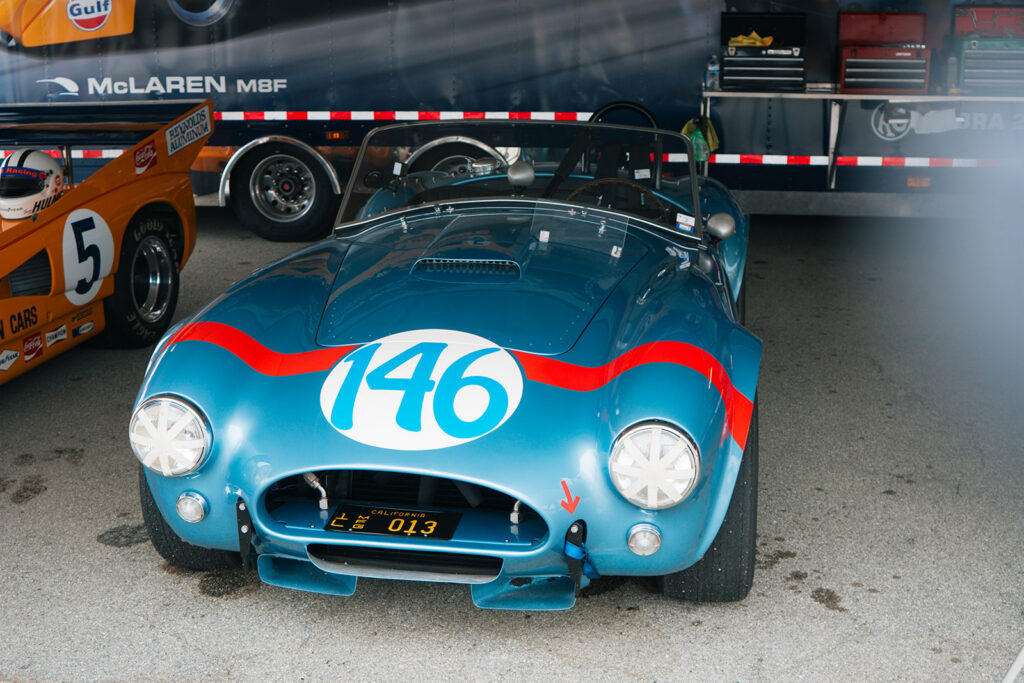
Quick Facts: Shelby Cobra CSX2323
- Year: 1964
- Manufacturer: Shelby American
- Model: Cobra 289 FIA Roadster
- Chassis: CSX2323
- Engine: Ford 289-cubic-inch small-block V8
- Induction: Four Weber carburetors in period competition specification
- Transmission: Four-speed manual
- Body: Aluminum over a tubular steel chassis
- Drive: Rear-wheel drive
- 1964 Targa Florio Number: 146
- Targa Florio Drivers: Dan Gurney and Jerry Grant
- Targa Florio Result: Eighth overall and first in the GT category over three liters
- Other Period Events: Spa, Nürburgring practice, Daytona, and Sebring
- 2026 Rolex Reunion Driver: Alex MacAllister
- 2026 Race Group: 1955-1967 SCCA large-displacement production cars
- 2026 Best Reported Lap: 1:40.812
- 2026 Race Finish: Fourth overall in the final 10-lap Group 3 race
Frequently Asked Questions
Which Shelby Cobra did Dan Gurney race at the Targa Florio?
Dan Gurney and Jerry Grant shared Shelby Cobra chassis CSX2323 at the 1964 Targa Florio. The FIA-specification roadster carried race number 146.
How did Gurney and Grant finish at the 1964 Targa Florio?
They finished eighth overall and won the GT category for cars over three liters. CSX2323 was the only factory Shelby Cobra to complete the race.
How long was the Targa Florio?
The 1964 event used the approximately 72-kilometer Piccolo Madonie circuit. Competitors completed 10 laps for a total race distance of more than 700 kilometers, or roughly 447 miles.
How many FIA Shelby Cobra roadsters were built?
Shelby American constructed five FIA roadsters for the 1964 international racing season: CSX2259, CSX2260, CSX2301, CSX2323, and CSX2345.
Who drove CSX2323 at the 2026 Rolex Monterey Motorsports Reunion?
Alex MacAllister drove the Cobra in Group 3 for 1955 through 1967 SCCA large-displacement production cars.
How did CSX2323 perform at Laguna Seca in 2026?
The Cobra recorded a best lap of 1:40.812 in one race session. In the following 10-lap Group 3 race, it finished fourth overall with a best lap of 1:42.151.
Is CSX2323 an original Cobra?
Yes. CSX2323 is an original Shelby American FIA competition roadster with documented international racing history dating to 1964.
Did CSX2323 race against Ferrari?
Yes. It competed against Ferrari 250 GTOs during Shelby American’s 1964 FIA World Championship campaign. The Cobra’s appearance at the Targa Florio was part of Shelby’s effort to challenge Ferrari in international GT racing.



It is really cool that this car isn’t just sitting in a museum and is still being driven at the track.
Michael,
After reading all about Gurney and Cobra just impacted even more my original reply to another story you told about him and my meeting him personally at the world rally in Oregon in 1984. What a thrill that was!!!!
Jack
Michael, I am such a moron. I met Gurney at the Olympia, Wash. WRC rally in 1986.
I could have not been farther away from reality. Oh well, nobody is perfect. If I can find the photo I will pass it on.
Jack