
 TGR Staff
At 11:35 on the morning of June 22, 2009, a black Mercedes-Benz CLK Cabriolet rolled off the production line at the Karmann factory in Osnabrück, Germany.
It was not simply the last CLK to be assembled there. It was the final complete automobile produced by Wilhelm Karmann GmbH, bringing more than a century of independent coachbuilding and contract automobile manufacturing to an end. Contemporary reporting said Karmann had built approximately 225,000 CLK convertibles for Mercedes-Benz before the line stopped.
The final car appeared almost ordinary as it emerged from the factory. There was no experimental bodywork, no special commemorative shape, and none of the romance associated with the Volkswagen Karmann Ghia. It was a black luxury convertible, built to another company’s specifications.
That was fitting in its own way. Karmann had spent generations working behind the badges of other manufacturers, quietly building some of the most attractive, unusual, and technically demanding cars to come out of Europe.
From Horse-Drawn Carriages to Automobile Bodies
Karmann’s roots can be traced to the Christian Klages carriage factory, founded in Osnabrück in 1874. Wilhelm Karmann acquired the business in 1901, just as the automobile was beginning to transform personal transportation.
Within a year, Karmann was building automobile bodywork, including an early body for the Dürkopp company of Bielefeld. The transition from carriage construction to automobile production was a logical one. Early cars were often mechanical chassis supplied to specialist firms, which then constructed the passenger compartment and body according to the customer’s requirements.
The arrangement created an entire industry of independent coachbuilders. Some specialized in one-off luxury automobiles, while others developed the ability to produce bodies and complete vehicles in larger quantities.
Karmann eventually became one of the most important of them.
Karmann and Volkswagen
Karmann’s defining relationship began in 1949, when Volkswagen commissioned the company to develop and produce a convertible version of the Beetle.
Volkswagen initially ordered 25 pre-production cars. Once those prototypes passed the company’s tests, the order grew to 1,000 vehicles. By 1952, annual production had increased to 10,000 Beetle convertibles.
The partnership provided Karmann with the stability needed to expand from a traditional body shop into a significant automobile manufacturer.
Its best-known creation arrived in 1955.
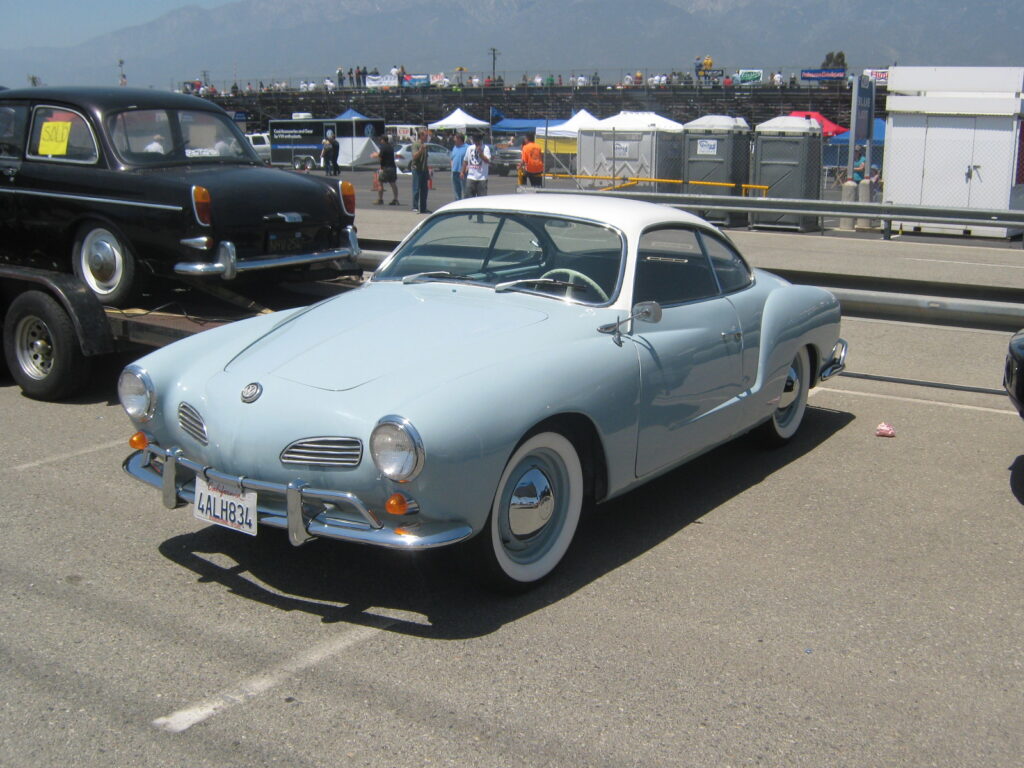
Based on Volkswagen Beetle mechanical components, the Karmann Ghia combined a body designed with the involvement of Italy’s Ghia studio with manufacturing and engineering work carried out by Karmann in Osnabrück. Production of the Type 14 coupe began in August 1955, followed by the convertible in 1957.
The Karmann Ghia looked far more exotic than the humble Beetle beneath it. It was not especially fast, but speed was never the whole point. The car offered Volkswagen reliability in a shape that looked as though it belonged outside a hotel on the Italian Riviera.
It also placed the Karmann name in chrome script where owners could see it.
More Than the Karmann Ghia
Although the Karmann Ghia became the company’s signature model, Karmann’s manufacturing history extended far beyond one Volkswagen coupe.
The company produced Beetle convertibles, Volkswagen Golf Cabriolets, Sciroccos, Corrados, and several generations of specialty Volkswagen models. Between the beginning of the Volkswagen partnership in 1949 and Karmann’s insolvency in 2009, approximately 2.5 million Volkswagen vehicles were produced at Karmann facilities.
The first two generations of the Volkswagen Scirocco alone accounted for 795,734 cars, while the Corrado was also assembled at Karmann’s Osnabrück factory.
Karmann worked with Porsche as well. The company manufactured 115,631 four-cylinder Porsche 914 models in Osnabrück through 1976. The six-cylinder 914/6 was assembled separately by Porsche.
The company is shifting its focus to parts manufacturing and will continue to supply the automotive industry. “We could no longer avoid shutting down the vehicle assembly line because auto manufacturers’ strategies have changed,” the company’s administrator, Ottmar Hermann, said. Karmann management is placing the bulk of the blame with the costs of union benefits. Still, union spokesmen Hartmut Riemann of the IG Metall union responded: “It is outrageous that the insolvency should be blamed on the social plan costs when they are not even paying severance pay.” Already, the US division of Karmann has begun supplying the automotive restoration industry with replacement convertible tops and parts for classic Karmann-built vehicles.
The Changing Coachbuilding Business
By the early 2000s, the economic foundation beneath independent contract manufacturers was beginning to shift.
Large automakers became less willing to outsource the development and production of specialty models. Advances in flexible manufacturing made it easier to build multiple body styles within a manufacturer’s existing factory network. Employment agreements also encouraged automakers to keep new projects inside their own plants rather than awarding them to outside contractors.
Karmann depended heavily on a steady flow of new contracts. When Audi and Mercedes-Benz prepared replacements for models Karmann had been producing, the manufacturers chose to bring more of that work in-house.
At the same time, convertibles were becoming more mechanically complex. Folding hardtops, electronic roof controls, structural reinforcements, safety requirements, and increasingly integrated vehicle electronics demanded enormous investment.
Karmann continued developing roof systems and proposing new vehicles, but it struggled to secure enough complete-car contracts to keep its German assembly operations busy.
Then the global financial crisis arrived.
Automobile sales fell sharply, manufacturers cut production, and specialty models became easy targets for cancellation or postponement. On April 8, 2009, Karmann filed for insolvency, citing the collapse in automotive demand and its financial obligations.
The failure was sometimes attributed to labor problems, but Karmann’s difficulties ran deeper. The market for independent, high-volume coachbuilding was disappearing, the company’s largest clients were reclaiming production, and the economic crisis accelerated a decline that had already begun.
The Final Mercedes-Benz CLK Cabriolet
The CLK Cabriolet had been one of Karmann’s final major vehicle programs.
Mercedes-Benz produced the CLK coupe at its own Bremen factory, while Karmann assembled the convertible in Osnabrück. The division of labor reflected Karmann’s traditional strength. Removing a fixed roof requires extensive structural changes, specialized assembly processes, and expertise in weather sealing and folding-top systems.
By June 2009, however, the CLK program had reached its conclusion, and Karmann had no large replacement contract ready to take its place.
When the black CLK Cabriolet reached the end of the line, workers gathered around it for photographs. The moment marked the end of complete automobile manufacturing under the independent Karmann company.
But it did not mean the Osnabrück factory would remain silent forever.
Volkswagen Buys the Osnabrück Factory
Following the insolvency, Volkswagen moved to acquire the core Karmann property in Osnabrück.
In November 2009, Volkswagen agreed to purchase the factory buildings, land, machinery, and production equipment from the insolvent company. Volkswagen Osnabrück GmbH was then established to carry forward vehicle manufacturing, technical development, toolmaking, body production, painting, and final assembly at the site.
The transition preserved part of Karmann’s industrial knowledge, along with many of the facilities and skilled workers associated with the old coachbuilder.
Vehicle production resumed under Volkswagen ownership. In 2011, the Osnabrück plant began manufacturing the Volkswagen Golf Cabriolet, returning convertible production to the same factory where generations of Karmann specialists had built open-top Volkswagens.
Today, the operation is known as Volkswagen Osnabrück. The plant remains involved in technical development, tooling, body construction, painting, and automobile assembly.
The Karmann company did not survive intact, but its factory and much of its manufacturing culture were absorbed into the automaker that had been its closest partner for 60 years.
The Legacy of Karmann
Karmann’s collapse represented more than the failure of a single automotive supplier. It marked the fading of a particular kind of automobile company.
Traditional coachbuilders occupied the territory between design studios, engineering firms, and mass manufacturers. They could turn a conventional sedan platform into a convertible, build a sports car in limited numbers, or give a major manufacturer access to production skills it did not possess internally.
Karmann excelled at that work for generations.
Its name can be found on cars as different as the graceful Karmann Ghia, the practical Golf Cabriolet, the mid-engine Porsche 914, the muscular Chrysler Crossfire, and the understated Mercedes-Benz CLK Cabriolet.
Some were designed by Karmann. Others were engineered, assembled, painted, or fitted with convertible roofs there. Most carried another company’s badge.
The final CLK did not erase that history. Nor did Volkswagen’s acquisition of the factory.
What ended in 2009 was Karmann’s independence. The tools, buildings, and knowledge continued, but the era in which a family-owned coachbuilder could manufacture millions of automobiles for the world’s largest car companies had reached its final mile.
The black Mercedes-Benz at the end of the line was not Karmann’s most famous car.
It was simply the one that turned out the lights.
Karmann Final Car Quick Facts
- Company: Wilhelm Karmann GmbH
- Founded: 1901
- Headquarters: Osnabrück, Germany
- Original business: Carriage and coach construction
- First automobile bodywork: Produced shortly after Wilhelm Karmann acquired the company in 1901
- Final complete vehicle: Black Mercedes-Benz CLK Cabriolet
- Final production date: June 22, 2009, according to contemporary reporting
- Final car completed: Approximately 11:35 a.m.
- Insolvency filing: April 8, 2009
- Mercedes-Benz CLK production: Approximately 225,000 convertibles assembled by Karmann
- Vehicles contract-assembled since 1949: More than 3.4 million
- Best-known model: Volkswagen Karmann Ghia
- Other major models: Volkswagen Beetle Cabriolet, Volkswagen Golf Cabriolet, Volkswagen Scirocco, Volkswagen Corrado, Porsche 914, Audi A4 Cabriolet, Chrysler Crossfire, and Mercedes-Benz CLK Cabriolet
- What happened to the factory: Volkswagen acquired the principal Osnabrück manufacturing assets and established Volkswagen Osnabrück GmbH
- Vehicle production resumed: 2011 with the Volkswagen Golf Cabriolet
Frequently Asked Questions
What was the last car built by Karmann?
The final complete automobile produced by the independent Karmann company was a black Mercedes-Benz CLK Cabriolet. It left the production line at the Osnabrück factory in June 2009.
Why did Karmann go out of business?
Karmann lost several important vehicle-production contracts as major automakers brought specialty manufacturing back into their own factories. Falling automobile demand during the global financial crisis added to the company’s financial difficulties, leading Karmann to file for insolvency in April 2009.
Did the Karmann factory close permanently?
No. Independent Karmann vehicle production ended in 2009, but Volkswagen purchased the main Osnabrück factory assets and established Volkswagen Osnabrück GmbH. Automobile production resumed under Volkswagen ownership.
What cars did Karmann manufacture?
Karmann built or helped manufacture the Volkswagen Karmann Ghia, Beetle Cabriolet, Golf Cabriolet, Scirocco, Corrado, Porsche 914, Ford Escort Cabriolet, Audi Cabriolet, Audi A4 Cabriolet, Chrysler Crossfire, Volkswagen New Beetle Cabriolet, and Mercedes-Benz CLK Cabriolet, among many others.
Did Karmann design the Volkswagen Karmann Ghia?
The Karmann Ghia was a collaborative project. Karmann initiated and developed the project, Italian design house Ghia created the styling, Volkswagen supplied the Beetle-based mechanical platform, and Karmann manufactured the car in Germany.
How many cars did Karmann produce?
Karmann contract-assembled more than 3.4 million vehicles in Germany between 1949 and its 2009 insolvency. Approximately 2.5 million of those were produced for Volkswagen.
Who owns Karmann today?
The original Wilhelm Karmann GmbH was divided during the insolvency process. Volkswagen acquired the Osnabrück vehicle-manufacturing operation and created Volkswagen Osnabrück GmbH. Other companies acquired portions of Karmann’s roof-system and component businesses.
Is the Karmann name still used?
The Karmann name remains strongly associated with classic Volkswagen models and automotive history. It is also still used by Karmann-Mobil, a recreational-vehicle brand whose history developed from Karmann’s motorhome activities, although it is separate from the former independent automobile-manufacturing company.