
 Michael Satterfield
For anyone making the pilgrimage through Italy’s Motor Valley, the itinerary tends to write itself: Ferrari in Maranello, Lamborghini in Sant’Agata Bolognese, Maserati in Modena, Pagani nearby, and, just outside Bologna, Ducati. But unlike some museums that feel like polished brand shrines built after the legend was secure, the Ducati Museum sits at the source. This is Borgo Panigale, the home ground, the working address, the place where the red bikes are more than display pieces. They are family history.
The museum is part of Ducati’s Borgo Panigale Experience, located at the company’s factory headquarters in Bologna. That matters. You are not wandering through a theme park version of Ducati. You are stepping into the neighborhood where the company has worked, rebuilt, raced, won, stumbled, and come roaring back for nearly a century.
Ducati’s story did not begin with a motorcycle. It began with radio. In 1926, Adriano, Bruno, and Marcello Ducati founded Società Scientifica Radio Brevetti Ducati in Bologna, building components in the early age of wireless communication. Before the name Ducati meant dry clutches, desmodromic valves, and red fairings blurred at Mugello, it meant capacitors, short-wave experiments, and a certain Italian confidence that engineering could make the world smaller.
That origin gives the museum its first surprise. Ducati was never simply a motorcycle company. It was an ideas company that found its way onto two wheels.
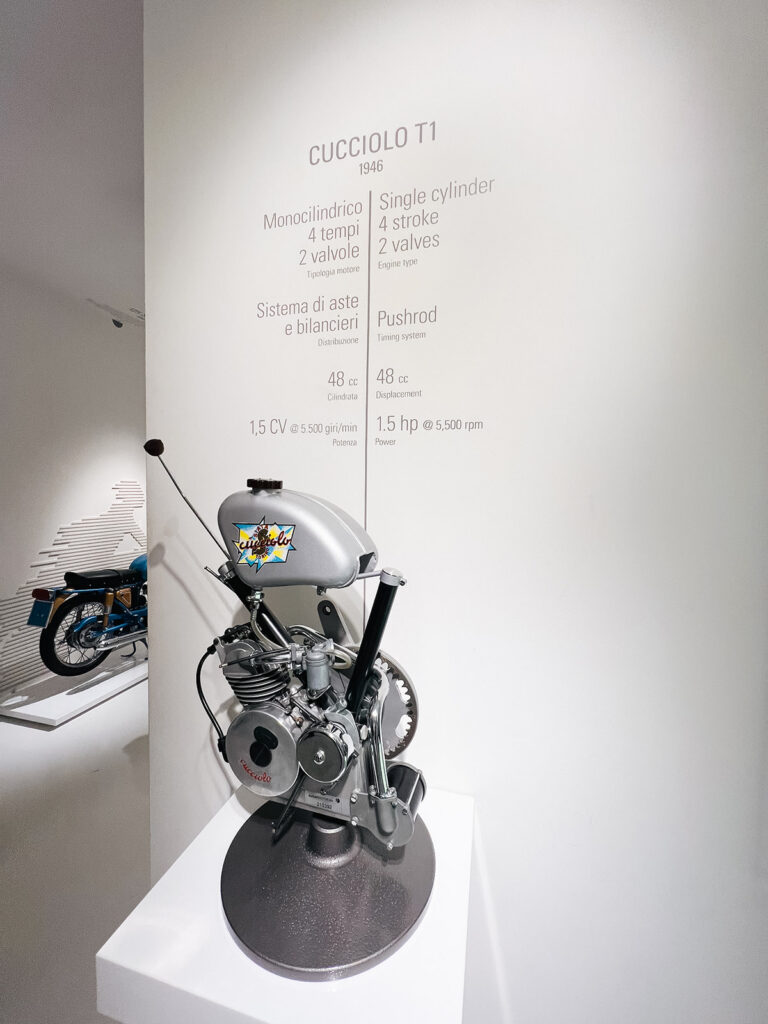
The transition came after World War II, when the Borgo Panigale factory had been damaged and Italy itself was rebuilding. Like so many great postwar mobility stories, Ducati’s future began small. The Cucciolo engine helped motorize bicycles, and by 1949 the Ducati 60 became the company’s first complete motorcycle. It was modest by modern standards, but the line from that small machine to today’s Panigale V4 is unmistakable. Both were built around the same question: how much performance can you pull from a compact, beautifully engineered machine?
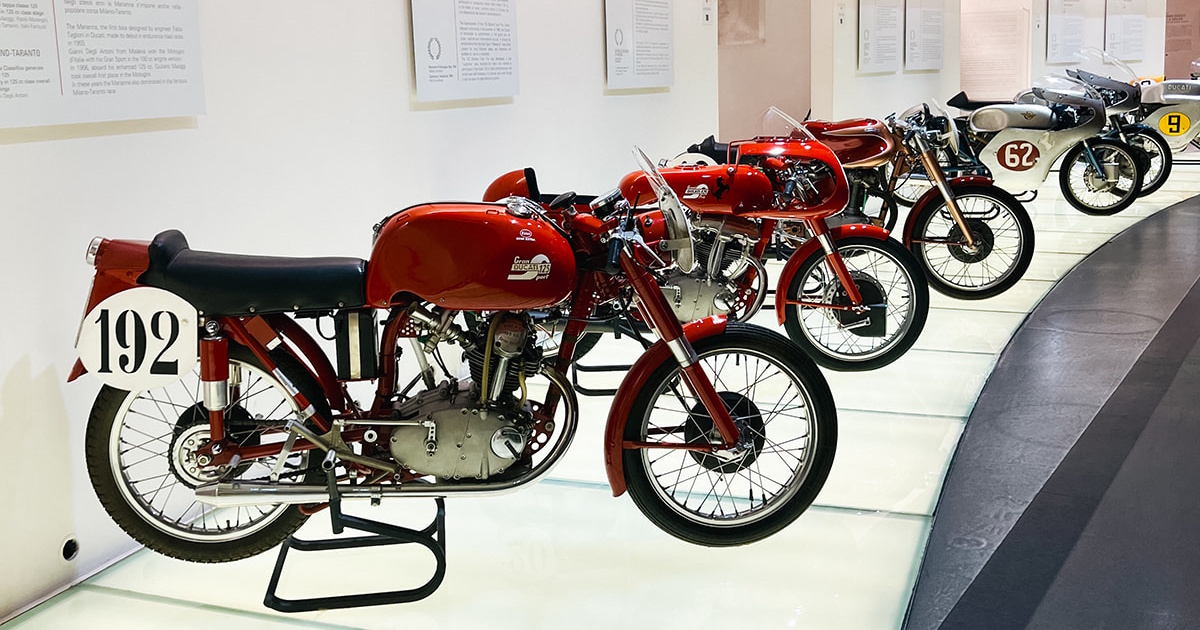
Walking the Ducati Museum is less like reading a timeline and more like watching an Italian argument unfold. Form and function keep interrupting each other, and both are usually right.
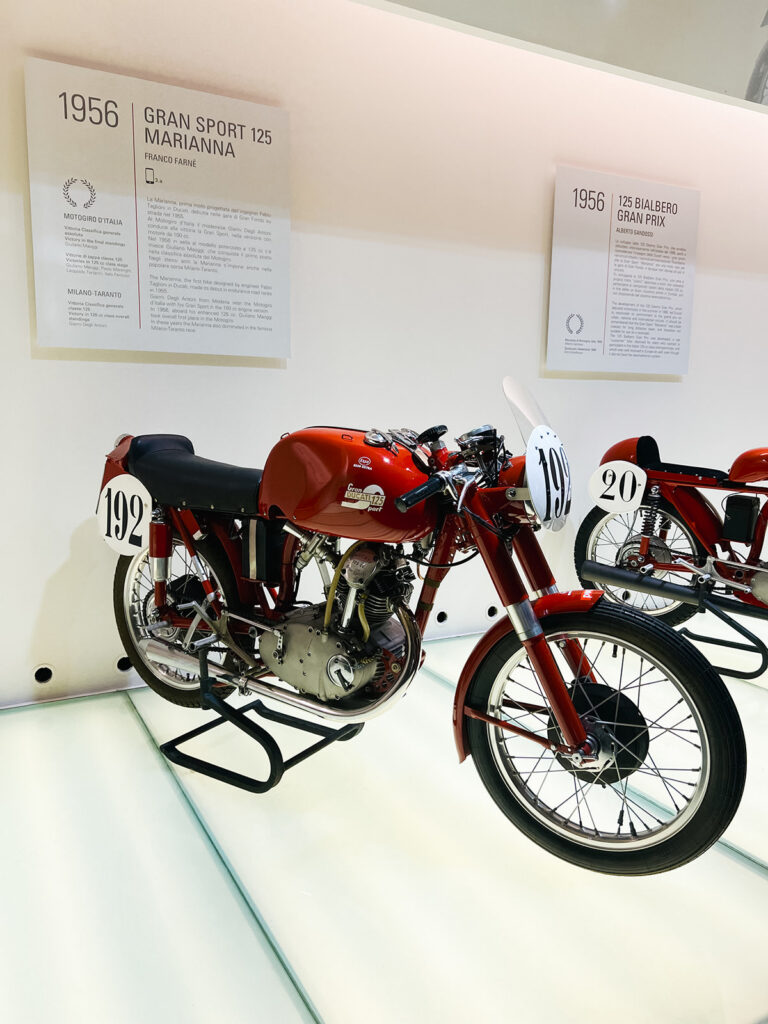
There are early road bikes that show Ducati learning its shape, machines that still carry the upright practicality of the postwar years. Then the proportions begin to change. Tanks stretch. Frames tighten. Engines become the visual center of the motorcycle. The bikes start to crouch, as though they are impatient with standing still.
By the time you reach the sportbikes, the room seems to get sharper. Ducati’s design language has always carried a kind of mechanical honesty. A Ferrari can be sensual. A Lamborghini can be theatrical. A Ducati, at its best, feels surgical. Beautiful, yes, but with a whiff of danger, like a stiletto left on a drafting table.
The 916 remains one of the museum’s gravitational centers, and for good reason. Designed under Massimo Tamburini, it is one of those rare machines that made everything before it look older overnight. The underseat exhausts, single-sided swingarm, narrow waist, and predatory stance became a visual code that sportbike designers are still decoding decades later. Parked in a museum, it does not look retired. It looks like it is waiting for someone to make a poor decision.
That is the trick Ducati has always understood. Performance matters, but emotion sells the memory.
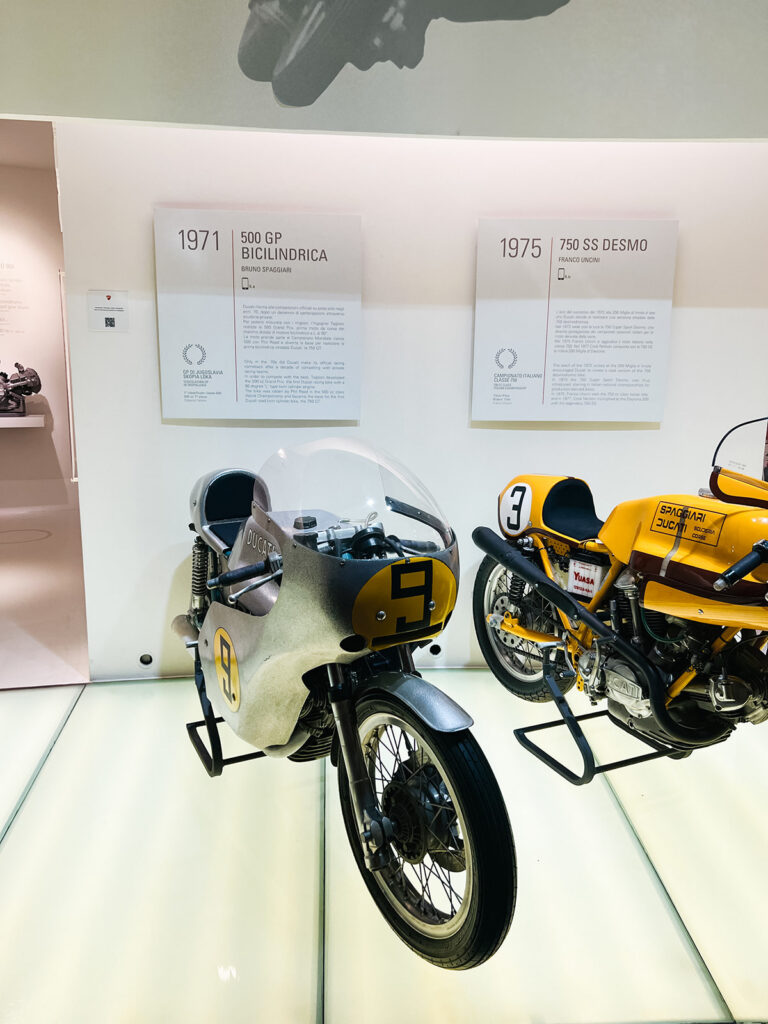
The racing displays make that point even louder. Ducati’s competition history runs through Grand Prix racing, Superbike dominance, and the modern MotoGP era, where the Desmosedici became one of the most formidable machines on the grid. The museum’s race bikes are not arranged like static sculptures. They feel like evidence. Evidence of risk, obsession, engineering stubbornness, and the Italian habit of treating racing as both a national sport and opera.
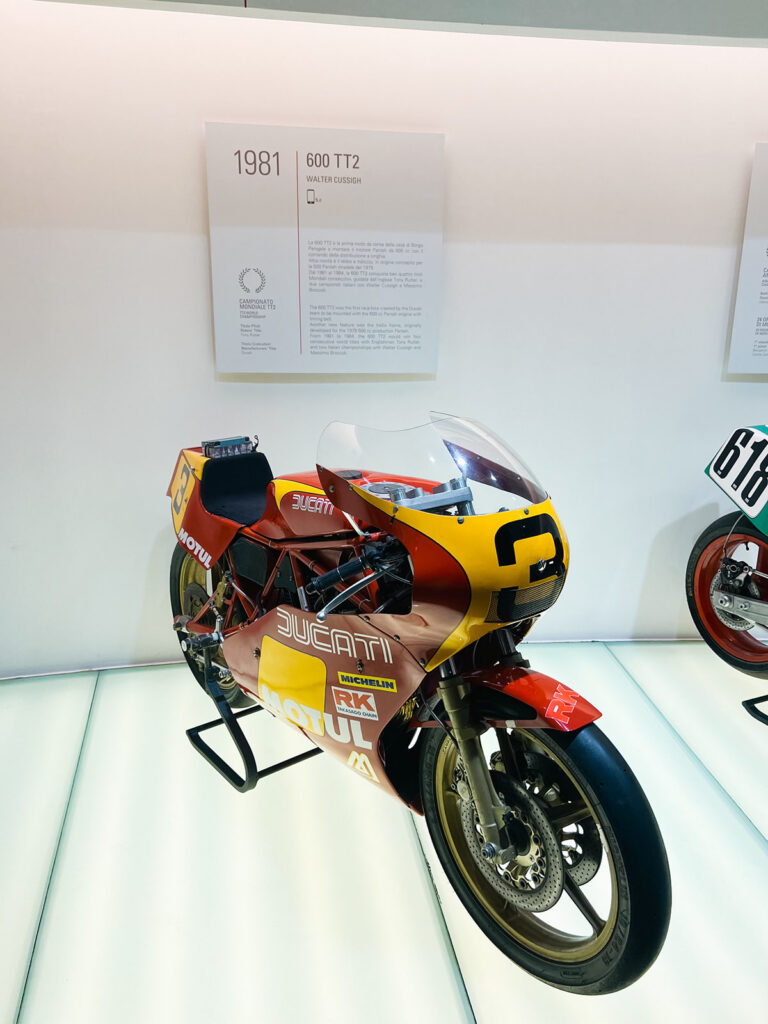
The trophies, liveries, carbon fiber, worn slicks, and sponsor decals tell their own story. They also remind you that racing motorcycles is among the most uncompromising forms of transportation. A race car still offers a cockpit, a shell, a little illusion of separation from consequences. A motorcycle makes no such promise. At speed, the rider is not so much inside the machine as attached to the idea of survival.
That makes Ducati’s racing success feel especially personal. Every improvement in power delivery, chassis behavior, braking, aerodynamics, and electronics eventually comes down to a rider willing to trust it all at lean angles that look like a clerical error.
The Ducati Museum does not require you to be a motorcyclist to appreciate it, though it certainly helps. Anyone who cares about design, Italian industry, motorsport, or mechanical culture will find something here. It is compact enough to visit in about an hour, but rich enough that enthusiasts can easily linger, circling back to favorite bikes like they are checking on old friends.
For the Motor Valley traveler, it also adds an important counterpoint. So much of the region’s automotive mythology is built around V12 engines, coachbuilt bodies, and heroic four-wheeled machinery. Ducati brings the story down to something more elemental: engine, frame, rider, road. No doors. No roof. No excuses.
That purity is what makes the museum so rewarding. You leave understanding that Ducati’s appeal was never just horsepower or paint color. It is the tension between precision and passion, between Bologna’s industrial discipline and Italy’s refusal to build anything completely cold. Even the most advanced Ducati still feels like it has a temper. In a world of increasingly sanitized performance machines, that counts for something.
A visit to the Ducati Museum is not just a stop for motorcycle fans. It is one of the essential Motor Valley experiences, a reminder that speed has many dialects in this part of Italy. In Maranello, it speaks through twelve cylinders. In Modena, it wears a trident. In Sant’Agata, it shouts. In Borgo Panigale, it leans into a corner and disappears in a flash of red.
Plan your visit to the Ducati Museum and Factory at Ducati.com.
Quick Facts: Visiting The Ducati Museum
Location: Via Antonio Cavalieri Ducati, 3, Borgo Panigale, Bologna, Italy
Best For: Motorcycle enthusiasts, motorsport fans, design lovers, and anyone planning a full Motor Valley itinerary
Typical Visit Time: About one hour for the museum, longer if paired with the factory experience
What You’ll See: Historic Ducati road bikes, racing motorcycles, Ducati design milestones, trophies, engines, and exhibits tracing the company from its early industrial roots to modern MotoGP and Superbike success
Travel Tip: Book tickets in advance through Ducati’s official Borgo Panigale Experience site, especially if you want to pair the museum with a factory tour.
2026 Visitor Note: Ducati has announced that the museum is closed for renovation from March 30 to July 1, 2026. Check current availability before planning your visit.
FAQ
Where is the Ducati Museum?
The Ducati Museum is located at Ducati’s factory headquarters in Borgo Panigale, just outside Bologna, Italy.
Is the Ducati Museum worth visiting if I am not a motorcycle rider?
Yes. The museum is as much about Italian design, engineering, racing culture, and industrial history as it is about motorcycles.
How long does it take to visit the Ducati Museum?
Most visitors can tour the museum in about one hour, though Ducati enthusiasts may want more time.
Can you tour the Ducati factory too?
Yes, Ducati offers factory tours as part of the Borgo Panigale Experience, though availability can vary due to production schedules and special closures.
What is the most famous bike in the Ducati Museum?
That depends on your taste, but the Ducati 916 is one of the most celebrated motorcycles on display, while Ducati’s racing machines are a major highlight for MotoGP and Superbike fans.
When did Ducati start making motorcycles?
Ducati began as a radio components company in 1926. Its first complete motorcycle, the Ducati 60, arrived after July 1949.